Jalali Amir, Chavoshani Fatemeh, Rasad Raheleh, Darvishi Niloufar, Fashi Fatemeh Merati, Khodamorovati Mahbod, Moradi Khalil
Substance Abuse Prevention Research Center, Research Institute for Health, Kermanshah University of Medical Sciences, Kermanshah, Iran.
Department of Emergency and Critical Care Nursing, School of Nursing and Midwifery Kermanshah University of Medical Sciences, Kermanshah, Iran.
SAGE Open Nurs. 2024 Nov 22;10:23779608241299275. doi: 10.1177/23779608241299275. eCollection 2024 Jan-Dec.
The competency of a nurse in integrating knowledge, skills, attitudes, and values in various healthcare areas depends on their ability to apply these elements. It is a basic indicator of performance in nursing, and its assessment is a necessity among nursing students.
The present study was conducted to determine the psychometric properties of the Persian version of the nursing competence tool for Iranian nursing students in 2023.
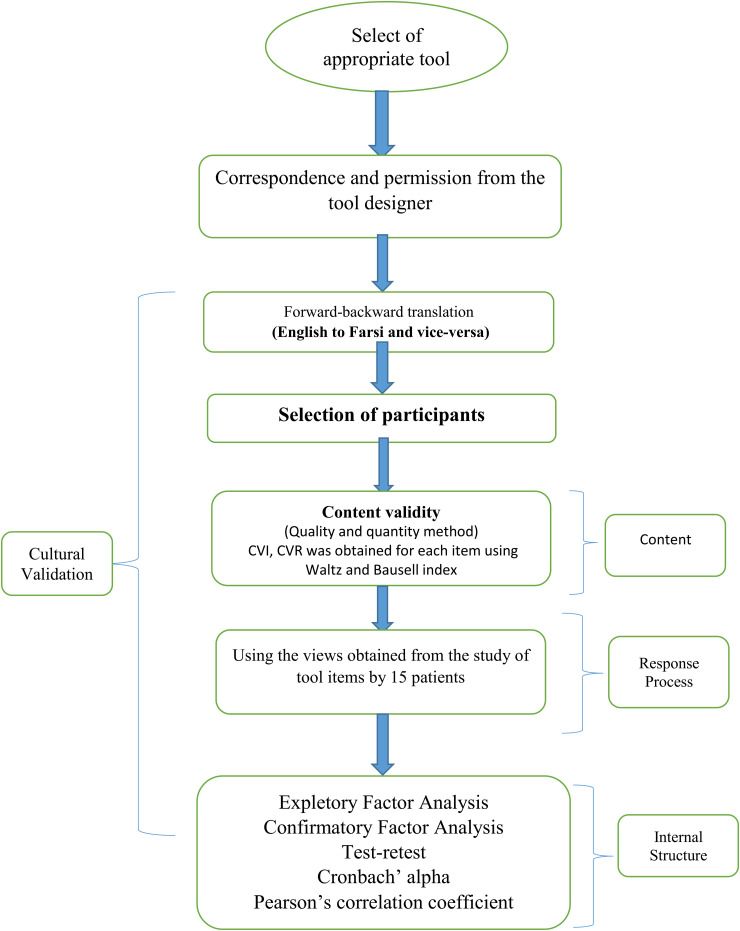
This is a methodological study in which the Nursing Student Competence Scale (NSCS) was translated into Persian using the forward-backward translation method. A total of 321 nursing students were selected for construct validity by the exploratory factor analysis (EFA) (the first 190 nursing students) and confirmatory factor analysis (CFA) by convenience sampling method. Cronbach's alpha coefficient was used to evaluate the internal consistency, and the test-retest method was used to check the instrument's reliability.
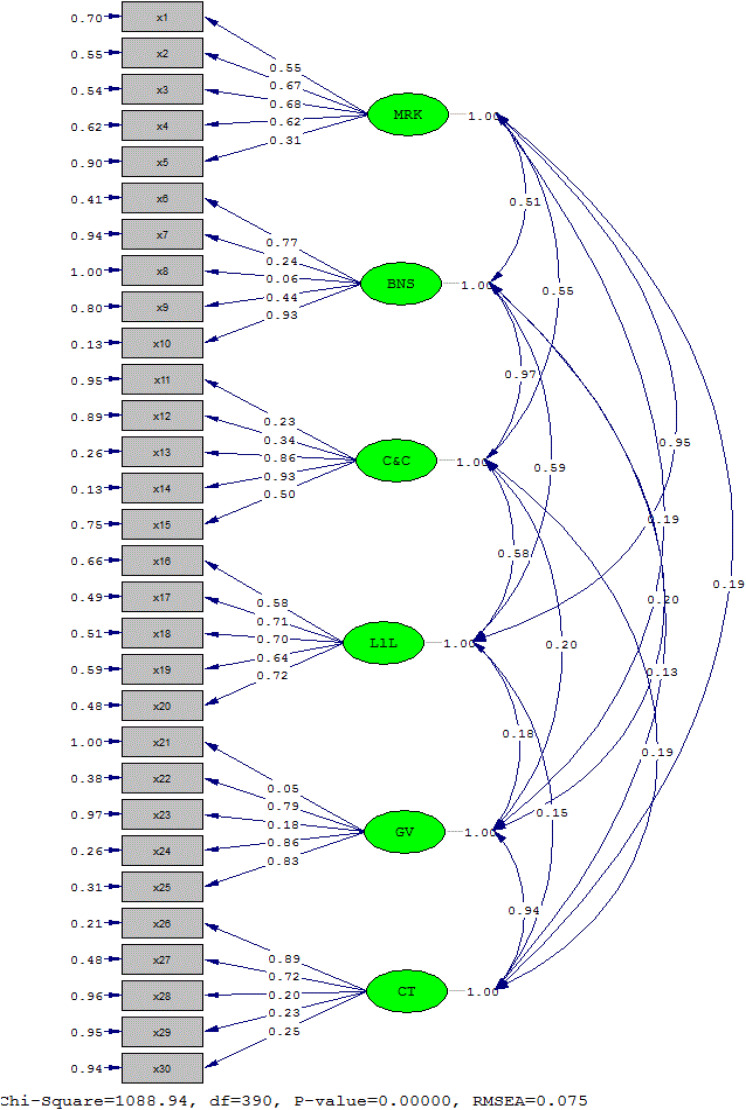
The results of EFA and CFA confirmed the instrument with six factors and 28 items. The results showed that the fit indices of the model in CFA included (CFI = .91, NNFI = .90, goodness of fit index = .83, root mean square error of approximation = .075, standardized root mean square residual = .047). Pearson's correlation coefficient between items and subscales showed a direct and significant relationship with the main scale. Also, Cronbach's alpha coefficient (0.9) and test-retest (0.88) confirmed the reliability of the Persian version of (NSCS).
Generally, the Persian version of the NSCS with 28 items and six factors is a valid and reliable scale. This instrument has good internal consistency, validity, and reliability, which can be used to evaluate nursing students' competence in bachelor training.
护士在各个医疗保健领域整合知识、技能、态度和价值观的能力取决于他们应用这些要素的能力。这是护理工作表现的一项基本指标,对护理专业学生进行评估很有必要。
本研究旨在确定2023年伊朗护理专业学生使用的波斯语版护理能力工具的心理测量特性。
这是一项方法学研究,采用前后翻译法将护理专业学生能力量表(NSCS)翻译成波斯语。通过探索性因素分析(EFA)(前190名护理专业学生)和验证性因素分析(CFA),采用便利抽样法选取了321名护理专业学生进行结构效度分析。使用Cronbach's alpha系数评估内部一致性,并采用重测法检验该工具的信度。
EFA和CFA的结果证实该工具包含六个因素和28个项目。结果表明,CFA模型的拟合指数包括(CFI = 0.91,NNFI = 0.90,拟合优度指数 = 0.83,近似均方根误差 = 0.075,标准化均方根残差 = 0.047)。项目与子量表之间的Pearson相关系数与主量表呈直接且显著的关系。此外,Cronbach's alpha系数(0.9)和重测信度(0.88)证实了波斯语版(NSCS)的信度。
一般来说,包含28个项目和六个因素的波斯语版NSCS是一个有效且可靠的量表。该工具具有良好的内部一致性、效度和信度,可用于评估本科护理专业学生的能力。