Department of Environmental Health, Harvard T.H. Chan School of Public Health, Boston, Massachusetts, USA.
Epidemiology Branch, Division of Intramural Research, National Institute of Environmental Health Sciences, National Institutes of Health, Research Triangle Park, Durham, North Carolina, USA.
Paediatr Perinat Epidemiol. 2024 Nov;38(8):654-665. doi: 10.1111/ppe.13129.
Associations between early-life menstrual cycle characteristics (MCC) and gestational diabetes (GDM) remain unclear.
To evaluate associations between early-life MCCs and GDM in first pregnancy, across pregnancies and its recurrence.
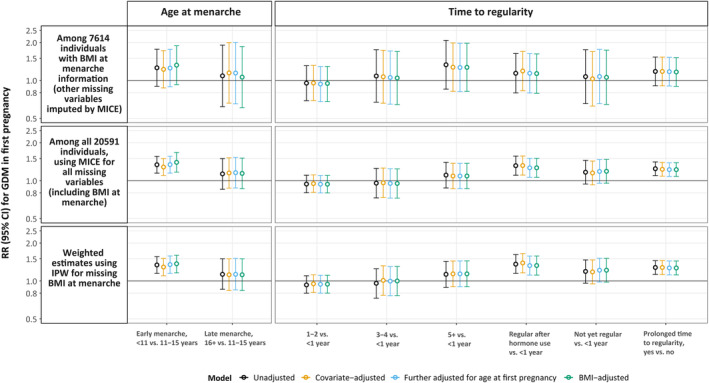
This analysis included participants from a US-based digital cohort enrolled between 11/2019 and 9/2023 who provided consent, completed relevant surveys, were without diabetes and aged ≥18 at first pregnancy (n = 30,473). Age at menarche [<11 (early), 11-15 (referent), ≥16 (late) years] and time from menarche to cycle regularity [<1 (referent), 1-2, 3-4, ≥5 years, not yet regular, regular after hormones] were self-recalled at enrolment. Additionally, the last three categories were considered prolonged time-to-regularity (PTTR). GDM history was recalled at enrolment for each pregnancy. We restricted to pregnancies of ≥24 weeks with a live birth. We evaluated associations of early-life MCCs with GDM at first pregnancy using modified Poisson regression, across pregnancies using cluster-weighted Poisson generalised estimating equation and GDM recurrence using multinomial logistic regression, adjusted for sociodemographic, early-life factors and age at pregnancy. Missing variables were imputed with multiple imputation by chained equations.
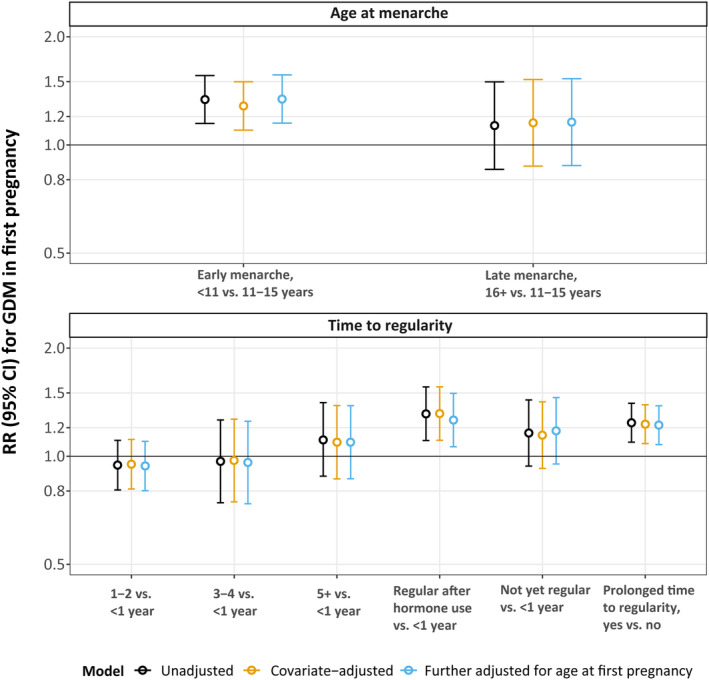
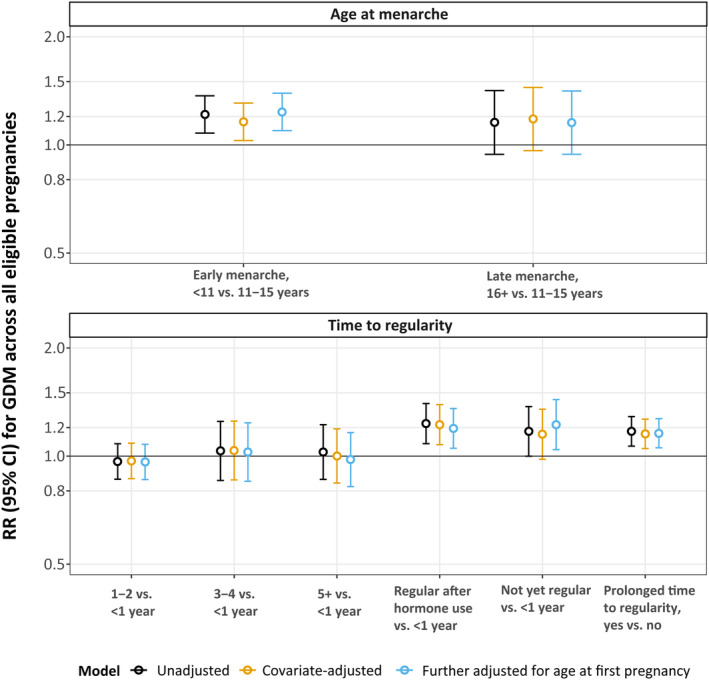
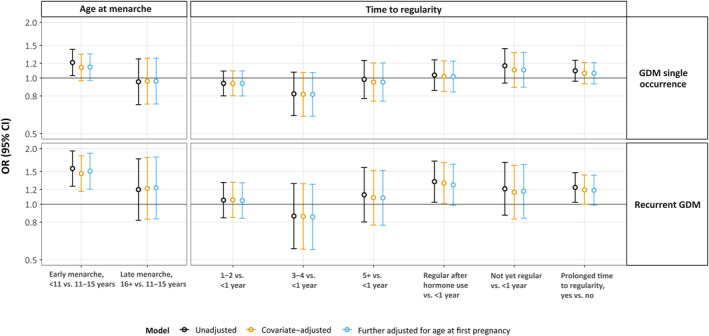
Among 30,473 participants, 20,591 had eligible first pregnancies, of which 5.9% reported GDM. In 17,512 participants with ≥2 pregnancies, 8.3% had GDM once and 3.7% had recurrent GDM. Early menarche (<11 years, vs. 11-15 years) was associated with GDM in first pregnancy (RR 1.34, 95% CI 1.15, 1.57), across pregnancies (RR 1.24, 95% CI 1.10, 1.39) and recurrence (OR 1.51, 95% CI 1.21, 1.89). PTTR was associated with GDM in the first pregnancy (RR 1.22, 95% CI 1.08, 1.38), across pregnancies (RR 1.16, 95% CI 1.05, 1.27) and recurrence (OR 1.19, 95% CI 0.99, 1.43).
Earlier menarche and prolonged time-to-regularity are associated with higher risk of GDM and recurrence, suggesting menstrual characteristics during childhood/adolescence as potential early-life markers for GDM.
初潮年龄和月经周期规律与妊娠糖尿病(GDM)的关系仍不清楚。
评估初潮时月经周期特征(MCC)与首次妊娠、多次妊娠及其复发的 GDM 之间的关系。
本分析纳入了 2019 年 11 月至 2023 年 9 月期间参加美国一项基于数字的队列研究并同意参与、完成了相关调查、首次妊娠时年龄≥18 岁且无糖尿病的参与者(n=30473)。初潮年龄[<11 岁(早)、11-15 岁(参考)、≥16 岁(晚)]和从初潮到月经规律的时间[<1 年(参考)、1-2 年、3-4 年、≥5 年、尚未规律、用激素后规律]在入组时自我报告。此外,后三个类别被认为是月经规律时间延长(PTTR)。在每次妊娠时都在入组时回忆 GDM 病史。我们将≥24 周且活产的妊娠限制为符合条件的妊娠。我们使用改良泊松回归评估初潮时 MCC 与首次妊娠 GDM 的关系,使用聚类加权泊松广义估计方程评估多次妊娠 GDM 的关系,使用多项逻辑回归评估 GDM 复发,调整了社会人口统计学、儿童期因素和妊娠年龄。缺失变量用链方程多重插补法进行插补。
在 30473 名参与者中,有 20591 名符合条件的首次妊娠,其中 5.9%报告患有 GDM。在 17512 名有≥2 次妊娠的参与者中,8.3%的人曾患过一次 GDM,3.7%的人患有复发性 GDM。初潮早(<11 岁,与 11-15 岁相比)与首次妊娠 GDM 相关(RR 1.34,95%CI 1.15,1.57)、多次妊娠 GDM 相关(RR 1.24,95%CI 1.10,1.39)和复发 GDM 相关(OR 1.51,95%CI 1.21,1.89)。PTTR 与首次妊娠 GDM 相关(RR 1.22,95%CI 1.08,1.38)、多次妊娠 GDM 相关(RR 1.16,95%CI 1.05,1.27)和复发 GDM 相关(OR 1.19,95%CI 0.99,1.43)。
初潮早和月经规律时间延长与 GDM 和复发风险增加相关,这表明儿童期/青春期的月经特征可能是 GDM 的潜在早期生命标志物。