Donahue Maria Andrea, Akram Hammad, Brooks Julianne D, Modi Avani C, Veach Jessica, Kukla Alison, Benard Shawna W, Herman Susan T, Farrell Kathleen, Ficker David M, Zafar Sahar F, Trescher William H, Sirsi Deepa, Phillips Donald J, Pellinen Jacob, Buchhalter Jeffrey, Moura Lidia, Fureman Brandy E
Department of Neurology (MAD, HA, JDB, SFZ, LM), Massachusetts General Hospital, Harvard Medical School, Boston, MA; Behavioral Medicine and Clinical Psychology (ACM), Cincinnati Children's Hospital Medical Center; University of Cincinnati-College of Medicine (ACM), Cincinnati, OH; Epilepsy Foundation (JV, AK, KF, BEF), Bowie, MD; Department of Neurology (SWB), Keck Medicine of University of Southern California, Los Angeles, CA; Department of Neurology (STH), Barrow Neurological Institute, Phoenix, AZ; Department of Neurology (DMF), UC Gardner Neuroscience Institute, Cincinnati, OH; Neurology Department (WHT), Penn State Health Children's, Hershey, PA; Neurology Department (DS), UT Southwestern Medical Center Children's Health, Dallas, TX; CHOC Neuroscience Center (DJP), Children's Hospital of Orange County, Orange, CA; Department of Neurology (JP), University of Colorado School of Medicine, Denver, CO; and Department of Pediatrics (JB), Cumming School of Medicine, University of Calgary, Calgary, Alberta, Canada.
Neurol Clin Pract. 2025 Feb;15(1):e200403. doi: 10.1212/CPJ.0000000000200403. Epub 2024 Nov 27.
Epilepsy affects approximately 1.2% of the US population, resulting in 3.4 million Americans with active epilepsy. Antiseizure medication (ASM) is considered the mainstay of treatment, effective for two-thirds of people with epilepsy (PWE), while at least one-third experience drug-resistant epilepsy. A significant percentage of PWE who are treated with ASMs report nonadherence to this type of medication, leading to potentially preventable seizures and the potential for being inappropriately classified as having drug-resistant epilepsy. Ongoing seizures are associated with increased morbidity, mortality, and health care costs, among other consequences. Recognizing when PWE struggle with ASM adherence is essential for creating effective interventions and prevention strategies to improve patient outcomes.
As part of the Epilepsy Learning Healthcare System Registry, we collected data from 2020 through 2023 from 4,917 individuals seen at 8 epilepsy clinics in the United States. In this cross-sectional study, we used logistic regression analysis to examine the relationship between patient-reported seizure control (or provider-reported seizure control for some sites) and endorsed barriers to medication adherence. In addition, we explored potential associations with demographic variables such as sex, race, and ethnicity. The data analysis was conducted using R version 2023.06.1 + 524.
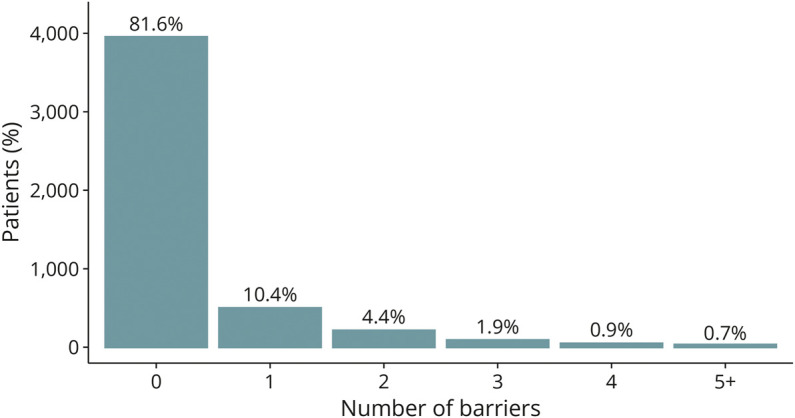
Overall, 18.4% (893/4,848) reported adherence barriers and 37.7% (1,447/3,834) reported seizure control, defined as no seizures for the preceding 12 months or longer. The most prevalent barriers were forgetting to take ASMs (48.2%), experiencing ASM side effects (29.2%), and feeling as if the ASMs were not helping in controlling seizures (21.3%). The PWE who reported adherence barriers had 0.6 lower odds of having seizure control compared with those who did not report barriers (95% CI 0.4-0.7) and 0.6 lower odds of having seizure control after adjusting for race, ethnicity, and sex (95% CI 0.5-0.7).
We observed significant barriers to medication adherence and inadequate seizure control among adult PWE across 8 centers in the United States. This study suggests that PWE might benefit from standardized screening for adherence barriers with behavioral strategies to address these barriers offered during clinical encounters to personalize care.
癫痫影响着约1.2%的美国人口,致使340万美国人患有活动性癫痫。抗癫痫药物(ASM)被视为治疗的主要手段,对三分之二的癫痫患者(PWE)有效,而至少三分之一的患者患有耐药性癫痫。相当比例接受ASM治疗的PWE报告称未坚持服用此类药物,这导致了潜在可预防的癫痫发作,并有可能被不恰当地归类为患有耐药性癫痫。持续发作会带来发病率、死亡率上升以及医疗保健成本增加等诸多后果。识别PWE何时在坚持服用ASM方面存在困难,对于制定有效的干预措施和预防策略以改善患者预后至关重要。
作为癫痫学习型医疗系统注册研究的一部分,我们收集了2020年至2023年期间在美国8家癫痫诊所就诊的4917名个体的数据。在这项横断面研究中,我们使用逻辑回归分析来检验患者报告的癫痫控制情况(或部分站点由医疗服务提供者报告的癫痫控制情况)与认可的药物依从性障碍之间的关系。此外,我们还探讨了与性别、种族和民族等人口统计学变量的潜在关联。数据分析使用的是R版本2023.06.1 + 524。
总体而言,18.4%(893/4848)报告存在依从性障碍,37.7%(1447/3834)报告癫痫得到控制,癫痫得到控制定义为在过去12个月或更长时间内无癫痫发作。最常见的障碍是忘记服用ASM(48.2%)、出现ASM副作用(29.2%)以及感觉ASM无助于控制癫痫发作(21.3%)。报告存在依从性障碍的PWE与未报告障碍的PWE相比,癫痫得到控制的几率低0.6(95%置信区间0.4 - 0.7),在调整种族、民族和性别后,癫痫得到控制的几率低0.6(95%置信区间0.5 - 0.7)。
我们观察到美国8个中心的成年PWE在药物依从性和癫痫控制方面存在显著障碍。这项研究表明,PWE可能会从针对依从性障碍的标准化筛查中受益,并在临床问诊期间采用行为策略来解决这些障碍,从而实现个性化护理。