Hoshino Takao, Ishizuka Kentaro, Seki Misa, Hosoya Megumi, Toi Sono, Mizuno Takafumi, Arai Satoko, Wako Sho, Takahashi Shuntaro, Oshima Rie, Kitagawa Kazuo
Department of Neurology, Tokyo Women's Medical University Hospital.
Department of Neurology, Tokyo Women's Medical University Adachi Medical Center.
J Atheroscler Thromb. 2025 Jun 1;32(6):676-687. doi: 10.5551/jat.65277. Epub 2024 Nov 30.
The Pemafibrate for Prevention of Atherosclerotic Diseases in Stroke (PPAR Stroke) study aimed to assess the effects of pemafibrate, a novel selective peroxisome proliferator-activated receptor alpha modulator, on the progression of cerebrovascular atherosclerosis in patients with stroke and hypertriglyceridemia.
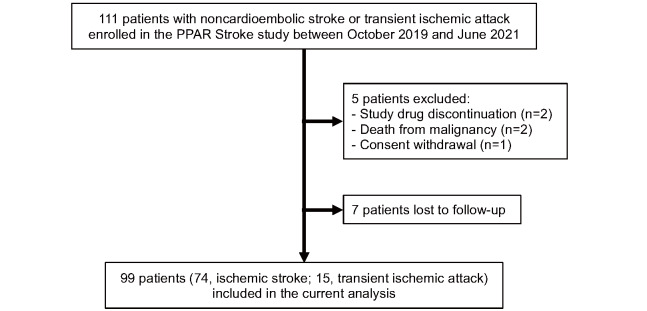
Ninety-nine patients (mean age, 65.6 years; male, 74.7%) with hypertriglyceridemia and a history of stroke or transient ischemic attack of non-cardioembolic origin were included in this prospective single-arm study. Hypertriglyceridemia was defined as a fasting serum triglyceride (TG) level ≥ 150 mg/dL. All patients were treated with pemafibrate (0.2 mg or 0.1 mg/day) for 2 years. The primary outcome was change in carotid intima-media thickness (IMT) from baseline at 2 years, as assessed using carotid ultrasonography. The secondary outcomes were changes in blood biomarker levels and progression of intracranial artery stenosis on magnetic resonance angiography.
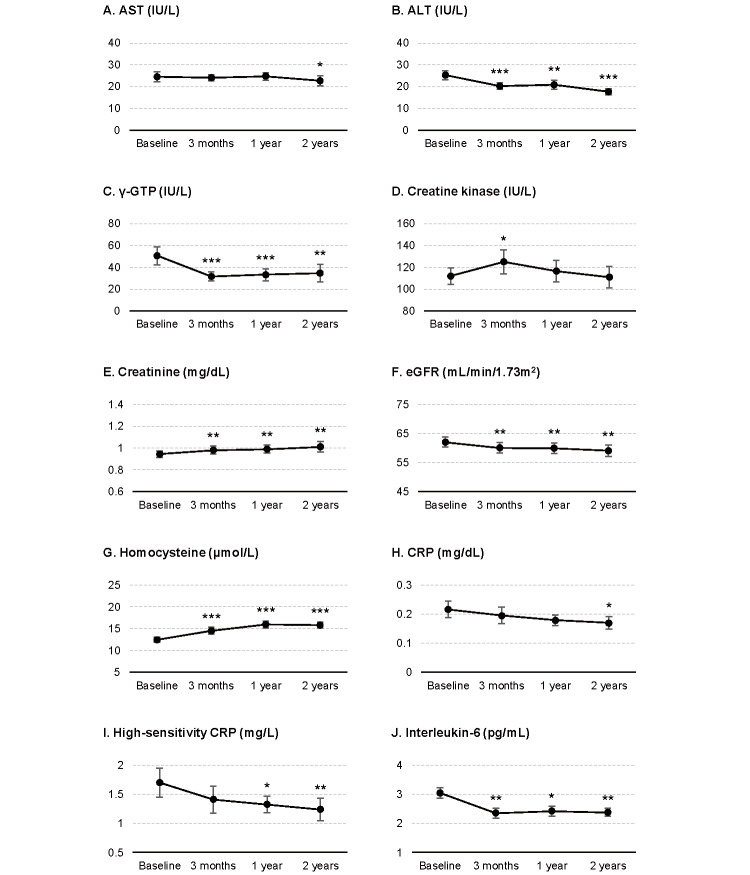
The mean TG level significantly decreased from 269 mg/dL at baseline to 139 mg/dL at 2 years (P<0.001) and high-density lipoprotein cholesterol level increased from 49 to 54 mg/dL (P<0.001), whereas low-density lipoprotein cholesterol level remained unchanged. Significant reductions in high-sensitivity C-reactive protein and interleukin-6 levels were also observed (P=0.003 and P=0.002, respectively). With regard to mean IMT in the internal carotid arteries, the difference was significant for the left side (1.59 mm at baseline vs. 1.52 mm at 2 years; P=0.009) and borderline significant for the right side (1.32 mm at baseline vs. 1.28 mm at 2 years; P=0.053). Among the 48 stenotic lesions in the intracranial arteries, regression and progression was observed in 9 (18.8%) and 4 (8.3%) cases, respectively.
Pemafibrate was observed to have TG-lowering and anti-inflammatory effects and could attenuate atherosclerosis progression in the intra- and extracranial arteries of patients with stroke and hypertriglyceridemia.
卒中患者使用匹伐他汀预防动脉粥样硬化疾病(PPAR卒中)研究旨在评估新型选择性过氧化物酶体增殖物激活受体α调节剂匹伐他汀对卒中合并高甘油三酯血症患者脑血管动脉粥样硬化进展的影响。
本前瞻性单臂研究纳入了99例高甘油三酯血症且有卒中或非心源性短暂性脑缺血发作病史的患者(平均年龄65.6岁;男性占74.7%)。高甘油三酯血症定义为空腹血清甘油三酯(TG)水平≥150mg/dL。所有患者接受匹伐他汀(0.2mg或0.1mg/天)治疗2年。主要结局是2年后使用颈动脉超声评估的颈动脉内膜中层厚度(IMT)相对于基线的变化。次要结局是血液生物标志物水平的变化以及磁共振血管造影显示的颅内动脉狭窄进展情况。
平均TG水平从基线时的269mg/dL显著降至2年时的139mg/dL(P<0.001),高密度脂蛋白胆固醇水平从49mg/dL升至54mg/dL(P<0.001),而低密度脂蛋白胆固醇水平保持不变。还观察到高敏C反应蛋白和白细胞介素-6水平显著降低(分别为P = 0.003和P = 0.002)。关于颈内动脉的平均IMT,左侧差异显著(基线时为1.59mm,2年时为1.52mm;P = 0.009),右侧接近显著(基线时为1.32mm,2年时为1.28mm;P = 0.053)。在颅内动脉的48个狭窄病变中,分别观察到9例(18.8%)病变缩小和4例(8.3%)病变进展。
观察到匹伐他汀具有降低TG和抗炎作用,并且可以减缓卒中合并高甘油三酯血症患者颅内和颅外动脉的动脉粥样硬化进展。