Ho Jonathan Ka Ming, Wong Janet Yuen Ha, Tse Gary, Chong Andy Chun Yin, Chau Calvin Chi Wai, Wong Chi Yip, Tse Johnson Wai Keung, Tam Jeremy Yan Hon, Lam Simon Ching
Hong Kong Metropolitan University, Hong Kong, Hong Kong.
Hong Kong Metropolitan University, Hong Kong, Hong Kong
Open Heart. 2024 Dec 2;11(2):e003005. doi: 10.1136/openhrt-2024-003005.
A novel handheld point-of-care high-sensitivity cardiac troponin I analyser has recently been introduced to the market. Evaluating its diagnostic performance against laboratory standards is imperative, given the variations in cardiac troponin levels across populations. This study compared the diagnostic performance between the point-of-care high-sensitivity cardiac troponin I assay (Siemens Healthineers Atellica VTLi) and a laboratory high-sensitivity cardiac troponin I assay (Abbott ARCHITECT STAT High Sensitive Troponin-I) performed using blood samples from various populations (overall, male, female, younger and older) of Chinese patients with chest pain.
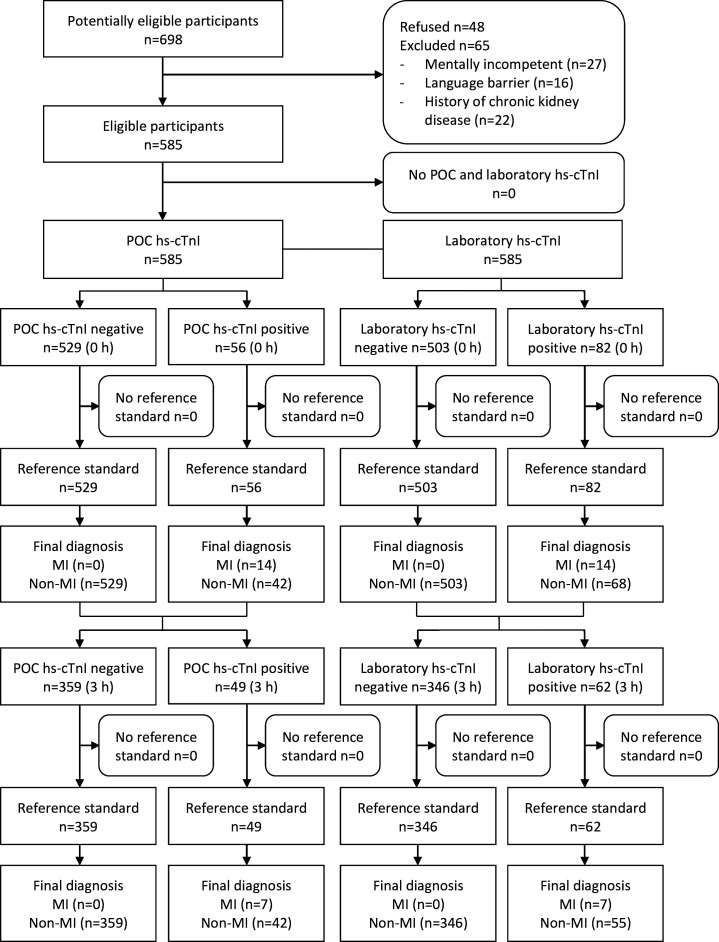
This cross-sectional study included 585 consecutive Chinese patients (age ≥18 year) who presented to an emergency department with chest pain (lasting >5 min) and were managed following the chest pain protocol between 1 August 2023 and 12 June 2024. For both assays, blood samples were collected at two time points (0 hour (initial) and 3 hour (subsequent)). The primary outcome was the diagnostic performance of the two assays, evaluated with their 99th percentile upper reference limits used as the cut-off values for diagnosing myocardial infarction. The gold standard for comparison was the final diagnoses made by attending physicians.
The point-of-care and laboratory assays exhibited equivalent sensitivity and negative predictive values (both 100%) for blood samples collected at both time points. However, the point-of-care assay outperformed the laboratory assay in terms of specificity (initial: 90.5% to 96.3% vs 79.8% to 94.7%; subsequent: 87.8% to 94.8% vs 77.7% to 92.4%) and positive predictive value (initial: 24.4% to 30.8% vs 11.6% to 23.5%; subsequent: 12.5% to 25.0% vs 5.9% to 18.8%), particularly in older patients.
The point-of-care assay is recommended for rapid clinical decision-making. Future studies should explore the effects of its integration into clinical practice and the feasibility of using sex-race-age-specific 99th percentile upper reference limits to enhance its diagnostic performance.
一种新型手持式即时检测高敏心肌肌钙蛋白I分析仪最近已投放市场。鉴于不同人群中心肌肌钙蛋白水平存在差异,评估其相对于实验室标准的诊断性能至关重要。本研究比较了即时检测高敏心肌肌钙蛋白I检测法(西门子医疗Atellica VTLi)与实验室高敏心肌肌钙蛋白I检测法(雅培ARCHITECT STAT高敏肌钙蛋白I)在来自中国胸痛患者的不同人群(总体、男性、女性、年轻和老年)血样中的诊断性能。
这项横断面研究纳入了585例连续的中国患者(年龄≥18岁),这些患者因胸痛(持续时间>5分钟)就诊于急诊科,并在2023年8月1日至2024年6月12日期间按照胸痛诊疗方案进行管理。对于这两种检测法,在两个时间点(0小时(初始)和3小时(后续))采集血样。主要结局是两种检测法的诊断性能,以其第99百分位数的上限参考值作为诊断心肌梗死的临界值进行评估。比较的金标准是主治医生做出的最终诊断。
即时检测法和实验室检测法在两个时间点采集的血样中均表现出相当的敏感性和阴性预测值(均为100%)。然而,即时检测法在特异性(初始:90.5%至96.3%对79.8%至94.7%;后续:87.8%至94.8%对77.7%至92.4%)和阳性预测值(初始:24.4%至30.8%对11.6%至23.5%;后续:12.5%至25.0%对5.9%至18.8%)方面优于实验室检测法,尤其是在老年患者中。
推荐使用即时检测法进行快速临床决策。未来的研究应探讨将其整合到临床实践中的效果以及使用性别-种族-年龄特异性的第99百分位数上限参考值来提高其诊断性能的可行性。