Rossignon Pierre, Chaudhry Abouzar, Alloum Mounia, Antoine-Moussiaux Thomas, Soupart Alain
Department of Internal Medicine, Iris Hospitals South (Molière), Brussels, Belgium.
Research Unit for the Study of Hydromineral Metabolism, Free University of Brussels (ULB), Brussels, Belgium.
Eur J Case Rep Intern Med. 2024 Nov 19;11(12):005028. doi: 10.12890/2024_005028. eCollection 2024.
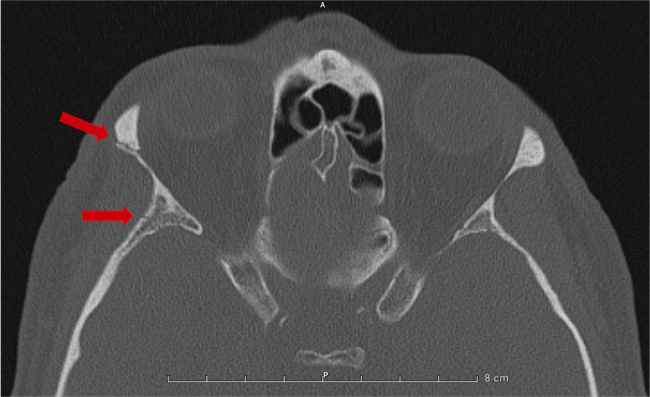
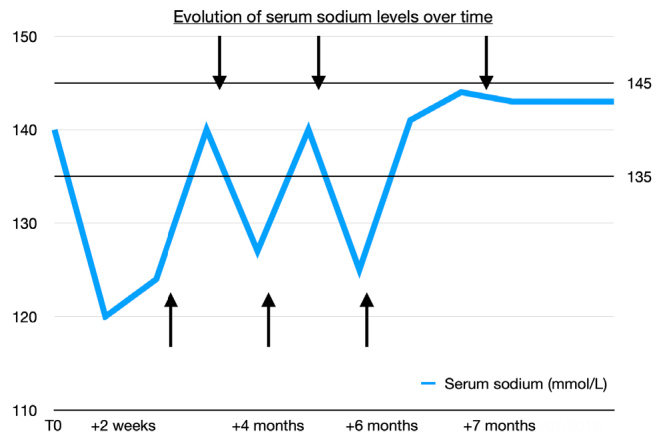
The syndrome of inappropriate antidiuretic hormone secretion (SIADH) is a common cause of euvolemic hyponatremia, resulting from non-osmotic release of antidiuretic hormone (ADH). SIADH is frequently associated with neurological conditions, including traumatic brain injury (TBI). TBI-associated SIADH usually develops within days to weeks and resolves within a few weeks. We present the case of a 74-year-old man who, after a fall resulting in TBI, initially had normal sodium levels. Fifteen days later, he developed moderate-to-severe hyponatremia (120 mmol/l) and significant neurological symptoms. Treatment with urea effectively normalized his sodium levels and resolved symptoms. However, recurrent hyponatremia persisted for over six months whenever urea treatment was discontinued. This unusual duration of TBI-associated SIADH underscores the importance of long-term follow-up in the management of post-traumatic hyponatremia.
While the syndrome of inappropriate antidiuretic hormone secretion (SIADH) is typically transient, it can persist after even minor head trauma, highlighting the importance of long-term follow-up in cases of post-traumatic hyponatremia.Urea therapy is effective and well-tolerated for managing chronic hyponatremia in SIADH, offering a sustainable long-term treatment option.Even mild hyponatremia can lead to subtle but impactful cognitive and motor symptoms.
抗利尿激素分泌不当综合征(SIADH)是等渗性低钠血症的常见原因,由抗利尿激素(ADH)的非渗透性释放引起。SIADH常与神经系统疾病相关,包括创伤性脑损伤(TBI)。TBI相关的SIADH通常在数天至数周内出现,并在几周内缓解。我们报告一例74岁男性病例,该患者因跌倒导致TBI,最初钠水平正常。15天后,他出现中度至重度低钠血症(120 mmol/L)及明显的神经症状。尿素治疗有效地使他的钠水平恢复正常并缓解了症状。然而,每当停止尿素治疗时,复发性低钠血症持续超过六个月。TBI相关SIADH的这种不寻常病程强调了创伤后低钠血症管理中长期随访的重要性。
虽然抗利尿激素分泌不当综合征(SIADH)通常是短暂的,但即使是轻微头部创伤后也可能持续存在,这突出了创伤后低钠血症病例中长期随访的重要性。尿素疗法对于管理SIADH中的慢性低钠血症有效且耐受性良好,提供了一种可持续的长期治疗选择。即使是轻度低钠血症也可能导致细微但有影响的认知和运动症状。