Youssef George, Huynh Nha Uyen T, Nacy Somer
Experimental Mechanics Laboratory, Mechanical Engineering Department, San Diego State University, 5500 Campanile Drive, San Diego, CA 92182, USA.
Biomedical Engineering, University of Baghdad, Baghdad 10071, Iraq.
Materials (Basel). 2024 Nov 29;17(23):5854. doi: 10.3390/ma17235854.
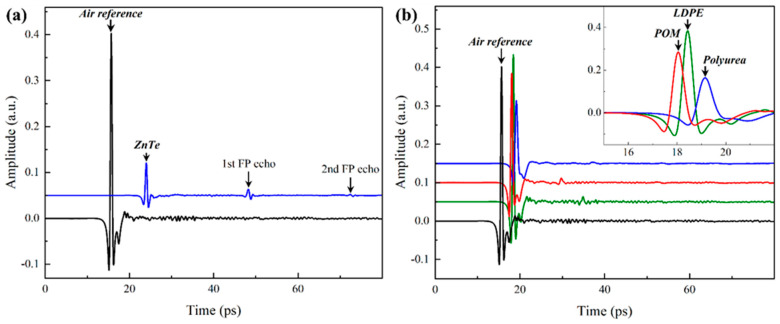
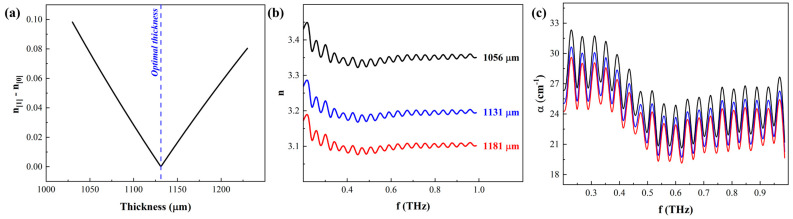
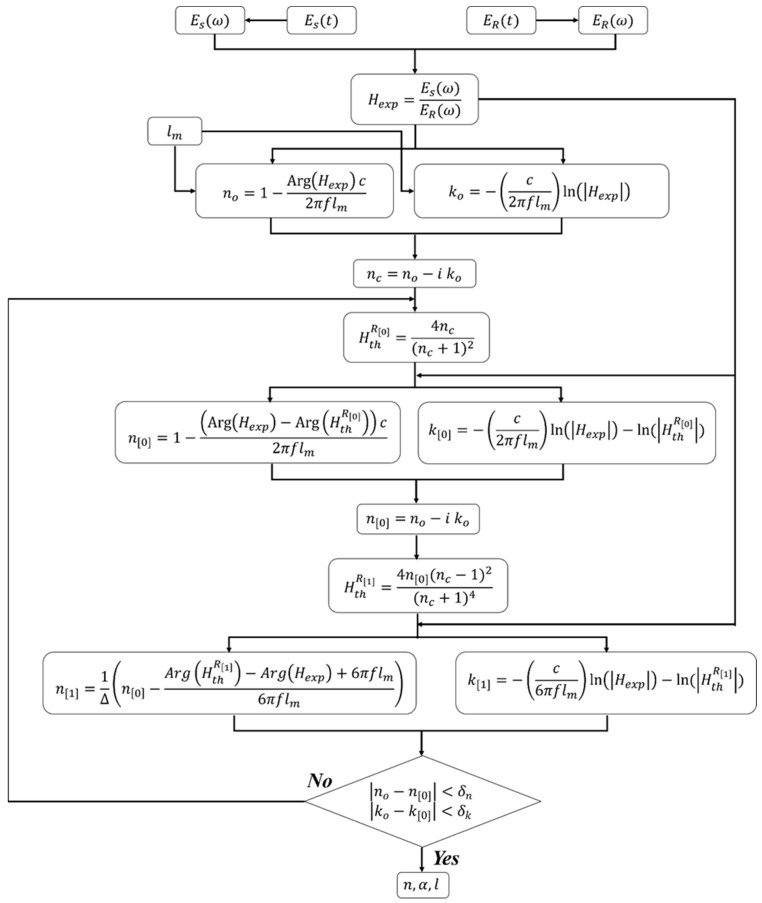
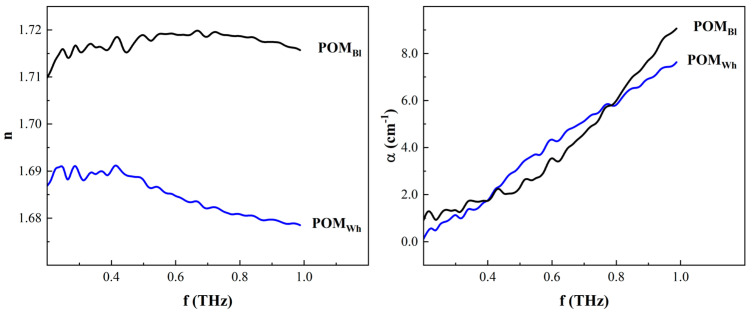
Terahertz waves are nondestructive and non-ionizing to synthetic and natural materials, including polymeric and biological materials. As a result, terahertz-based spectroscopy has emerged as a suitable technique to uncover fundamental molecular mechanisms and material properties in this electromagnetic spectrum regime. In terahertz time-domain spectroscopy (THz-TDS), the material's optical properties are resolved using the raw time-domain signals collected from the sample and air reference data depending on accurate prior knowledge of the sample geometry. Alternatively, different spectral analysis algorithms can extract the complex index of refraction of optically thick or optically thin samples without specific thickness knowledge. A THz-TDS signal without apparent Fabry-Pérot oscillations is commonly associated with optically thin samples, whereas the terahertz signal of optically thick samples exhibits distinct Fabry-Pérot oscillations. While several extraction algorithms have been reported , the steps from reducing the time-domain signal to calculating the complex index of refraction and resolving the correct thickness can be daunting and intimidating while obscuring important steps. Therefore, the objective is to decipher, demystify, and demonstrate the extraction algorithms for Fabry-Pérot-absent and -present terahertz signals for various polymers with different molecular structure classifications and nonlinear optical crystal zinc telluride. The experimental results were in good agreement with previously published values while elucidating the contributions of the molecular structure to the stability of the algorithms. Finally, the necessary condition for manifesting Fabry-Pérot oscillations was delineated.
太赫兹波对合成材料和天然材料(包括聚合物材料和生物材料)具有无损且非电离的特性。因此,基于太赫兹的光谱技术已成为一种合适的技术,用于揭示该电磁频谱范围内的基本分子机制和材料特性。在太赫兹时域光谱(THz-TDS)中,根据对样品几何形状的准确先验知识,利用从样品和空气参考数据收集的原始时域信号来解析材料的光学特性。或者,不同的光谱分析算法可以在无需特定厚度知识的情况下,提取光学厚或光学薄样品的复折射率。没有明显法布里-珀罗振荡的太赫兹时域光谱信号通常与光学薄样品相关,而光学厚样品的太赫兹信号则表现出明显的法布里-珀罗振荡。虽然已经报道了几种提取算法,但从减少时域信号到计算复折射率以及确定正确厚度的步骤可能既艰巨又令人望而生畏,同时还会掩盖重要步骤。因此,目标是解读、揭开神秘面纱并展示针对不同分子结构分类的各种聚合物以及非线性光学晶体碲化锌的、有无法布里-珀罗振荡的太赫兹信号的提取算法。实验结果与先前发表的值高度吻合,同时阐明了分子结构对算法稳定性的贡献。最后,明确了出现法布里-珀罗振荡的必要条件。