Fujiwara Shintaro, Otsuka Yuki, Furukawa Masanori, Higashikage Akihito, Otsuka Fumio
Department of General Medicine, Okayama University Graduate School of Medicine, Dentistry and Pharmaceutical Sciences, Okayama 700-8558, Japan.
Department of Pediatrics, NHO Okayama Medical Center, Okayama 701-1192, Japan.
J Clin Med. 2024 Nov 23;13(23):7078. doi: 10.3390/jcm13237078.
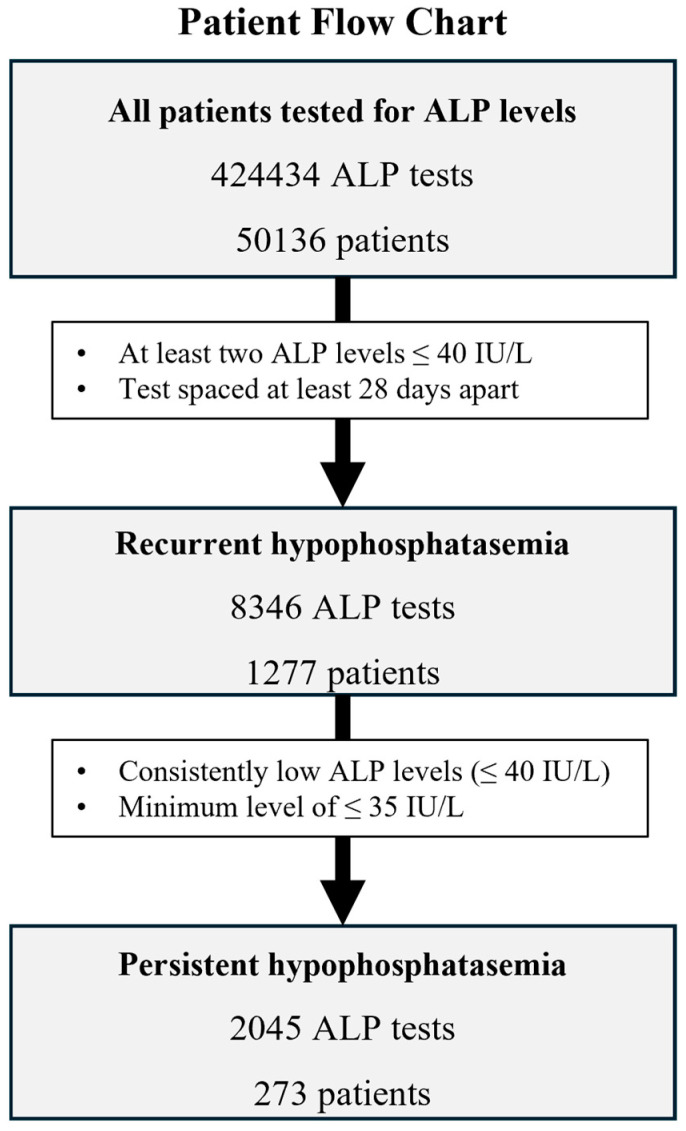
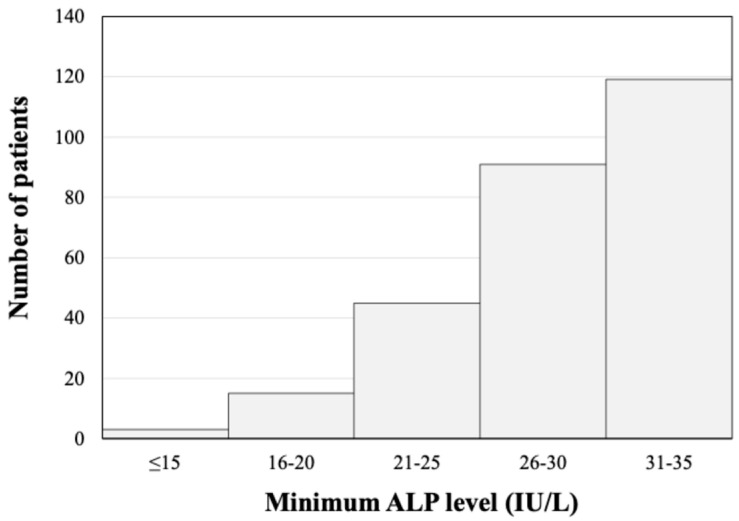
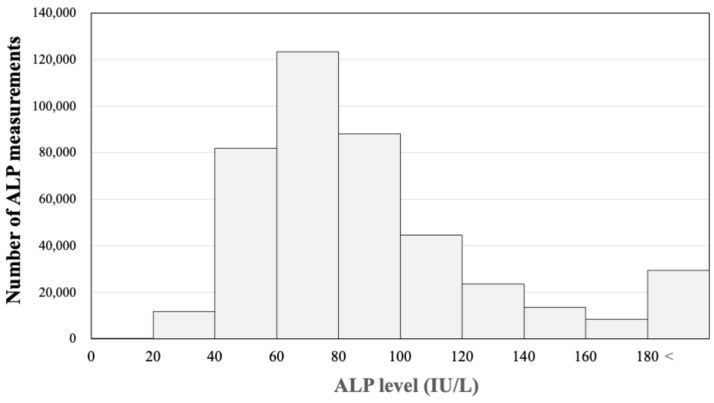
Hypophosphatasemia is often overlooked despite its potential to indicate underlying pathologies. The aim of this study was to determine the prevalence of persistent hypophosphatasemia in a large, urban, multi-specialty hospital population and characterize the clinical and laboratory findings in adult patients with this condition. In this retrospective observational study, the results of 424,434 alkaline phosphatase (ALP) tests in 50,136 patients aged ≥18 years that were performed at Okayama University Hospital between July 2020 and October 2023 were analyzed. Persistent hypophosphatasemia was defined as consistently low ALP levels (≤40 IU/L) for 28 days with a minimum recorded level of ≤35 IU/L. Persistent hypophosphatasemia was detected in 273 patients (0.54% of the tested patients), and the patients with persistent hypophosphatasemia included a higher proportion of females (72.5% vs. 52.9% in the people without persistent hypophosphatasemia; chi-squared test, < 0.01) and had a younger median age (51 years vs. 63 years; Mann-Whitney U test, < 0.01) than those in the overall tested population. The common causes of persistent hypophosphatasemia were cancer (30%), glucocorticoid use (21%), and immunosuppressants (16%). Notably, 38 patients (14%) had no apparent cause for low ALP values. These patients were categorized on the basis of their clinical characteristics, with some patients presenting symptoms potentially related to adult hypophosphatasia. This study provides prevalence and insights into the causes and characteristics of persistent hypophosphatasemia in a Japanese tertiary care setting. While most cases were associated with known causes, patients with unexplained hypophosphatasemia and symptoms such as chronic pain, muscle weakness, and general fatigue could have adult hypophosphatasia. In such cases, comprehensive evaluation and further investigation for hypophosphatasia should be considered. Persistent hypophosphatasemia of undetermined etiology could be a crucial initial step in diagnostic algorithms for this condition.
低磷血症尽管有可能提示潜在的病理状况,但常常被忽视。本研究的目的是确定一家大型城市多专科医院人群中持续性低磷血症的患病率,并描述成年患者的临床和实验室检查结果。在这项回顾性观察研究中,分析了2020年7月至2023年10月在冈山大学医院对50136名≥18岁患者进行的424434次碱性磷酸酶(ALP)检测结果。持续性低磷血症定义为ALP水平持续低(≤40 IU/L)达28天,最低记录水平≤35 IU/L。在273名患者中检测到持续性低磷血症(占检测患者的0.54%),持续性低磷血症患者中女性比例更高(72.5%,而无持续性低磷血症者为52.9%;卡方检验,<0.01),且中位年龄更年轻(51岁对63岁;曼-惠特尼U检验,<0.01)。持续性低磷血症的常见原因是癌症(30%)、使用糖皮质激素(21%)和免疫抑制剂(16%)。值得注意的是,38名患者(14%)ALP值低无明显原因。这些患者根据其临床特征进行分类,一些患者出现了可能与成人低磷血症相关的症状。本研究提供了日本三级医疗环境中持续性低磷血症的患病率以及对其病因和特征的见解。虽然大多数病例与已知病因有关,但不明原因低磷血症且有慢性疼痛、肌肉无力和全身疲劳等症状的患者可能患有成人低磷血症。在这种情况下,应考虑对低磷血症进行全面评估和进一步检查。病因不明的持续性低磷血症可能是该病诊断算法中的关键初始步骤。