Zhou Wu, Xiong Yanqiang, Zhao Liangping, Levin Gabriel, Batalini Felipe, Liu Zhihui, Ma Yuanxue
Department of Obstetrics and Gynecology, Wuhan Children's Hospital (Wuhan Maternal and Child Healthcare Hospital), Tongji Medical College, Huazhong University of Science & Technology, Wuhan, China.
Division of Gynecologic Oncology, Jewish General Hospital, McGill University, Montreal, QC, Canada.
Transl Cancer Res. 2024 Nov 30;13(11):6315-6322. doi: 10.21037/tcr-24-1909. Epub 2024 Nov 27.
Ovarian cancer accounts for 3% of all malignancies in women and kills about 140,000 women worldwide each year, representing the fifth leading cause of cancer-related death in women. At diagnosis, 70% of patients with ovarian cancer are already at stage III or IV disease, with a 5-year survival rate of less than 45%. Studies have found that solute carrier family 1 member 3 () is highly expressed in various cancers and is associated with the poor prognosis of these cancers. However, the role of in ovarian cancer remains unknown. The purpose of this study was to investigate the role of the gene in the proliferation, apoptosis, migration, and outcomes of ovarian cancer.
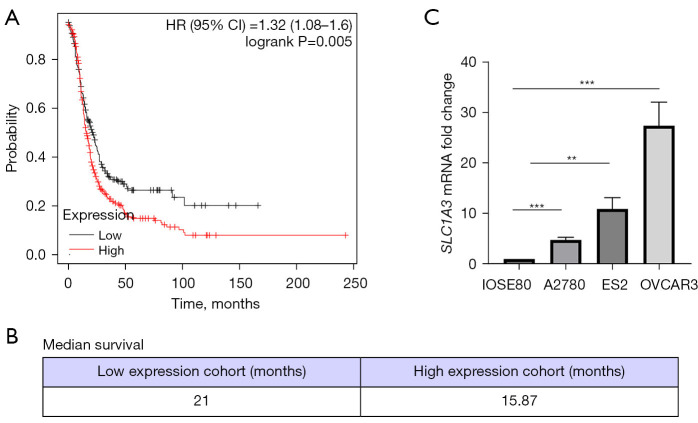
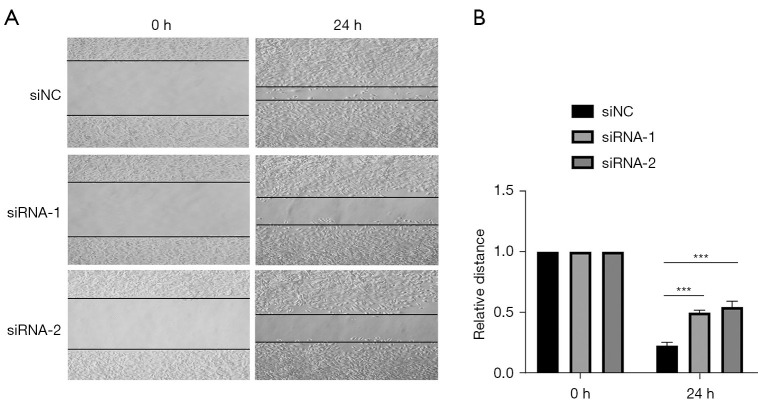
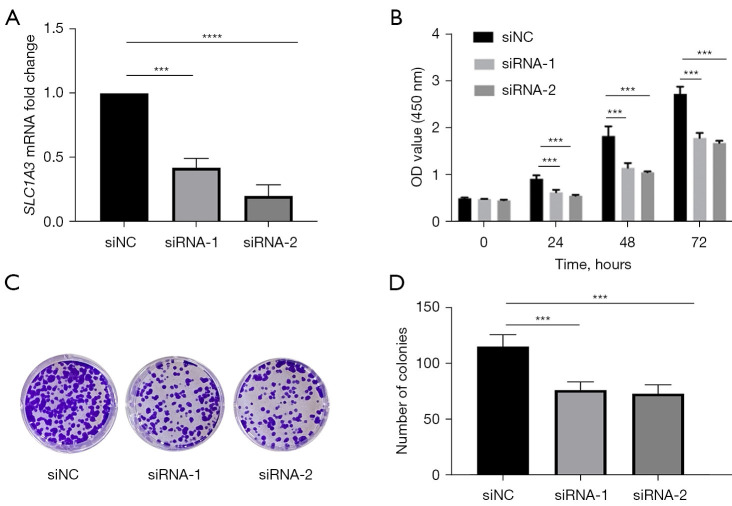
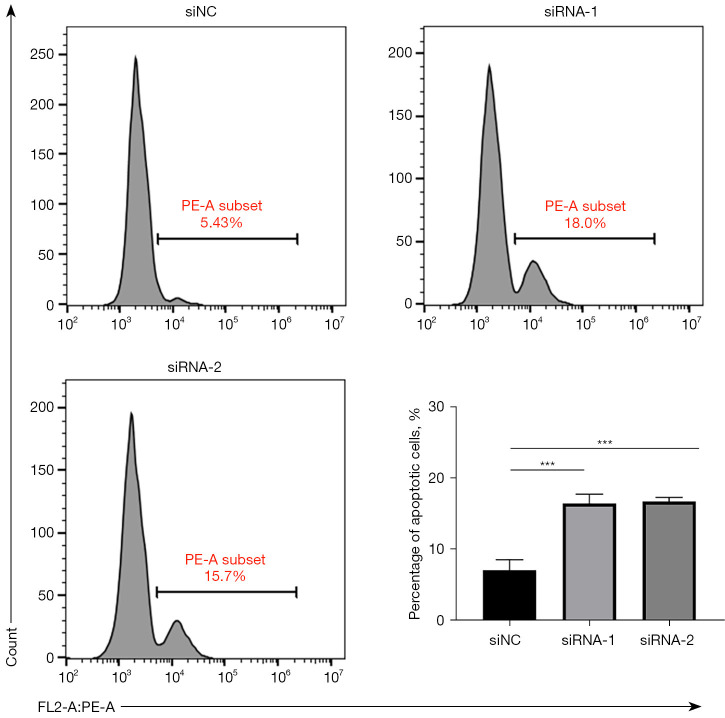
The expression level of was measured via quantitative real-time reverse transcription polymerase chain reaction (qRT-PCR). Knockdown experiments were performed with small interfering RNA targeting in ovarian cancer cells. After the knockdown of , proliferation was evaluated with Cell Counting Kit 8 (CCK8) assay, apoptosis was measured by flow cytometry, and migration was evaluated via wound-healing assay. Kaplan-Meier method was used to analyze the effect of expression on the prognosis of patients with ovarian cancer.
High expression of was associated with poor prognosis in ovarian cancer patients, and the expression of in ovarian cancer cells was higher than that in ovarian epithelial cells. experiments demonstrated that knockdown of restrained the proliferation activity of ovarian cancer cells, enhanced cell apoptosis, and inhibited cell migration.
High expression of is linked to poor prognosis in ovarian cancer patients. activity impedes apoptosis while enhancing the proliferation and migration of ovarian cancer cells, suggesting its potential as a therapeutic target for drug development.
卵巢癌占女性所有恶性肿瘤的3%,每年在全球导致约14万名女性死亡,是女性癌症相关死亡的第五大主要原因。在确诊时,70%的卵巢癌患者已处于III期或IV期疾病,5年生存率低于45%。研究发现,溶质载体家族1成员3()在多种癌症中高表达,并与这些癌症的不良预后相关。然而,其在卵巢癌中的作用仍不清楚。本研究的目的是探讨该基因在卵巢癌增殖、凋亡、迁移及预后中的作用。
通过定量实时逆转录聚合酶链反应(qRT-PCR)检测的表达水平。在卵巢癌细胞中用靶向的小干扰RNA进行敲低实验。敲低后,用细胞计数试剂盒8(CCK8)检测评估增殖,通过流式细胞术检测凋亡,通过伤口愈合实验评估迁移。采用Kaplan-Meier法分析表达对卵巢癌患者预后的影响。
高表达与卵巢癌患者的不良预后相关,且卵巢癌细胞中的表达高于卵巢上皮细胞。实验表明,敲低可抑制卵巢癌细胞的增殖活性,增强细胞凋亡,并抑制细胞迁移。
高表达与卵巢癌患者的不良预后相关。活性可阻碍凋亡,同时增强卵巢癌细胞的增殖和迁移,提示其作为药物开发治疗靶点的潜力。