Pinheiro Ana Kedma Correa, Raymundo Carlos Eduardo, da Silva Santos Eliene do Socorro, Saldanha Dos Santos Marcio Yrochy, de Oliveira Sarefino Adriana, do Nascimento Souza Maria Helena, Lima Ingrid Bentes, da Silva Raquel Gomes, Nogueira Laura Maria Vidal
Escola de Enfermagem Anna Nery da Universidade Federal do Rio de Janeiro (UFRJ), Rio de Janeiro, Rio de Janeiro, Brazil.
Faculdade de Ciências Médicas da Universidade do Estado do Rio de Janeiro (UERJ), Rio de Janeiro, Rio de Janeiro, Brazil.
BMC Prim Care. 2024 Dec 19;25(1):428. doi: 10.1186/s12875-024-02684-y.
the riverside population lives in a vulnerable social situation, shaped by geographical, economic, social, and educational aspects that have repercussions on health literacy, the limitations of which can compromise Quality of Life. These specificities influence the actions of Primary Health Care, especially in the rural context. This study aimed to assess the factors associated with Functional Health Literacy and Quality of Life among riverside residents of the Brazilian Amazon who use Primary Health Care.
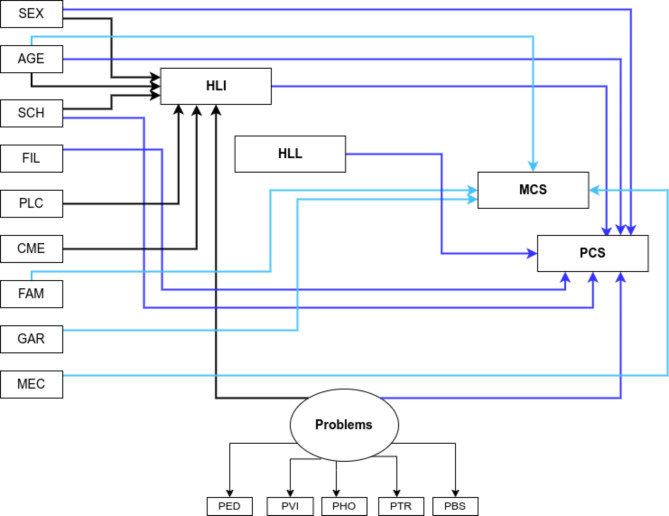
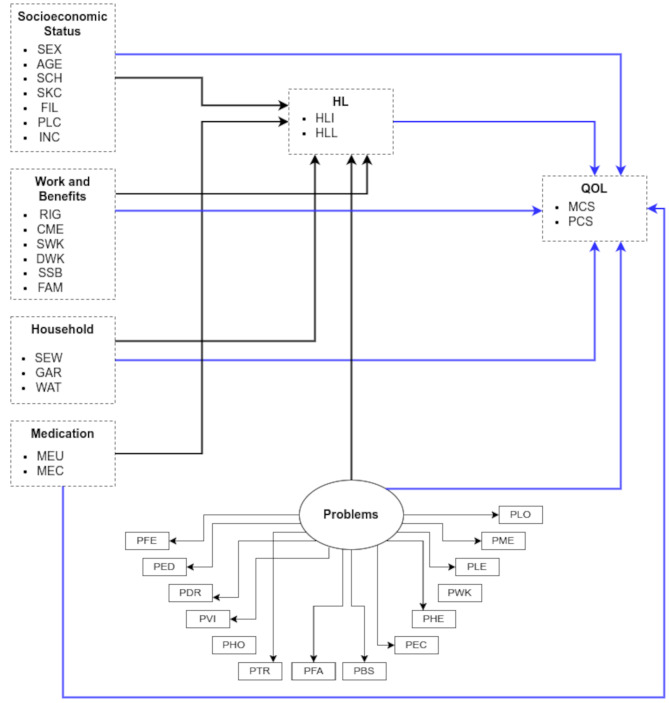
a cross-sectional study with 312 users of a riverside Family Health Team, using the Health Literacy Test, classified as adequate, limited, and inadequate, and the Study Short Form 12 Health Survey questionnaire, analyzing the physical and mental components in isolation. A theoretical model was built to assess the associations between sociodemographic and environmental variables and the Functional Health Literacy and Quality of Life outcomes. The Functional Health Literacy outcome was considered as two dichotomous variables (inadequate versus adequate; limited versus adequate), while the Quality of Life outcomes were considered as counts, with a Poisson distribution. Thus, a structural equation model was used to adjust the proposed theoretical model.
there was a worsening in inadequate Functional Health Literacy, associated with females, aged over 40, elementary school education, living close to the health service, and using only a cell phone for communication. Factors that compromised physical Quality of Life: livelihood problems; inadequate literacy; age range 40-59; and having two children or more. And those that worsened mental Quality of Life: age over 40; having a family allowance; and being in control of their medication.
sociodemographic, environmental, and economic factors and adherence to medication by river communities have been shown to be associated with Health Literacy and Quality of Life. Knowing these implications is fundamental for health provision. These findings can support the formulation of strategies in health services to improve Health Literacy and Quality of Life.
河畔居民生活在脆弱的社会环境中,受到地理、经济、社会和教育等方面的影响,这些因素会对健康素养产生影响,而健康素养的局限可能会损害生活质量。这些特殊性影响着初级卫生保健的行动,尤其是在农村地区。本研究旨在评估巴西亚马逊地区使用初级卫生保健的河畔居民中与功能性健康素养和生活质量相关的因素。
对312名河畔家庭健康团队的使用者进行横断面研究,使用健康素养测试(分为充分、有限和不充分)以及简短健康调查问卷12项版本,分别分析身体和心理成分。构建了一个理论模型来评估社会人口学和环境变量与功能性健康素养及生活质量结果之间的关联。功能性健康素养结果被视为两个二分变量(不充分与充分;有限与充分),而生活质量结果则被视为计数变量,服从泊松分布。因此,使用结构方程模型来调整所提出的理论模型。
不充分的功能性健康素养情况有所恶化,与女性、40岁以上、小学教育程度、居住在靠近卫生服务机构的地方以及仅使用手机进行通信有关。影响身体生活质量的因素包括:生计问题;健康素养不足;年龄在40 - 59岁之间;以及有两个或更多孩子。而那些使心理生活质量恶化的因素包括:40岁以上;有家庭津贴;以及自行管理药物。
社会人口学、环境和经济因素以及河畔社区对药物的依从性已被证明与健康素养和生活质量相关。了解这些影响对于提供卫生保健至关重要。这些发现可为卫生服务部门制定改善健康素养和生活质量的策略提供支持。