Pla Indira, Szabolcs Botond L, Péter Petra Nikolett, Ujfaludi Zsuzsanna, Kim Yonghyo, Horvatovich Peter, Sanchez Aniel, Pawlowski Krzysztof, Wieslander Elisabet, Kuras Magdalena, Murillo Jimmy Rodriguez, Guedes Jéssica, Pál Dorottya M P, Ascsillán Anna A, Betancourt Lazaro Hiram, Németh István Balázs, Gil Jeovanis, de Almeida Natália Pinto, Szeitz Beáta, Szadai Leticia, Doma Viktória, Woldmar Nicole, Bartha Áron, Pahi Zoltan, Pankotai Tibor, Győrffy Balázs, Szasz A Marcell, Domont Gilberto, Nogueira Fábio, Kwon Ho Jeong, Appelqvist Roger, Kárpáti Sarolta, Fenyö David, Malm Johan, Marko-Varga György, Kemény Lajos V
Department of Biomedical Engineering, Faculty of Engineering, LTH, Lund University, Lund, Sweden.
European Cancer Moonshot Lund Center, Lund, Sweden.
Int J Dermatol. 2025 May;64(5):870-881. doi: 10.1111/ijd.17586. Epub 2024 Dec 25.
The utilization of PD1 and CTLA4 inhibitors has revolutionized the treatment of malignant melanoma (MM). However, resistance to targeted and immune-checkpoint-based therapies still poses a significant problem.
Here, we mine large-scale MM proteogenomic data to identify druggable targets and forecast treatment efficacy and resistance.
Leveraging protein profiles from established MM subtypes and molecular structures of 82 cancer treatment drugs, we identified nine candidate hub proteins, mTOR, FYN, PIK3CB, EGFR, MAPK3, MAP4K1, MAP2K1, SRC, and AKT1, across five distinct MM subtypes. These proteins are potential drug targets applicable to one or multiple MM subtypes. Additionally, by integrating proteogenomic profiles obtained from MM subtypes with MM cell line dependency and drug sensitivity data, we identified a total of 162 potentially targetable genes. Lastly, we identified 20 compounds exhibiting potential drug impact in at least one melanoma subtype.
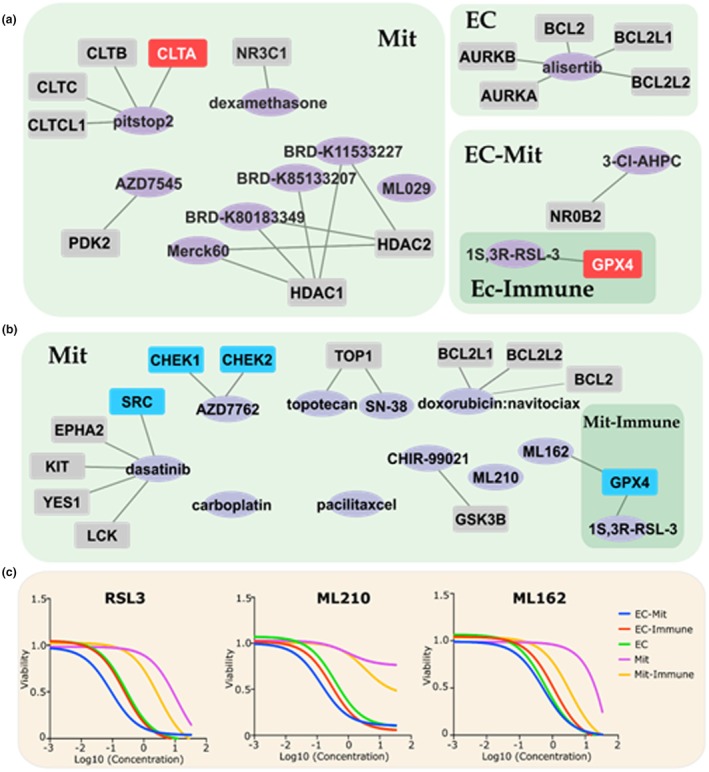
Employing these unbiased approaches, we have uncovered compounds targeting ferroptosis demonstrating a striking 30× fold difference in sensitivity among different subtypes.
Our results suggest innovative and novel therapeutic strategies by stratifying melanoma samples through proteomic profiling, offering a spectrum of novel therapeutic interventions and prospects for combination therapy.
PD1和CTLA4抑制剂的应用彻底改变了恶性黑色素瘤(MM)的治疗方式。然而,对基于靶向和免疫检查点的疗法产生耐药性仍然是一个重大问题。
在此,我们挖掘大规模MM蛋白质基因组数据,以识别可成药靶点并预测治疗效果和耐药性。
利用已确立的MM亚型的蛋白质谱和82种癌症治疗药物的分子结构,我们在五种不同的MM亚型中鉴定出九个候选枢纽蛋白,即mTOR、FYN、PIK3CB、EGFR、MAPK3、MAP4K1、MAP2K1、SRC和AKT1。这些蛋白质是适用于一种或多种MM亚型的潜在药物靶点。此外,通过将从MM亚型获得的蛋白质基因组谱与MM细胞系依赖性和药物敏感性数据相结合,我们总共鉴定出162个潜在可靶向基因。最后,我们鉴定出20种在至少一种黑色素瘤亚型中显示出潜在药物影响的化合物。
采用这些无偏倚方法,我们发现了靶向铁死亡的化合物,其在不同亚型之间的敏感性存在惊人的30倍差异。
我们的结果表明,通过蛋白质组学分析对黑色素瘤样本进行分层可提出创新的治疗策略,为联合治疗提供一系列新的治疗干预措施和前景。