Lan Pingxiu, He Peng, Mu Aiqiu, Cao Mengji, Wang Yun, Zhou Guohua, Chen Xiaojiao, Cai Hong, Li Fan
State Key Laboratory for Conservation and Utilization of Bio-Resources in Yunnan, Yunnan Agricultural University, Kunming, 650201, China.
National Citrus Engineering Research Center, Citrus Research Institute, Southwest University, Chongqing, 400712, China.
Sci Rep. 2025 Jan 2;15(1):473. doi: 10.1038/s41598-024-84226-1.
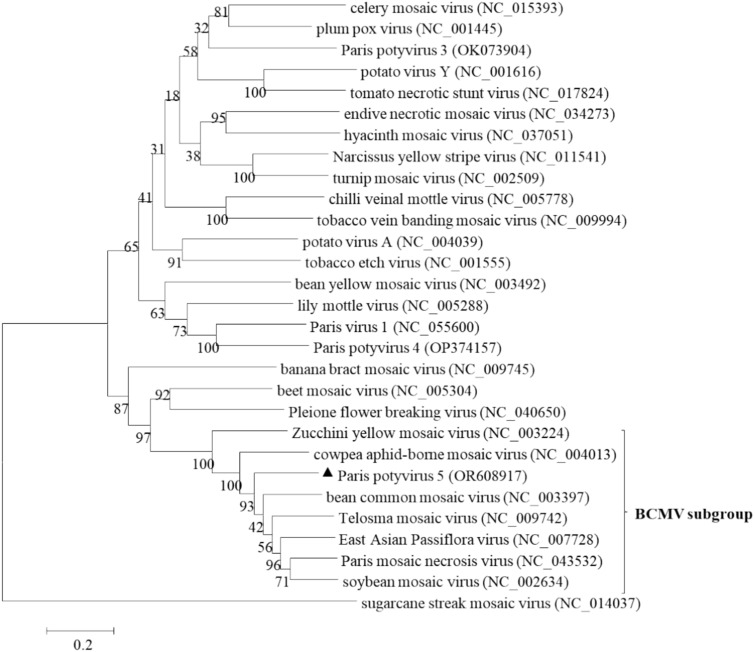
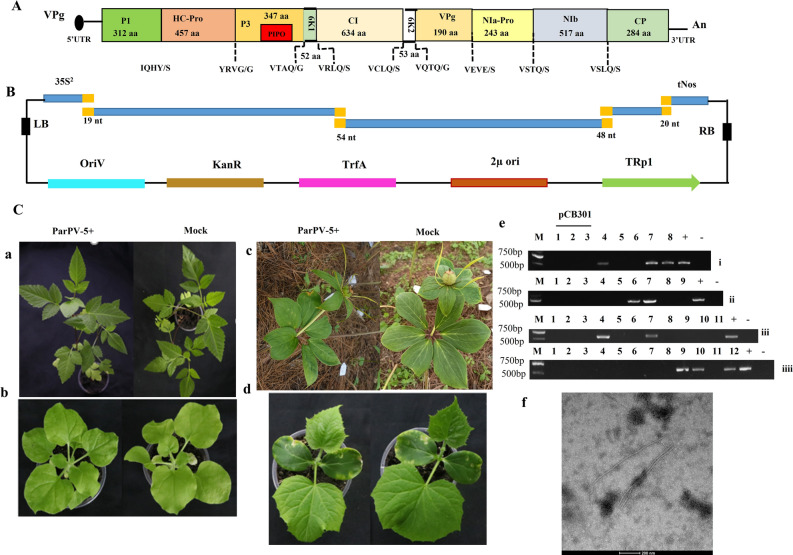
Paris yunnanensis, also named as Rhizoma Paridis in the Chinese Pharmacopeia, is a perennial Chinese medicinal herb commonly grown in Southwest China. However, several viruses have been found infecting this plant in recent years. Using high-throughput sequencing (HTS) and Sanger sequencing, this study obtained the complete genome sequences of three capillovirus isolates and one potyvirus isolate. Genomic and phylogenetic analyses revealed that these three capillovirus isolates are the same virus as the newly reported capillovirus, Paris polyphylla chlorotic mottle virus. The newly found potyvirus isolate shares 52.4-68.9% nucleotide sequence identity with other known potyviruses and thus, is grouped into the bean common mosaic virus subgroup. Based on the nucleotide sequence identity, we consider this virus a novel potyvirus species and propose 'Paris potyvirus 5' (ParPV-5) as its common name, and 'Potyvirus shilinense' as its species name. To characterize their biological features, two infectious clones, representing the two viruses, have been constructed through homologous recombination or yeast homologous recombination, and inoculated to several species plants, respectively. The results showed both of the viruses can infect P. yunnanensis and Nicotiana benthamiana. In addition, Paris polyphylla chlorotic mottle virus (PpCMV) can infect N. tabacum var. Xanthi nc, Cucurbita moschata, and Capsicum annuum, and ParPV-5 can infect Cucumis sativus L. and Bidens pilosa L. However, except mild leaf deformation exhibited on the PpCMV-inoculated C. moschata plants, no obvious symptom were observed in these plants including P. yunnanensis. A total of 179 field P. yunnanensis leaf samples from four counties in 2020-2021, and all 640 P. yunnanensis plants from a whole study plot of Lijiang in 2024, were tested using RT-PCR and specific primers, the results showed that PpCMV is a potential preponderant species in some regions, and ParPV-5 has the possible transmission from the original site to other regions.
滇重楼,在中国药典中也被称为重楼,是一种多年生中药材,常见于中国西南部。然而,近年来发现有几种病毒感染这种植物。本研究通过高通量测序(HTS)和桑格测序,获得了三种毛形病毒分离株和一种马铃薯Y病毒分离株的完整基因组序列。基因组和系统发育分析表明,这三种毛形病毒分离株与新报道的毛形病毒——滇重楼褪绿斑驳病毒是同一种病毒。新发现的马铃薯Y病毒分离株与其他已知马铃薯Y病毒的核苷酸序列同一性为52.4 - 68.9%,因此被归类到菜豆普通花叶病毒亚组。基于核苷酸序列同一性,我们认为这种病毒是一种新的马铃薯Y病毒物种,并提出将‘滇重楼马铃薯Y病毒5’(ParPV - 5)作为其通用名,‘石林马铃薯Y病毒’作为其种名。为了表征它们的生物学特性,通过同源重组或酵母同源重组构建了代表这两种病毒的两个感染性克隆,并分别接种到几种植物物种上。结果表明这两种病毒都能感染滇重楼和本氏烟草。此外,滇重楼褪绿斑驳病毒(PpCMV)能感染烟草品种Xanthi nc、南瓜和辣椒,ParPV - 5能感染黄瓜和三叶鬼针草。然而,除了接种PpCMV的南瓜植株上出现轻微的叶片变形外,包括滇重楼在内的这些植物均未观察到明显症状。使用RT - PCR和特异性引物对2020 - 2021年来自四个县的179份滇重楼田间叶片样本以及2024年丽江一个完整研究地块的所有640株滇重楼植株进行检测,结果表明PpCMV在某些地区是一种潜在的优势物种,ParPV - 5有可能从原发地传播到其他地区。