
鉴定SETD4作为一种肿瘤免疫生物标志物,涵盖多种人类癌症中的肿瘤微环境、预后及治疗反应。
Identification of SETD4 as an Onco-Immunological Biomarker Encompassing the Tumor Microenvironment, Prognoses, and Therapeutic Responses in Various Human Cancers.
作者信息
Zhong Yuyun, Wang Ruiqi, Huang Zijie, Hu Zhaoting, Peng Bin, Chen Bin, Sun Liyue
机构信息
Department of Health Management Center, The Third Affiliated Hospital of Southern Medical University, Guangzhou, China.
The Guangzhou Bay Area Institute of Biomedicine, Guangzhou, China.
出版信息
Immun Inflamm Dis. 2025 Jan;13(1):e70126. doi: 10.1002/iid3.70126.
BACKGROUND
SET domain-containing protein 4 (SETD4) is a histone methyltransferase that has been shown to modulate cell proliferation, differentiation, and inflammatory responses by regulating histone H4 trimethylation (H4K20me3). Previous reports have demonstrated its function in the quiescence of cancer stem cells as well as drug resistance in several cancers. A limited number of systematic studies have examined SETD4's role in the tumor microenvironment, pathogenesis, prognosis, and therapeutic response.
METHODS
Utilizing The Cancer Genome Atlas database, and other publicly accessible platforms, we comprehensively analyzed SETD4 gene expression, methylation patterns, and prognostic significance. Furthermore, we investigated its association with cancer-related pathways, the immune microenvironment, immunotherapy markers, and drug resistance signatures of chemotherapy. Additionally, qRT-PCR was performed to validate SETD4 expression in clinical specimens.
RESULTS
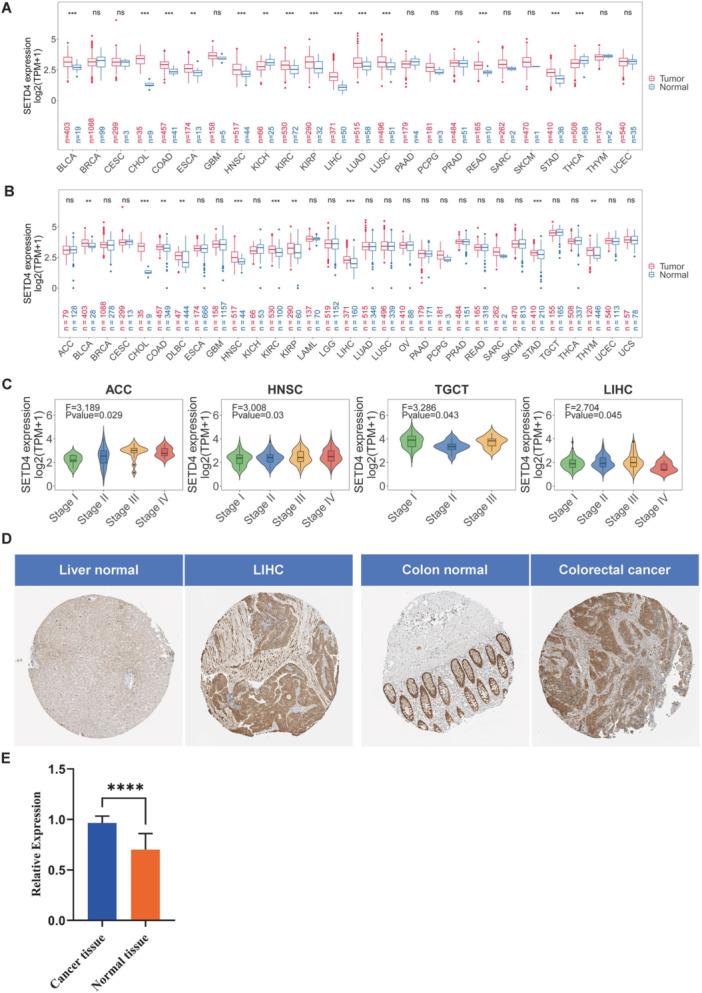
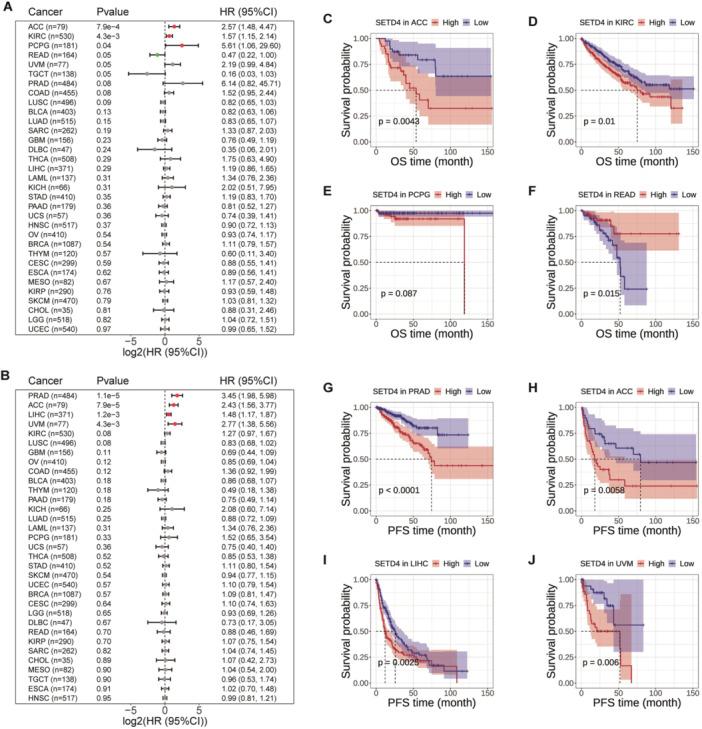
The expression of SETD4 was abnormal across a variety of cancer types and the expression of SETD4 in colorectal cancer tissues was verified in clinical specimens. The upregulation of SETD4 may be a prognostic risk factor predicting poor overall survival and progression-free survival. The analysis revealed that the mRNA level of SETD4 was modulated by promoter methylation, and patients with lower methylation levels showed shorter survival times. Pathway analysis showed that SETD4 influenced several key cell cycle pathways, including the G2M checkpoint, and mitotic spindle pathways. In addition, SETD4 negatively affects immune cell infiltration in most cancers, including B cells, CD8 T cells, and macrophages. The correlation between SETD4 and cancer stemness as well as homologous recombination deficiency varied across tumor types, suggesting that SETD4 may play a multifaceted role in tumor resistance. Notably, we identified several potential agents targeting SETD4.
CONCLUSIONS
This study demonstrates that SETD4 is an immune-oncogenic molecule in multiple cancers, with the potential to be a diagnosis, prognosis, and targeted therapy marker.
背景
含SET结构域蛋白4(SETD4)是一种组蛋白甲基转移酶,已证明其可通过调节组蛋白H4三甲基化(H4K20me3)来调控细胞增殖、分化和炎症反应。先前的报道已证实其在癌症干细胞静止以及多种癌症的耐药性方面发挥作用。仅有少数系统性研究探讨了SETD4在肿瘤微环境、发病机制、预后及治疗反应中的作用。
方法
利用癌症基因组图谱数据库及其他公开可用平台,我们全面分析了SETD4基因表达、甲基化模式及预后意义。此外,我们研究了其与癌症相关通路、免疫微环境、免疫治疗标志物及化疗耐药特征的关联。另外,进行了qRT-PCR以验证临床标本中SETD4的表达。
结果
SETD4在多种癌症类型中的表达均异常,且临床标本验证了结直肠癌组织中SETD4的表达。SETD4的上调可能是预测总生存期和无进展生存期较差的预后危险因素。分析显示SETD4的mRNA水平受启动子甲基化调节,甲基化水平较低的患者生存期较短。通路分析表明SETD4影响多个关键细胞周期通路,包括G2M检查点和有丝分裂纺锤体通路。此外,SETD4在大多数癌症中对免疫细胞浸润有负面影响,包括B细胞、CD8 T细胞和巨噬细胞。SETD4与癌症干性及同源重组缺陷之间的相关性因肿瘤类型而异,表明SETD4可能在肿瘤耐药中发挥多方面作用。值得注意的是,我们鉴定了几种靶向SETD4的潜在药物。
结论
本研究表明SETD4是多种癌症中的免疫致癌分子,并有可能成为诊断、预后及靶向治疗标志物。



 Zotero 插件