Wang Weining, Ren Xiaoyu, Xue Qinxin, Sliman Hussein, Gao Bin, Li Shu, Chang Yu, Liu Youjun
College of Chemistry and Life Science, Beijing University of Technology, Beijing, China.
Jiangsu STMed Technology Co., Ltd., Suzhou, China.
J Thorac Dis. 2024 Dec 31;16(12):8620-8632. doi: 10.21037/jtd-24-1650. Epub 2024 Dec 28.
Left ventricular assist device (LVAD) has been widely used as an alternative treatment for heart failure, however, aortic regurgitation is a common complication in patients with LVAD support. And the O-A angle (the angle between LVAD outflow graft and the aorta) is considered as a vital factor associated with the function of aortic valve. To date, the biomechanical effect of the O-A angle on the aortic valve remains largely unknown. The aim of this study was to evaluate the O-A angle how to influence the aortic valve biomechanical properties.
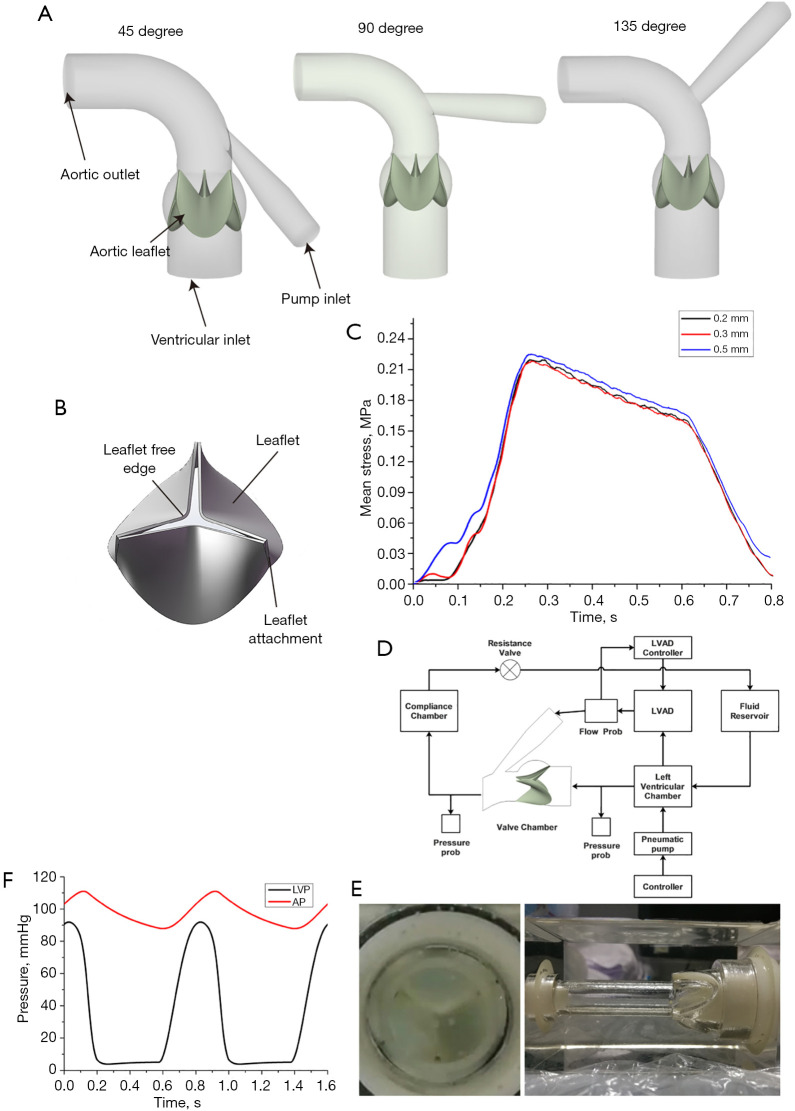
The current study employed a novel fluid-structure interaction (FSI) model that integrates the Lattice Boltzmann method (LBM) and the finite element method (FEM) to investigate the biomechanical effect of the O-A angle on the aortic valve under LVAD support. The biomechanical status of the aortic valve was evaluated at three different O-A angles (45, 90 and 135 degrees) and. four indicators, including stress distribution, the mean stress, the axial hemodynamic force (AHF) and the wall shear stress (WSS) distribution were evaluated at three timepoints (28, 133, and 266 ms).
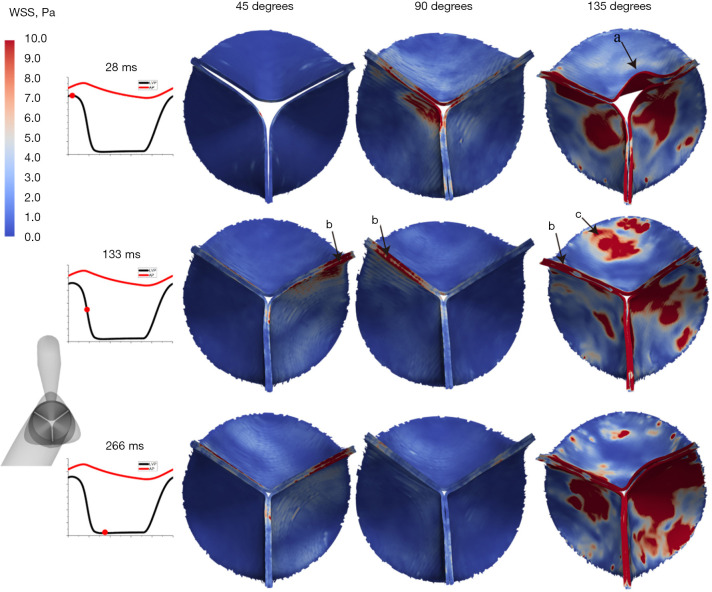
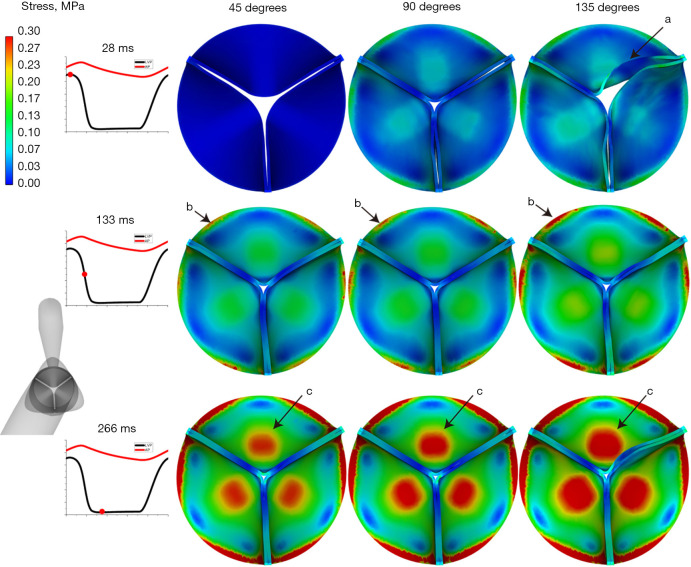
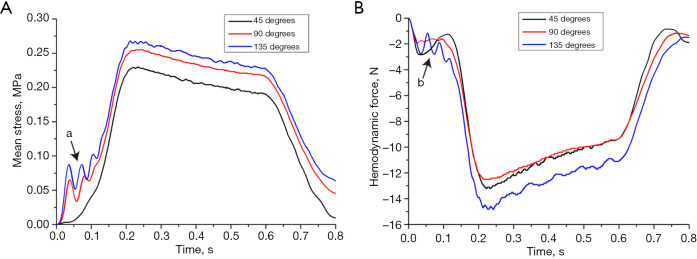
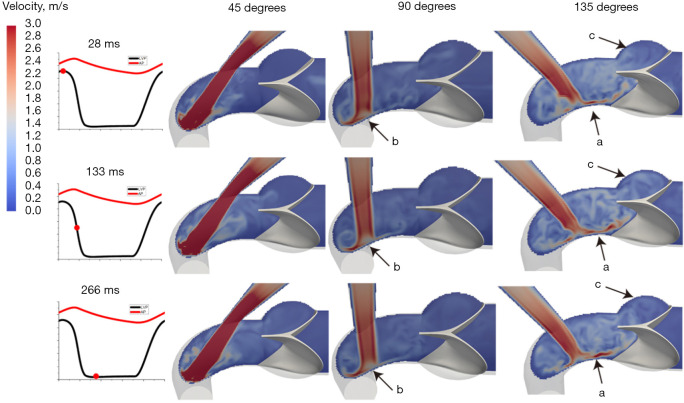
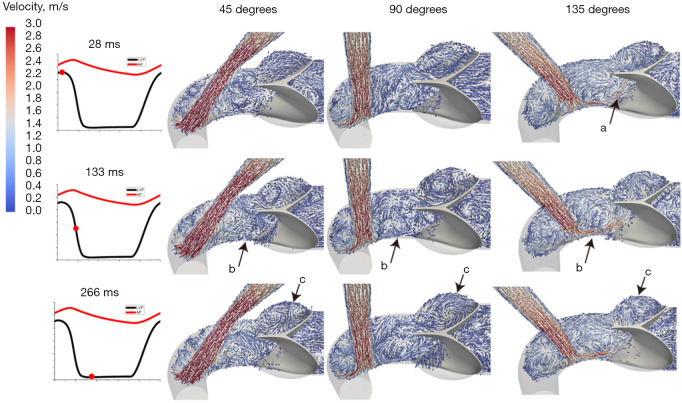
The results showed that the stress and the high-stress region on the aortic leaflets increased as the O-A angle increased and as the difference between the left ventricular pressure (LVP) and aortic pressure (AP) increased. And the aortic insufficiency was observed at the 28 ms (systolic phase) in the 135-degree O-A angle. During the systolic phase, significant fluctuation in the mean stress was observed when the O-A angle was 90 or 135 degrees. During the diastolic phase, the mean stress increased in the three O-A angle conditions when the difference between the LVP and AP increased. Regarding to the AHF, an obvious fluctuation was observed during the systolic phase (0-100 ms) in the 135-degree O-A angle. During the diastolic phase, the AHF increased in the three O-A angle conditions when the difference between the LVP and AP increased. For the WSS distribution evaluation, the WSS was increased when the O-A angle increased. At 28 ms (the systolic phase), a high WSS was located on the free edge of the leaflets, and the deformed leaflets were observed in the 135-degree O-A angle. And at 133 ms (the rapid diastolic phase), a high WSS was observed at the free edge of the leaflets when the O-A angles were 45 or 90 degrees, and at both free edge and belly of the leaflets in the 135-degree O-A angle.
The O-A angle is closely associated with the biomechanical status of the aortic valve under LVAD support. A large O-A angle caused high stress and WSS on the aortic leaflets, as well as broad stress and WSS distribution, thus leading to deformed leaflets and retrograde flow. Therefore, optimization of the O-A angle will favor to maintain aortic valve function.
左心室辅助装置(LVAD)已被广泛用作心力衰竭的替代治疗方法,然而,主动脉瓣关闭不全是接受LVAD支持的患者常见的并发症。并且O-A角(LVAD流出道与主动脉之间的夹角)被认为是与主动脉瓣功能相关的一个重要因素。迄今为止,O-A角对主动脉瓣的生物力学影响在很大程度上仍不清楚。本研究的目的是评估O-A角如何影响主动脉瓣的生物力学特性。
本研究采用一种新型的流固耦合(FSI)模型,该模型整合了格子玻尔兹曼方法(LBM)和有限元方法(FEM),以研究在LVAD支持下O-A角对主动脉瓣的生物力学影响。在三个不同的O-A角(45度、90度和135度)下评估主动脉瓣的生物力学状态,并在三个时间点(28毫秒、133毫秒和266毫秒)评估四个指标,包括应力分布、平均应力、轴向血流动力学力(AHF)和壁面剪应力(WSS)分布。
结果表明,随着O-A角的增加以及左心室压力(LVP)与主动脉压力(AP)之间差异的增加,主动脉瓣叶上的应力和高应力区域增加。并且在135度O-A角的28毫秒(收缩期)观察到主动脉瓣关闭不全。在收缩期,当O-A角为90度或135度时,平均应力出现显著波动。在舒张期,当LVP与AP之间的差异增加时,在三种O-A角条件下平均应力均增加。关于AHF,在135度O-A角的收缩期(0-100毫秒)观察到明显波动。在舒张期,当LVP与AP之间的差异增加时,在三种O-A角条件下AHF均增加。对于WSS分布评估,随着O-A角的增加WSS增加。在28毫秒(收缩期),高WSS位于瓣叶的游离缘,并且在135度O-A角观察到瓣叶变形。在133毫秒(快速舒张期),当O-A角为45度或90度时,在瓣叶的游离缘观察到高WSS,而在135度O-A角,在瓣叶的游离缘和中部均观察到高WSS。
在LVAD支持下,O-A角与主动脉瓣的生物力学状态密切相关。较大的O-A角会导致主动脉瓣叶上出现高应力和WSS,以及广泛的应力和WSS分布,从而导致瓣叶变形和反流。因此,优化O-A角将有利于维持主动脉瓣功能。