Li Yang, Liu Jian, Sun Yue, Hu Yuedi, Zhou Qiao, Cong Chengzhi, Chen Yiming
Department of Rheumatology, The First Affiliated Hospital of Anhui University of Chinese Medicine, Hefei, Anhui, China.
First Clinical Medical School, Anhui University of Chinese Medicine, Hefei, Anhui, China.
Front Immunol. 2025 Jan 8;15:1521634. doi: 10.3389/fimmu.2024.1521634. eCollection 2024.
Rheumatoid arthritis (RA) is a chronic autoimmune disease characterized by synovial inflammation and progressive joint destruction. Neutrophil extracellular traps (NETs), a microreticular structure formed after neutrophil death, have recently been implicated in RA pathogenesis and pathological mechanisms. However, the underlying molecular mechanisms and key genes involved in NET formation in RA remain largely unknown.
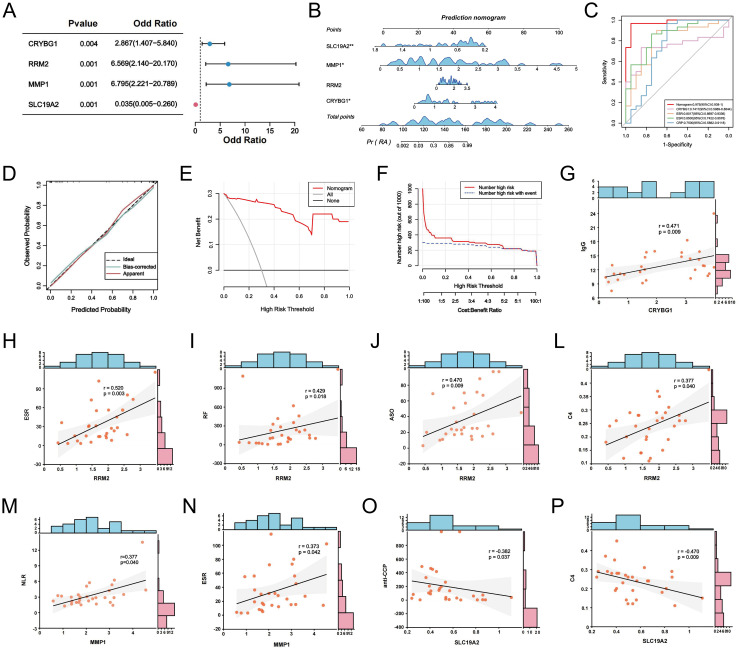
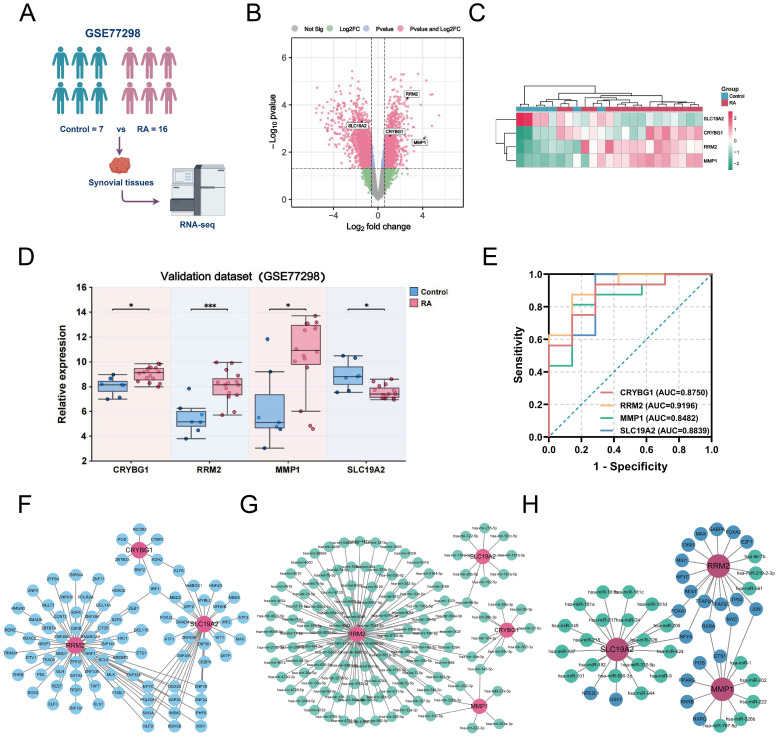
We obtained single-cell RNA sequencing data of synovial tissues from the Gene Expression Omnibus (GEO) database and performed cellular annotation and intercellular communication analyses. Subsequently, three microarray datasets were collected for a training cohort and correlated with a bulk RNA-seq dataset associated with NETs. Differentially expressed genes were identified, and weighted gene correlation network analysis was used to characterize gene association. Using three machine learning techniques, we identified the most important hub genes to develop and evaluate a nomogram diagnostic model. CIBERSORT was used to elucidate the relationship between hub genes and immune cells. An external validation dataset was used to verify pivotal gene expression and to construct co-regulatory networks using the NetworkAnalyst platform. We further investigated hub gene expression using immunohistochemistry (IHC) in an adjuvant-induced arthritis rat model and real-time quantitative polymerase chain reaction (RT-qPCR) in a clinical cohort.
Seven cellular subpopulations were identified through downscaling and clustering, with neutrophils likely the most crucial cell clusters in RA. Intercellular communication analysis highlighted the network between neutrophils and fibroblasts. In this context, 4 key hub genes (CRYBG1, RMM2, MMP1, and SLC19A2) associated with NETs were identified. A nomogram model with a diagnostic value was developed and evaluated. Immune cell infiltration analysis indicated associations between the hub genes and the immune landscape in NETs and RA. IHC and RT-qPCR findings showed high expression of CRYBG1, RMM2, and MMP1 in synovial and neutrophilic cells, with lower expression of SLC19A2. Correlation analysis further emphasized close associations between hub genes and laboratory markers in patients with RA.
This study first elucidated neutrophil heterogeneity in the RA synovial microenvironment and mechanisms of communication with fibroblasts. CRYBG1, RMM2, MMP1, and SLC19A2 were identified and validated as potential NET-associated biomarkers, offering insights for diagnostic tools and immunotherapeutic strategies in RA.
类风湿关节炎(RA)是一种慢性自身免疫性疾病,其特征为滑膜炎症和进行性关节破坏。中性粒细胞胞外陷阱(NETs)是中性粒细胞死亡后形成的一种微网状结构,最近被认为与RA的发病机制和病理机制有关。然而,RA中NET形成所涉及的潜在分子机制和关键基因仍 largely 未知。
我们从基因表达综合数据库(GEO)中获取滑膜组织的单细胞RNA测序数据,并进行细胞注释和细胞间通讯分析。随后,收集了三个微阵列数据集用于训练队列,并与一个与NETs相关的批量RNA测序数据集进行关联。鉴定出差异表达基因,并使用加权基因共表达网络分析来表征基因关联。使用三种机器学习技术,我们鉴定出最重要的枢纽基因,以开发和评估一个列线图诊断模型。使用CIBERSORT来阐明枢纽基因与免疫细胞之间的关系。使用一个外部验证数据集来验证关键基因的表达,并使用NetworkAnalyst平台构建共调控网络。我们进一步在佐剂诱导的关节炎大鼠模型中使用免疫组织化学(IHC)以及在临床队列中使用实时定量聚合酶链反应(RT-qPCR)来研究枢纽基因的表达。
通过降维和聚类鉴定出七个细胞亚群,中性粒细胞可能是RA中最关键的细胞簇。细胞间通讯分析突出了中性粒细胞与成纤维细胞之间的网络。在此背景下,鉴定出了4个与NETs相关的关键枢纽基因(CRYBG1、RMM2、MMP1和SLC19A2)。开发并评估了一个具有诊断价值的列线图模型。免疫细胞浸润分析表明枢纽基因与NETs和RA中的免疫格局之间存在关联。IHC和RT-qPCR结果显示CRYBG1、RMM2和MMP1在滑膜细胞和中性粒细胞中高表达,而SLC19A2表达较低。相关性分析进一步强调了枢纽基因与RA患者实验室指标之间的密切关联。
本研究首次阐明了RA滑膜微环境中的中性粒细胞异质性以及与成纤维细胞的通讯机制。CRYBG1、RMM2、MMP1和SLC19A2被鉴定并验证为潜在的NET相关生物标志物,为RA的诊断工具和免疫治疗策略提供了见解。