
带锁定螺钉系统的三维打印纯钛接骨板治疗胫骨远端骨折的临床疗效
Clinical Efficacy of Three-Dimensional-Printed Pure Titanium Fracture Plates with Locking Screw Systems in Distal Tibia Fractures.
作者信息
Choi Ji Hye, Lee Jun Hyoung, Lee Seung Hyeop, Jang Woo Young
机构信息
Department of Orthopedic Surgery, Anam Hospital, Korea University College of Medicine, 73 Goryeodae-ro Seongbuk-gu, Seoul 02841, Republic of Korea.
Department of Orthopedic Surgery, Korea University College of Medicine, Seoul 02841, Republic of Korea.
出版信息
Medicina (Kaunas). 2025 Jan 15;61(1):137. doi: 10.3390/medicina61010137.
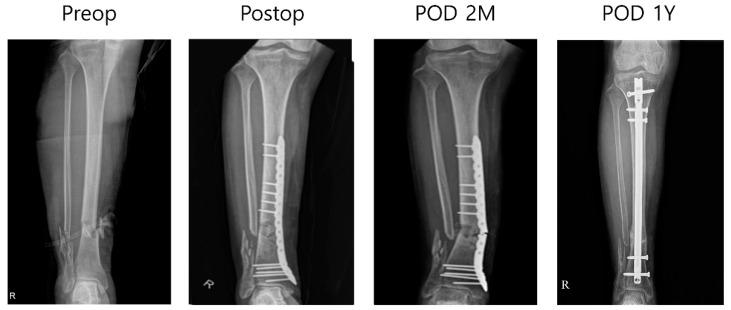
Distal tibia fractures are high-energy injuries characterized by a mismatch between standard plate designs and the patient's specific anatomical bone structure, which can lead to severe soft tissue damage. Recent advancements have focused on the development of customized metal plates using three-dimensional (3D) printing technology. However, 3D-printed metal plates using titanium alloys have not incorporated a locking system due to the brittleness of these alloys. Therefore, this study aimed to determine whether a locking mechanism can be effectively implemented using 3D-printed pure titanium and further evaluate the clinical outcomes of such implants in patients with distal tibia fractures. : Between March 2021 and June 2022, nine patients who underwent open reduction and internal fixation for distal tibia fractures using 3D-printed pure titanium plates were enrolled. Pure titanium powder (Ti Gr.2, Type A, 3D Systems, USA) was spread to a thickness of 30 μm and partially sintered using a 500 W laser to produce the 3D-printed metal plates. The locking screws were fabricated using a milling process. Open reduction and internal fixation were performed on the nine patients using 10 customized plates. The clinical efficacy was analyzed using the union rate, and complications, such as infection and skin irritation, were evaluated to ensure a comprehensive outcome assessment. Surgical treatment was successfully performed on nine patients, with nine of ten plates remaining stable and undamaged. However, one patient with neurofibromatosis experienced a fractured metal plate, which necessitated revision surgery using a metal rod. No screw loosening or surgical wound complications occurred. This study showed that 3D-printed pure titanium plates with integrated locking screw systems provide a viable and effective solution for managing distal tibia fractures. Three-dimensional printing and pure titanium show promise for orthopedic advancements.
胫骨远端骨折是高能损伤,其特点是标准钢板设计与患者特定的解剖骨骼结构不匹配,这可能导致严重的软组织损伤。最近的进展集中在使用三维(3D)打印技术开发定制金属板。然而,由于钛合金的脆性,使用钛合金的3D打印金属板尚未纳入锁定系统。因此,本研究旨在确定是否可以使用3D打印的纯钛有效地实现锁定机制,并进一步评估此类植入物在胫骨远端骨折患者中的临床结果。2021年3月至2022年6月,招募了9例使用3D打印纯钛板进行胫骨远端骨折切开复位内固定的患者。将纯钛粉末(Ti Gr.2,A型,3D Systems,美国)铺展至30μm的厚度,并使用500W激光进行部分烧结以生产3D打印金属板。锁定螺钉采用铣削工艺制造。使用10块定制板对9例患者进行了切开复位内固定。使用愈合率分析临床疗效,并评估感染和皮肤刺激等并发症,以确保进行全面的结果评估。9例患者手术治疗成功,10块板中有9块保持稳定且未受损。然而,1例患有神经纤维瘤病的患者金属板发生骨折,需要使用金属棒进行翻修手术。未发生螺钉松动或手术伤口并发症。本研究表明,具有集成锁定螺钉系统的3D打印纯钛板为治疗胫骨远端骨折提供了一种可行且有效的解决方案。三维打印和纯钛在骨科进展方面显示出前景。


 Zotero 插件