
斑马鱼肝脏肿瘤模型的新进展:技术及其在肝细胞癌研究中的应用
New Progress in Zebrafish Liver Tumor Models: Techniques and Applications in Hepatocellular Carcinoma Research.
作者信息
Lin Qizhuan, Jin Libo, Peng Renyi
机构信息
Institute of Life Sciences, Biomedicine Collaborative Innovation Center of Zhejiang Province, College of Life and Environmental Science, Wenzhou University, Wenzhou 325035, China.
出版信息
Int J Mol Sci. 2025 Jan 17;26(2):780. doi: 10.3390/ijms26020780.
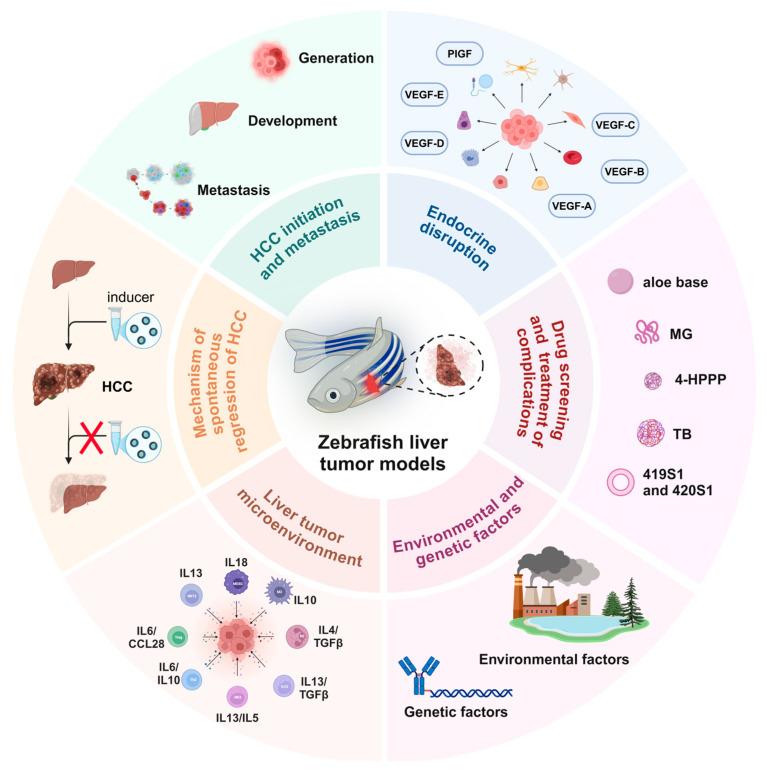
Liver tumors represent a serious clinical health problem that threatens human life. Previous studies have demonstrated that the pathogenesis of liver tumors is complex and influenced by various factors, highlighting limitations in both basic pathological research and clinical treatment. Traditional research methods often begin with the discovery of phenomena and gradually progress to the development of animal models and human trials. Among these, liver tumor animal models play a critical role in advancing related research. The zebrafish liver closely resembles the human liver in structure, function, and regenerative capacity. Additionally, the high transparency and rapid development of zebrafish embryos and larvae make them ideal model organisms for studying liver tumors. This review systematically summarizes recent methods for constructing zebrafish liver tumor models, including transplantation, transgenesis, induction, and gene knockout. Furthermore, the present paper explores the applications of these models in the study of liver cancer pathogenesis, metastasis, the tumor microenvironment, drug screening, and other related areas. By comparing the advantages and limitations of various models and integrating their distinct characteristics, this review provides insights for developing a novel liver tumor model that better aligns with clinical needs. This approach will offer valuable reference information for further in-depth studies of the pathological mechanisms of liver tumors and the development of new therapeutic drugs or strategies.
肝肿瘤是一个严重威胁人类生命的临床健康问题。以往研究表明,肝肿瘤的发病机制复杂,受多种因素影响,这凸显了基础病理研究和临床治疗的局限性。传统研究方法通常从现象发现开始,逐步发展到动物模型构建和人体试验。其中,肝肿瘤动物模型在推进相关研究中发挥着关键作用。斑马鱼肝脏在结构、功能和再生能力方面与人类肝脏极为相似。此外,斑马鱼胚胎和幼体的高透明度及快速发育使其成为研究肝肿瘤的理想模式生物。本综述系统总结了近期构建斑马鱼肝肿瘤模型的方法,包括移植、转基因、诱导和基因敲除。此外,本文还探讨了这些模型在肝癌发病机制、转移、肿瘤微环境、药物筛选及其他相关领域研究中的应用。通过比较各种模型的优缺点并整合其独特特性,本综述为开发更符合临床需求的新型肝肿瘤模型提供了见解。这种方法将为进一步深入研究肝肿瘤的病理机制以及开发新的治疗药物或策略提供有价值的参考信息。



 Zotero 插件