Dong Tianwei, Li Jinlian, Liang Xinfang, Wang Wang, Chen Meichi, Yang Guangyuan, Wu Dongmei
Key Laboratory of Microecology-Immune Regulatory Network and Related Diseases, School of Basic Medicine, Jiamusi University, Jiamusi, Heilongjiang, 154000, People's Republic of China.
College of Pharmacy, Jiamusi University, Jiamusi, Heilongjiang, 154007, People's Republic of China.
Drug Des Devel Ther. 2025 Jan 24;19:569-583. doi: 10.2147/DDDT.S497323. eCollection 2025.
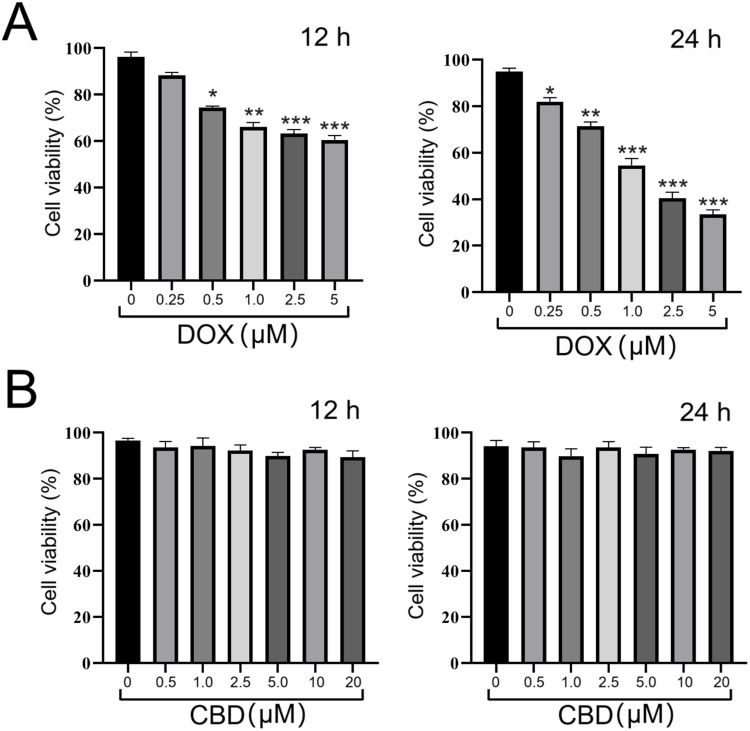
Doxorubicin (DOX) is a chemotherapeutic agent widely used for cancer treatment and has non-negligible cardiotoxicity. Some previous studies have reported that cannabidiol (CBD) has cardioprotective effects. In this study, we evaluated the protective effects of CBD against DOX-induced cardiomyocyte injury, and explored the downstream molecular mechanism.
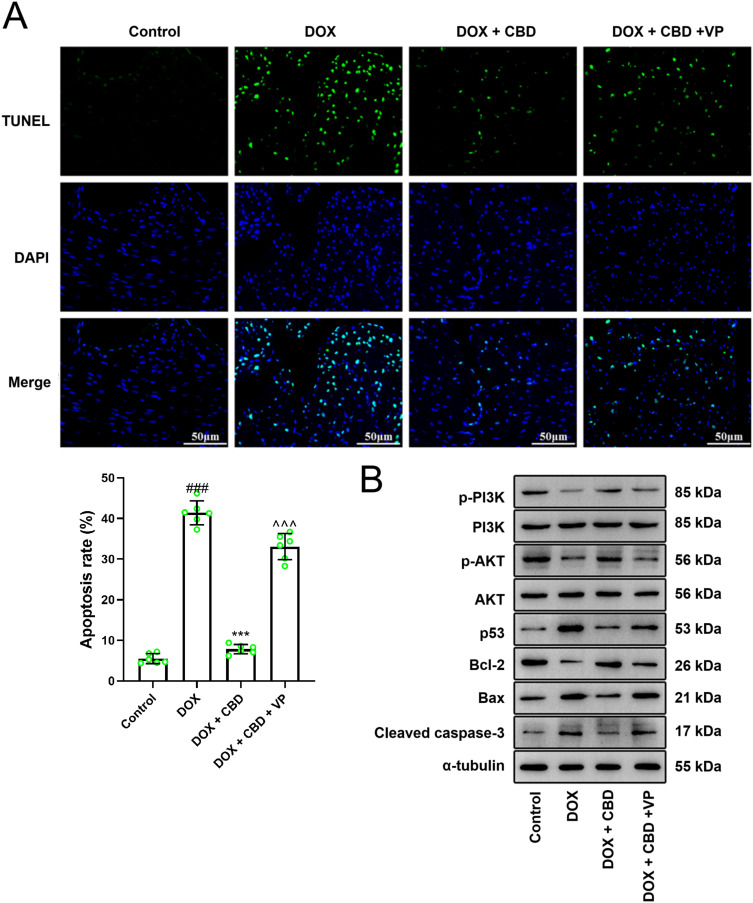
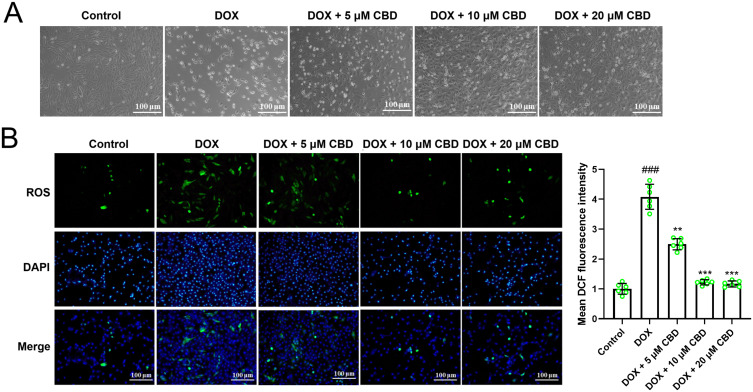
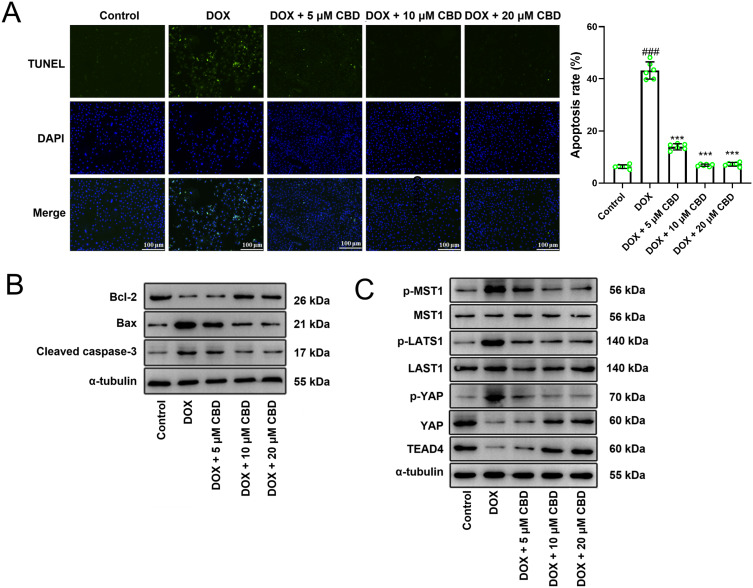
GSE193861, containing healthy myocardial tissues and myocardial tissues with DOX-induced injury, was analyzed to screen for the involved proteins and pathways. Molecular docking was performed to identify candidate drugs. After H9c2 cells were treated with DOX and CBD, their viability, oxidative stress, and apoptosis were assessed. After YAP depletion, the role of the Hippo pathway in CBD function was investigated. C57BL/6 mice were treated with DOX to establish an in vivo model, and CBD and verteporfin (VP) were used to treat the mice. Histological analyses and immunofluorescence were used to evaluate myocardial tissue injury, and apoptosis and oxidative stress of the myocardial tissues were also analyzed. Western blotting was used to investigate the regulatory effects of CBD on the Hippo and apoptosis-related pathways.
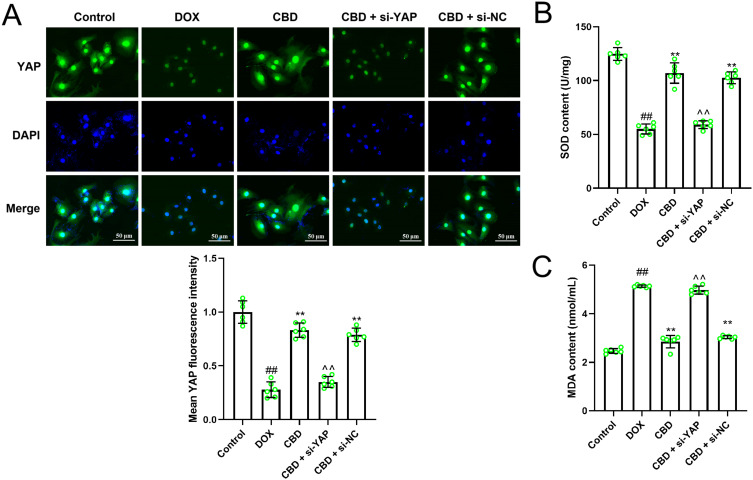
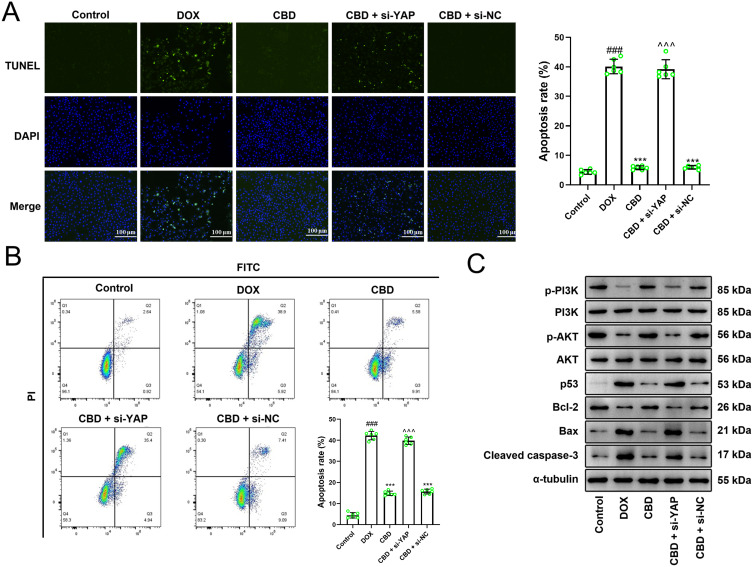
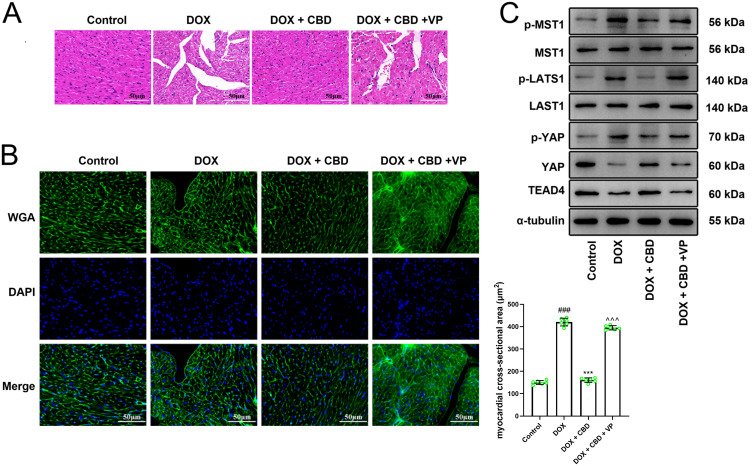
Bioinformatic analysis suggested that the Hippo pathway was a crucial pathway involved in DOX-induced myocardial injury. Molecular docking showed that CBD targeted multiple regulators of the Hippo pathway. CBD showed cardioprotective effects against DOX-induced myocardial injury both in vitro and in vivo and regulated Hippo pathway activity in cardiomyocytes. After inactivation of the Hippo pathway by YAP knockdown or VP intervention, the protective effects of CBD were reversed.
For the first time, we revealed that CBD is likely to reduce DOX-induced myocardial injury by regulating the Hippo signaling pathway.
阿霉素(DOX)是一种广泛用于癌症治疗的化疗药物,具有不可忽视的心脏毒性。先前的一些研究报道,大麻二酚(CBD)具有心脏保护作用。在本研究中,我们评估了CBD对DOX诱导的心肌细胞损伤的保护作用,并探讨了其下游分子机制。
分析包含健康心肌组织和DOX诱导损伤心肌组织的GSE193861数据集,以筛选相关蛋白质和信号通路。进行分子对接以鉴定候选药物。用DOX和CBD处理H9c2细胞后,评估其活力、氧化应激和凋亡情况。在敲低YAP后,研究Hippo信号通路在CBD功能中的作用。用DOX处理C57BL/6小鼠建立体内模型,并用CBD和维替泊芬(VP)治疗小鼠。采用组织学分析和免疫荧光评估心肌组织损伤,并分析心肌组织的凋亡和氧化应激情况。用蛋白质免疫印迹法研究CBD对Hippo和凋亡相关信号通路的调节作用。
生物信息学分析表明,Hippo信号通路是DOX诱导心肌损伤的关键信号通路。分子对接显示,CBD靶向Hippo信号通路的多个调节因子。CBD在体外和体内均对DOX诱导的心肌损伤具有心脏保护作用,并调节心肌细胞中的Hippo信号通路活性。通过敲低YAP或VP干预使Hippo信号通路失活后,CBD的保护作用被逆转。
我们首次揭示,CBD可能通过调节Hippo信号通路减轻DOX诱导的心肌损伤。