Assari Shervin, Zare Hossein
Department of Internal Medicine, Charles R. Drew University of Medicine and Science, Los Angeles, CA, United States.
Department of Family Medicine, Charles R. Drew University of Medicine and Science, Los Angeles, CA, United States.
Open J Neurosci. 2025;3(1). doi: 10.31586/ojn.2025.1247. Epub 2025 Jan 16.
Extreme heat exposure is an increasing public health concern, particularly in the context of climate change. Limited research has explored its impact on children's cognitive outcomes. This study investigates the association between extreme heat exposure and cognitive function in 9-10-year-old children, using data from the Adolescent Brain Cognitive Development (ABCD) study. Additionally, we assess whether this effect is independent of socio-demographic factors such as race, family socioeconomic status (SES), and neighborhood SES.
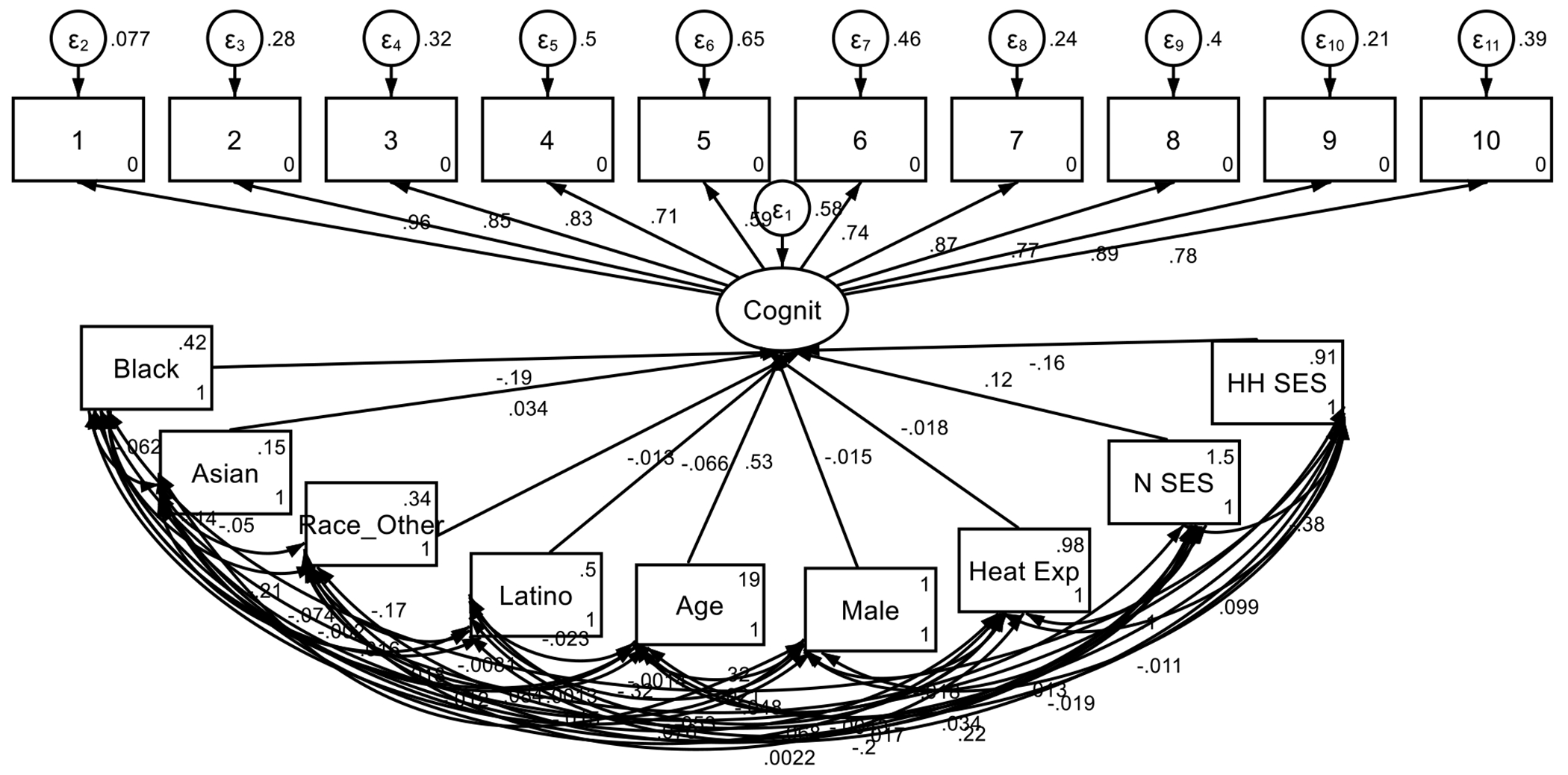
Data were drawn from the ABCD study, comprising over 10,000 children aged 9-10 years. Cognitive function was assessed through standardized cognitive tests, while extreme heat exposure was estimated using geographic and climate data. Structural equation modeling (SEM) was employed to examine the direct effects of heat exposure on cognitive outcomes and to account for potential confounding variables, including race, family SES, and neighborhood SES.
Black families, low SES households, and children from low SES neighborhoods were disproportionately exposed to extreme heat. Extreme heat exposure was significantly associated with lower cognitive function in children, and this association remained robust even after adjusting for socio-demographic factors.
Extreme heat exposure is linked to diminished cognitive function in children, particularly among socio-economically disadvantaged and marginalized populations. Given the increasing frequency of extreme heat events due to climate change, future research should further explore these implications for children's cognitive outcomes. Policy interventions that improve access to cooling infrastructure, expand green spaces, and prioritize at-risk populations are critical to mitigating the adverse cognitive effects of extreme heat in low SES communities.
暴露于极端高温环境正日益引起公众对健康的关注,尤其是在气候变化的背景下。仅有有限的研究探讨了其对儿童认知结果的影响。本研究利用青少年大脑认知发展(ABCD)研究的数据,调查了9至10岁儿童暴露于极端高温环境与认知功能之间的关联。此外,我们评估这种影响是否独立于种族、家庭社会经济地位(SES)和邻里SES等社会人口学因素。
数据取自ABCD研究,该研究包含10000多名9至10岁的儿童。认知功能通过标准化认知测试进行评估,而极端高温暴露则利用地理和气候数据进行估算。采用结构方程模型(SEM)来检验高温暴露对认知结果的直接影响,并考虑潜在的混杂变量,包括种族、家庭SES和邻里SES。
黑人家庭、低SES家庭以及来自低SES社区的儿童过度暴露于极端高温环境。极端高温暴露与儿童较低的认知功能显著相关,即使在调整社会人口学因素后,这种关联仍然很强。
极端高温暴露与儿童认知功能下降有关,尤其是在社会经济上处于不利地位和被边缘化的人群中。鉴于气候变化导致极端高温事件的频率不断增加,未来的研究应进一步探索其对儿童认知结果的这些影响。改善制冷基础设施的可及性、扩大绿地面积并优先考虑高危人群的政策干预措施对于减轻低SES社区极端高温对认知的不利影响至关重要。