
药物治疗对挪威多动症确诊儿童学业成绩的长期影响:一项目标试验模拟研究
Long-term effect of pharmacological treatment on academic achievement of Norwegian children diagnosed with ADHD: a target trial emulation.
作者信息
Varnet Pérez Tomás, Øvergaard Kristin Romvig, Frigessi Arnoldo, Biele Guido
机构信息
Department of Child Health and Development, Norwegian Institute of Public Health, Oslo, Norway.
Oslo Centre for Biostatistics and Epidemiology, University of Oslo, Oslo, Norway.
出版信息
Int J Epidemiol. 2025 Feb 16;54(2). doi: 10.1093/ije/dyaf010.
BACKGROUND
Attention-deficit/hyperactivity disorder (ADHD) is one of the most commonly diagnosed mental disorders in children. For many patients, treatment involves long-term medication in order to reduce symptoms, regulate behaviour, and, hopefully, improve school performance and achievement. However, there is little to no evidence to support a long-term effect on the latter complex outcomes.
METHODS
We utilize a target trial framework to emulate a pretest-posttest control group design and estimate the intention-to-treat effect of ADHD medication on national test scores in children diagnosed with ADHD born between 2000 and 2007 in Norway. The data were obtained through linkage of Norwegian registries (NorPD, Norwegian Prescription Database; NPR, Norwegian Patient Registry; KUHR, Database for Control and Payment of Health Reimbursement; SSB, Statistics Norway; MBRN, Medical Birth Registry of Norway).
RESULTS
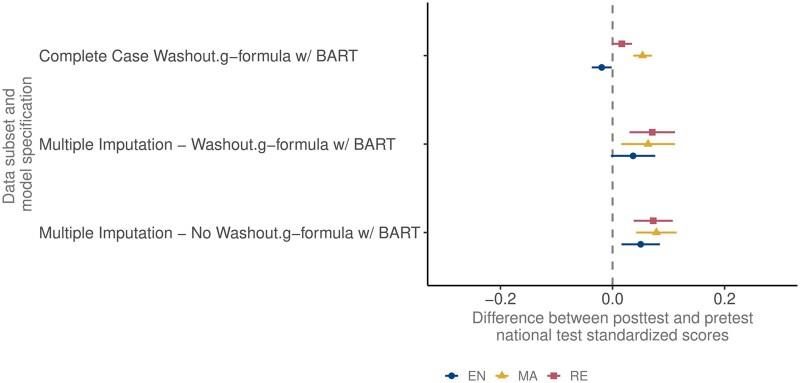
The resulting analytic sample size consisted of 8548 children diagnosed with ADHD, with about 9% missingness in their grade eight national test scores. We find that initiating ADHD medication had a slight positive average effect on national test scores for all three domains: English, numeracy, and reading [standardized mean differences: 0.037 (95% compatibility interval (CI95), -0.003; 0.076), 0.063 (CI95, 0.016; 0.111), 0.071 (CI95, 0.030; 0.111), respectively].
CONCLUSION
We conclude that the estimated long-term average effect of ADHD medication on learning, as measured by the Norwegian national tests, is not clinically relevant. Study strengths include the use of real-world data on ecologically valid and relevant outcomes and the robustness of results across model specifications. Limitations include possibility of unobserved confounding and lack of prescription data.
背景
注意力缺陷多动障碍(ADHD)是儿童中最常被诊断出的精神障碍之一。对于许多患者来说,治疗需要长期用药,以减轻症状、规范行为,并有望提高学业成绩。然而,几乎没有证据支持对后一种复杂结果有长期影响。
方法
我们利用目标试验框架来模拟前后测对照组设计,并估计ADHD药物对2000年至2007年在挪威出生的被诊断为ADHD的儿童全国测试成绩的意向性治疗效果。数据通过挪威登记处的链接获得(NorPD,挪威处方数据库;NPR,挪威患者登记处;KUHR,健康报销控制和支付数据库;SSB,挪威统计局;MBRN,挪威医学出生登记处)。
结果
最终的分析样本量包括8548名被诊断为ADHD的儿童,其八年级全国测试成绩约有9%缺失。我们发现,开始使用ADHD药物对所有三个领域的全国测试成绩都有轻微的积极平均效果:英语、算术和阅读[标准化平均差异分别为:0.037(95%相容区间(CI95),-0.003;0.076),0.063(CI95,0.016;0.111),0.071(CI95,0.030;0.111)]。
结论
我们得出结论,以挪威全国测试衡量,ADHD药物对学习的估计长期平均效果在临床上并不显著。研究优势包括使用关于生态有效和相关结果的真实世界数据以及跨模型规范结果的稳健性。局限性包括未观察到的混杂因素的可能性和缺乏处方数据。


 Zotero 插件