McCluskey Kate E, Stovell Katherine M, Law Karen, Kostyanovskaya Elina, Schmidt James D, Exner Cameron R T, Dea Jeanselle, Brimble Elise, State Matthew W, Willsey A Jeremy, Willsey Helen Rankin
Department of Psychiatry and Behavioral Sciences and the Weill Institute for Neurosciences, University of California San Francisco, San Francisco, CA, USA.
Citizen Health, San Francisco, CA, USA.
Nat Commun. 2025 Mar 6;16(1):2238. doi: 10.1038/s41467-025-57342-3.
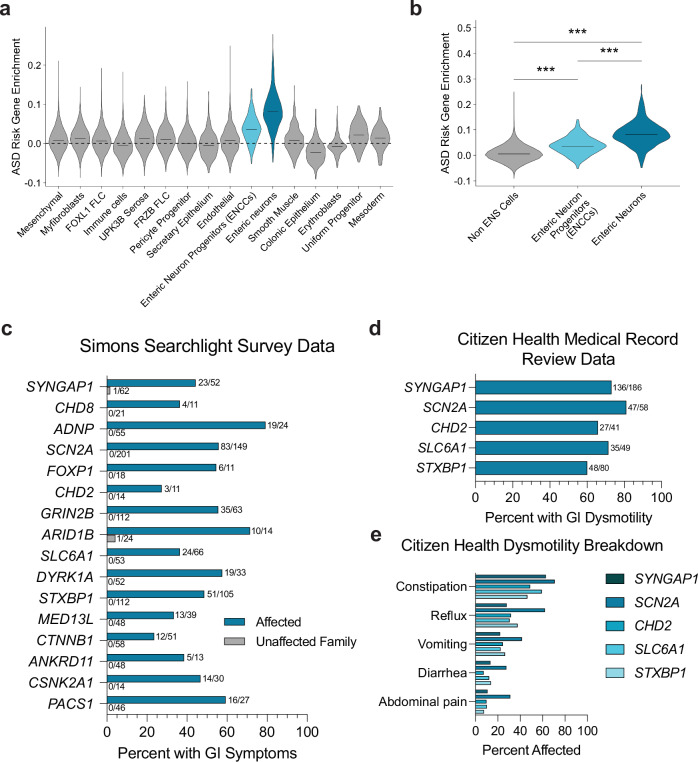
The co-occurrence of autism and gastrointestinal distress is well-established, yet the molecular underpinnings remain unknown. The identification of high-confidence, large-effect autism genes offers the opportunity to identify convergent, underlying biology by studying these genes in the context of the gastrointestinal system. Here we show that the expression of these genes is enriched in human prenatal gut neurons and their migratory progenitors, suggesting that the development and/or function of these neurons may be disrupted by autism-associated genetic variants, leading to gastrointestinal dysfunction. Here we document the prevalence of gastrointestinal issues in patients with large-effect variants in sixteen autism genes, highlighting dysmotility, consistent with potential enteric neuron dysfunction. Using Xenopus tropicalis, we individually target five of these genes (SYNGAP1, CHD8, SCN2A, CHD2, and DYRK1A) and observe disrupted enteric neuronal progenitor migration for each. Further analysis of DYRK1A reveals that perturbation causes gut dysmotility in vivo, which can be ameliorated by treatment with either of two serotonin signaling modulators, identified by in vivo drug screening. This work suggests that atypical development of enteric neurons contributes to the gastrointestinal distress commonly seen in individuals with autism and that serotonin signaling may be a productive therapeutic pathway.
自闭症与胃肠道不适同时出现的情况已得到充分证实,但其分子基础仍不清楚。确定高可信度、具有显著效应的自闭症基因,为通过在胃肠道系统背景下研究这些基因来识别趋同的潜在生物学机制提供了机会。我们在此表明,这些基因在人类产前肠道神经元及其迁移祖细胞中表达丰富,这表明这些神经元的发育和/或功能可能因自闭症相关基因变异而受到破坏,从而导致胃肠功能障碍。我们在此记录了16个自闭症基因中具有显著效应变异的患者胃肠道问题的患病率,突出了运动障碍,这与潜在的肠神经元功能障碍一致。利用热带爪蟾,我们分别针对其中5个基因(SYNGAP1、CHD8、SCN2A、CHD2和DYRK1A)进行研究,并观察到每个基因都存在肠神经元祖细胞迁移受阻的情况。对DYRK1A的进一步分析表明,干扰会在体内导致肠道运动障碍,而通过体内药物筛选确定的两种血清素信号调节剂中的任何一种进行治疗都可以改善这种情况。这项研究表明,肠神经元的非典型发育导致了自闭症患者常见的胃肠道不适,并且血清素信号传导可能是一条有效的治疗途径。