
使用患者来源的癌症类器官建立小鼠异种移植肿瘤模型在临床药物开发中的意义。
Significance of mouse xenograft tumor model using patient-derived cancer organoids for clinical drug development.
作者信息
Ogawa Hisataka, Yoshida Keiichi, Hasegawa Shinichiro, Wada Hiroshi, Yasui Masayoshi, Tahara Hideaki
机构信息
Nitto joint Research Department for Nucleic Acid Medicine, Research Center, Osaka International Cancer Institute, Osaka, Japan.
Next-generation Precision Medicine Research Center, Osaka International Cancer Institute, Osaka, Japan.
出版信息
Front Oncol. 2025 Feb 26;15:1485886. doi: 10.3389/fonc.2025.1485886. eCollection 2025.
BACKGROUND
and preclinical examinations of cancer cell lines are performed to determine the effectiveness of new drugs before initiating clinical trials. However, there is often a significant disparity between the promising results observed in preclinical evaluations and actual outcomes in clinical trials. Therefore, we hypothesized that this inconsistency might be due to the differences between the characteristics of cell lines and actual cancers in patients. Therefore, we screened drugs for bile duct cancer to test our hypotheses.
METHODS
We established patient-derived cancer organoids (PDCOs) from the surgical samples of patients with bile duct cancer and conducted multiple drug screening tests.
RESULTS
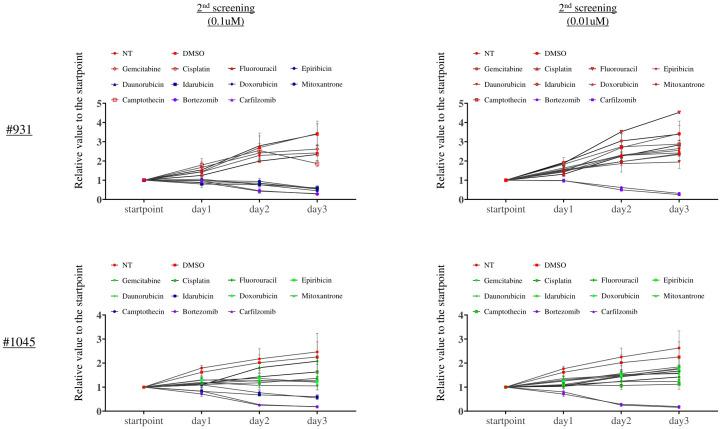
We identified proteasome inhibitors (Bortezomib and Carfilzomib) as promising drugs in the screening. Bortezomib has demonstrated a significant antitumor effect on bile duct cancer cell-derived xenografts, as previously reported in preclinical trials. However, although Bortezomib showed significant proliferation inhibition in PDCOs in three-dimensional culture , it did not exhibit significant anti-tumor effects in mouse xenograft tumor models using our PDCOs. Bile duct cancer cell-line-derived xenografts are characterized by structurally uniform, irregular glandular structures surrounded by simple and sparse stromal components. However, organoid-derived xenografts exhibit a spectrum of differentiation levels within irregular glandular structures and consist of a complex and rich stromal microenvironment similar to those observed in surgical specimens.
CONCLUSION
These findings suggest that studies using PDCO xenograft tumor models may be more suitable than conventional mouse tumor models for determining the clinical development of drugs.
背景
在启动临床试验之前,会对癌细胞系进行临床前检查,以确定新药的有效性。然而,临床前评估中观察到的有前景的结果与临床试验中的实际结果之间往往存在显著差异。因此,我们假设这种不一致可能是由于细胞系的特征与患者实际癌症之间的差异所致。因此,我们筛选了用于胆管癌的药物以检验我们的假设。
方法
我们从胆管癌患者的手术样本中建立了患者来源的癌症类器官(PDCO),并进行了多次药物筛选测试。
结果
我们在筛选中确定蛋白酶体抑制剂(硼替佐米和卡非佐米)为有前景的药物。如先前在临床前试验中所报道的,硼替佐米已对胆管癌细胞衍生的异种移植物显示出显著的抗肿瘤作用。然而,尽管硼替佐米在三维培养的PDCO中显示出显著的增殖抑制作用,但在使用我们的PDCO的小鼠异种移植肿瘤模型中并未表现出显著的抗肿瘤作用。胆管癌细胞系衍生的异种移植物的特征是结构均匀、不规则的腺结构被简单而稀疏的基质成分包围。然而,类器官衍生的异种移植物在不规则的腺结构内表现出一系列分化水平,并且由类似于手术标本中观察到的复杂而丰富的基质微环境组成。
结论
这些发现表明,使用PDCO异种移植肿瘤模型的研究可能比传统的小鼠肿瘤模型更适合确定药物的临床开发。



 Zotero 插件