
用于递送剪接转换寡核苷酸的新型可电离阳离子脂质纳米颗粒的制备与表征
Formulation and Characterization of Novel Ionizable and Cationic Lipid Nanoparticles for the Delivery of Splice-Switching Oligonucleotides.
作者信息
Ojansivu Miina, Barriga Hanna M G, Holme Margaret N, Morf Stefanie, Doutch James J, Andaloussi Samir El, Kjellman Tomas, Johnsson Markus, Barauskas Justas, Stevens Molly M
机构信息
Department of Medical Biochemistry and Biophysics, Karolinska Institute, Huddinge, Stockholm, 171 77, Sweden.
ISIS Neutron and Muon Source, Rutherford Appleton Laboratory, Harwell Campus, Oxfordshire, OX11 0QX, UK.
出版信息
Adv Mater. 2025 Apr;37(17):e2419538. doi: 10.1002/adma.202419538. Epub 2025 Mar 16.
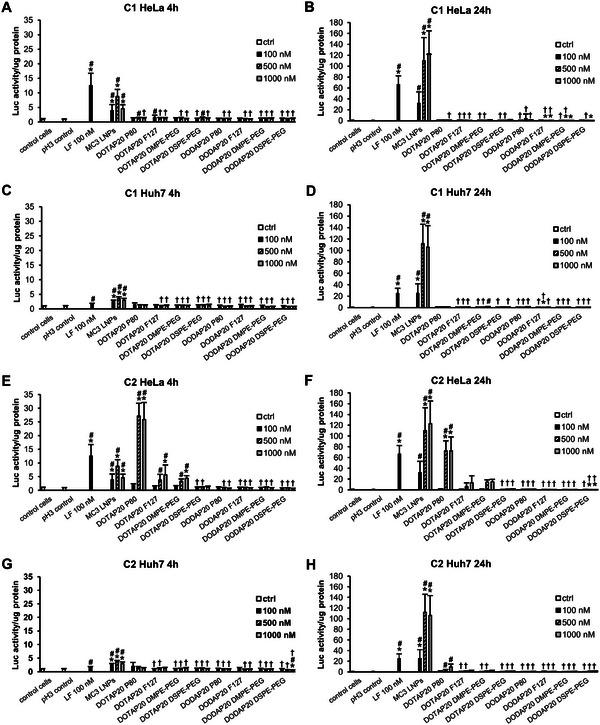
Despite increasing knowledge about the mechanistic aspects of lipid nanoparticles (LNPs) as oligonucleotide carriers, the structure-function relationship in LNPs has been generally overlooked. Understanding this correlation is critical in the rational design of LNPs. Here, a materials characterization approach is utilized, applying structural information from small-angle X-ray scattering experiments to design novel LNPs focusing on distinct lipid organizations with a minimal compositional variation. The lipid phase structures are characterized in these LNPs and their corresponding bulk lipid mixtures with small-angle scattering techniques, and the LNP-cell interactions in vitro with respect to cytotoxicity, hemolysis, cargo delivery, cell uptake, and lysosomal swelling. An LNP is identified that outperforms Onpattro lipid composition using lipid components and molar ratios which differ from the gold standard clinical LNPs. The base structure of these LNPs has an inverse micellar phase organization, whereas the LNPs with inverted hexagonal phases are not functional, suggesting that this phase formation may not be needed for LNP-mediated oligonucleotide delivery. The importance of stabilizer choice for the LNP function is demonstrated and super-resolution microscopy highlights the complexity of the delivery mechanisms, where lysosomal swelling for the majority of LNPs is observed. This study highlights the importance of advanced characterization for the rational design of LNPs to enable the study of structure-function relationships.
尽管人们对脂质纳米颗粒(LNPs)作为寡核苷酸载体的作用机制方面的认识不断增加,但LNPs的结构-功能关系却普遍被忽视。了解这种相关性对于合理设计LNPs至关重要。在此,采用了一种材料表征方法,将小角X射线散射实验的结构信息应用于设计新型LNPs,重点关注具有最小成分变化的不同脂质组织。利用小角散射技术对这些LNPs及其相应的本体脂质混合物中的脂质相结构进行了表征,并对LNPs与细胞在体外的相互作用进行了研究,包括细胞毒性、溶血、货物递送、细胞摄取和溶酶体肿胀。通过使用与临床金标准LNPs不同的脂质成分和摩尔比,鉴定出一种性能优于Onpattro脂质组成的LNP。这些LNPs的基本结构具有反胶束相组织,而具有反六角相的LNPs则没有功能,这表明这种相形成可能不是LNP介导的寡核苷酸递送所必需的。研究证明了稳定剂选择对LNP功能的重要性,超分辨率显微镜突出了递送机制的复杂性,其中观察到大多数LNPs存在溶酶体肿胀。这项研究强调了先进表征对于合理设计LNPs以研究结构-功能关系的重要性。


 Zotero 插件