
处理合并瓷化主动脉的头臂动脉动脉瘤
Approaching a Brachiocephalic Artery Aneurysm With Porcelain Aorta.
作者信息
Chaud German J, Gundelach Joaquín, Durand Marcos, Filippa Pablo A, Yañez Villa Jorge, Horta Jaime, González Carolina, Meriño Gustavo, Alvarado Cristóbal
机构信息
Department of Cardiovascular Surgery, Las Higueras Hospital, Talcahuano, Chile.
Faculty of Medicine, Universidad catolica de la Santisima Concepcion, Concepción, Chile.
出版信息
Ann Thorac Surg Short Rep. 2024 Sep 12;3(1):11-13. doi: 10.1016/j.atssr.2024.07.034. eCollection 2025 Mar.
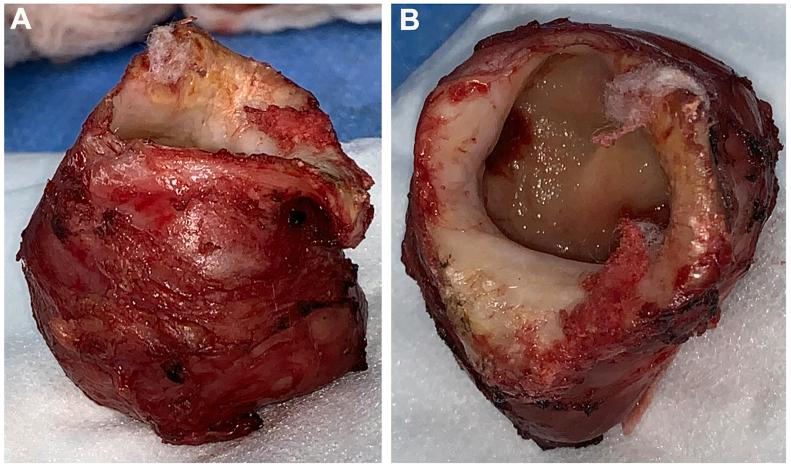
Brachiocephalic arterial trunk aneurysms, comprising 3% of supraaortic aneurysms, often manifest with local compression, thrombosis, or embolization. Surgical exclusion is preferred because of the risks of embolism and aneurysm rupture. We describe the case of a 51-year-old man with a pulsatile neck mass, a 48-mm brachiocephalic trunk aneurysm, and a porcelain aorta. Surgical steps included cannulation, aortic replacement, aortic root treatment, and coronary artery bypass. The patient recovered well postoperatively, and he was discharged on day 5 with no complications. Aortic arch aneurysms, primarily atherosclerotic aneurysms, pose challenges, especially in patients with a porcelain aorta, thus necessitating meticulous surgical planning for optimal outcomes and risk mitigation.
头臂干动脉瘤占主动脉弓上动脉瘤的3%,常表现为局部压迫、血栓形成或栓塞。由于存在栓塞和动脉瘤破裂风险,手术切除是首选治疗方法。我们报告一例51岁男性患者,有搏动性颈部肿块、48毫米头臂干动脉瘤及瓷化主动脉。手术步骤包括插管、主动脉置换、主动脉根部处理和冠状动脉搭桥。患者术后恢复良好,术后第5天出院,无并发症。主动脉弓动脉瘤,主要是动脉粥样硬化性动脉瘤,治疗颇具挑战,尤其是对于瓷化主动脉患者,因此需要精心的手术规划以实现最佳治疗效果并降低风险。

 Zotero 插件