
炎症性肠病患者非转移性直肠癌的治疗与生存情况:全国性队列研究
Treatment and survival of non-metastatic rectal cancer in patients with inflammatory bowel disease: nationwide cohort study.
作者信息
Lundqvist Erik, Westberg Karin, Dietrich Caroline E, Everhov Åsa H, Myrelid Pär, Glimelius Bengt, Martling Anna, Nordenvall Caroline
机构信息
Department of Surgery, Vrinnevi Hospital, Norrköping, Sweden.
Department of Biomedical and Clinical Sciences, Faculty of Health, Linköping University, Linköping, Sweden.
出版信息
BJS Open. 2025 Mar 4;9(2). doi: 10.1093/bjsopen/zraf014.
BACKGROUND
Patients with inflammatory bowel disease have an increased risk of colorectal cancer. There is a scarcity of large studies with a focus on rectal cancer in patients with inflammatory bowel disease. This study aimed to compare survival in resected patients with rectal cancer with and without inflammatory bowel disease.
METHODS
This national population-based study used the Colorectal Cancer Data Base. All Swedish patients ≥18 years of age with a diagnosis of stage I-III rectal cancer between 1997 and 2021, surgically treated with curative intent, were included and followed up until 2022. The outcome of interest was recurrence-free survival. Flexible parametric survival models adjusted for time since surgery, year of diagnosis, sex, age at diagnosis, and Charlson Co-morbidity Index were used to estimate proportional and time-dependent hazard ratios of recurrence-free survival with 95% confidence intervals.
RESULTS
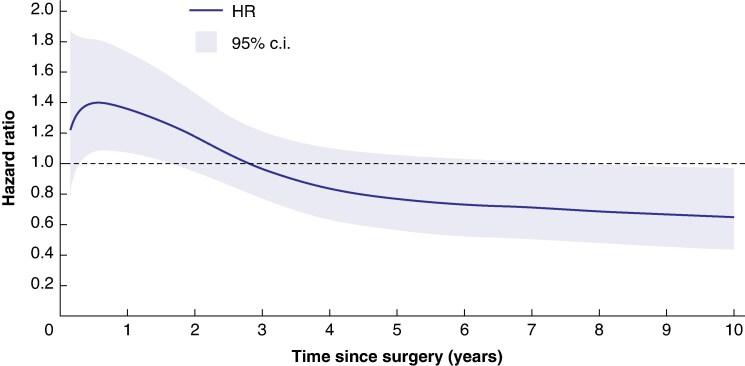
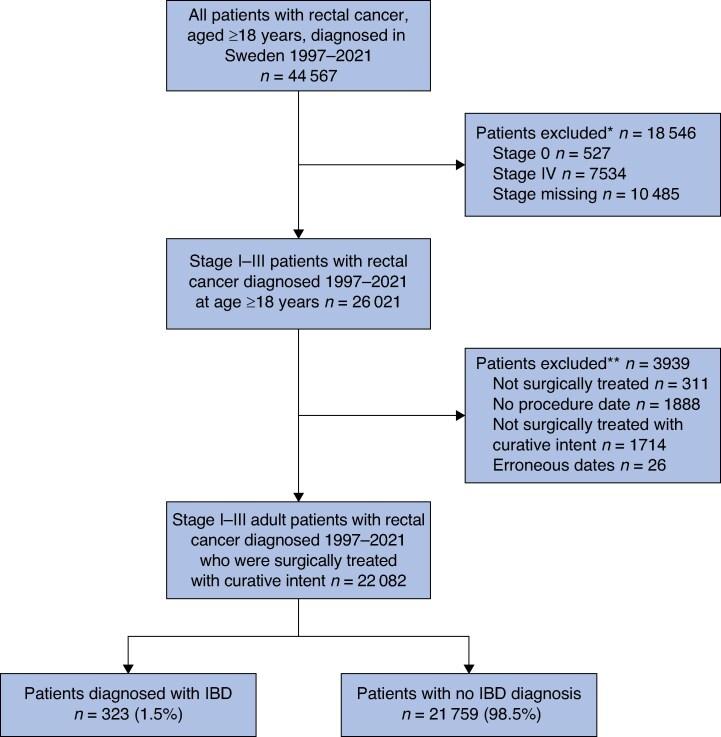
Overall, 22 082 patients with rectal cancer were included, among whom 323 (1.5%) had inflammatory bowel disease. Neoadjuvant radiotherapy/chemoradiotherapy was given to 55% and 63% of patients with and without inflammatory bowel disease respectively. The median follow-up time was 5.2 years (interquartile range (i.q.r.) 2.3-10) in patients with inflammatory bowel disease and 5.9 years (i.q.r. 2.9-10) in patients without inflammatory bowel disease. Based on the adjusted proportional hazards model, no overall difference in recurrence-free survival was found (HR 1.05, 95% c.i. 0.87 to 1.26). In the time-dependent adjusted model, patients with rectal cancer with inflammatory bowel disease experienced a lower recurrence-free survival during the first year after surgery (1 year HR 1.36, 95% c.i. 1.06 to 1.73), after which there was no difference in comparison with patients without inflammatory bowel disease (5 years HR 0.77, 95% c.i. 0.56 to 1.06).
CONCLUSION
Despite lower recurrence-free survival during the first year among those with inflammatory bowel disease, there were no long-term differences between patients with or without inflammatory bowel disease.
背景
炎症性肠病患者患结直肠癌的风险增加。针对炎症性肠病患者直肠癌的大型研究较少。本研究旨在比较患有和未患有炎症性肠病的直肠癌切除患者的生存率。
方法
这项基于全国人群的研究使用了结直肠癌数据库。纳入了所有1997年至2021年间年龄≥18岁、诊断为I-III期直肠癌且接受了根治性手术治疗的瑞典患者,并随访至2022年。感兴趣的结局是无复发生存率。采用灵活的参数生存模型,对术后时间、诊断年份、性别、诊断时年龄和Charlson合并症指数进行调整,以估计无复发生存率的比例风险比和时间依赖性风险比,并给出95%置信区间。
结果
总体而言,共纳入22082例直肠癌患者,其中323例(1.5%)患有炎症性肠病。患有和未患有炎症性肠病的患者分别有55%和63%接受了新辅助放疗/放化疗。炎症性肠病患者的中位随访时间为5.2年(四分位间距(i.q.r.)2.3 - 10年),未患炎症性肠病患者的中位随访时间为5.9年(i.q.r. 2.9 - 10年)。基于调整后的比例风险模型,未发现无复发生存率的总体差异(风险比1.05,95%置信区间0.87至1.26)。在时间依赖性调整模型中,患有炎症性肠病的直肠癌患者在术后第一年的无复发生存率较低(1年风险比1.36,95%置信区间1.06至1.73),之后与未患炎症性肠病的患者相比无差异(5年风险比0.77,95%置信区间0.56至1.06)。
结论
尽管炎症性肠病患者在第一年的无复发生存率较低,但患有和未患有炎症性肠病的患者之间没有长期差异。
 Zotero 插件