
头孢他啶-阿维巴坦治疗重症监护病房耐多药革兰阴性菌引起的下呼吸道感染
Treatment with Ceftazidime-Avibactam for Lower Respiratory Tract Infections Caused by the Multidrug-Resistant Gram-Negative Bacteria in the Intensive Care Unit.
作者信息
Pan Jingjing, Kong Haobo, Geng Zhi, Liang Min, Yu Shufeng, Fang Xuehui
机构信息
Department of Respiratory Intensive Care Unit, Anhui Chest Hospital, Hefei City, Anhui Province, People's Republic of China.
Department of Pulmonary and Critical Care Medicine, Anhui Chest Hospital, Hefei City, Anhui Province, People's Republic of China.
出版信息
Infect Drug Resist. 2025 Apr 5;18:1729-1742. doi: 10.2147/IDR.S513168. eCollection 2025.
PURPOSE
Ceftazidime avibactam (CAZ-AVI) is recommended for treating severe infections caused by multidrug-resistant gram-negative bacteria (MDR-GNB). However, there are few real-world studies on the use of CAZ-AVI to treat lower respiratory tract infections (LRTIs) caused by MDR-GNBs in intensive care units (ICUs). This study aimed to evaluate the clinical characteristics of patients with LRTIs caused by MDR-GNB who were treated with CAZ-AVI in the ICU, and to investigate the independent risk factors for mortality.
PATIENTS AND METHODS
This single-center retrospective study included patients with LRTIs treated with CAZ-AVI in the respiratory ICU of a tertiary hospital in Anhui Province between December 2022 and November 2024. The primary outcomes were 28-day survival and independent risk factors for all-cause mortality.
RESULTS
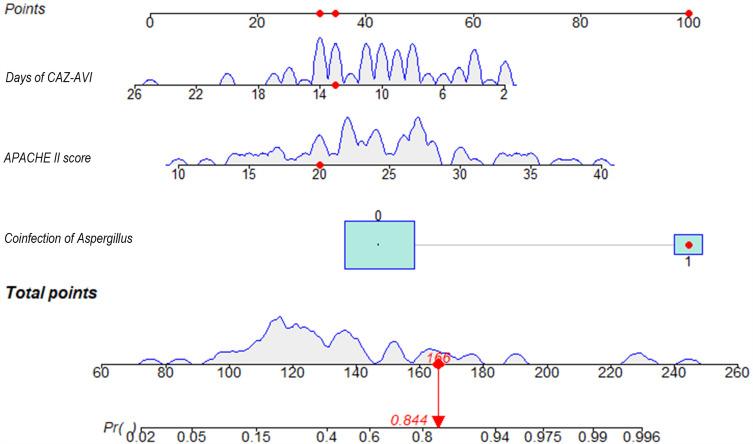
A total of 71 patients were enrolled in the study and 56.3% (40/71) had 28-day survival outcomes. The Acute Physiology and Chronic Health Evaluation (APACHE) II score (odds ratio [OR]: 1.144, 95% confidence interval [CI]: 1.012-1.293, p=0.032), coinfection with (OR: 42.753, 95% CI: 2.324-786.555, p=0.011), and days of CAZ-AVI (OR: 0.851, 95% CI: 0.734-0.986, p=0.032) were independent risk factors for 28-day all-cause mortality. Kaplan-Meier analysis demonstrated prolonged CAZ-AVI therapy (>10 days) improved survival (p<0.001), APACHE II scores >24 correlated with increased 28-day mortality (p=0.0048), and coinfection significantly reduced survival rates (p=0.001). We also constructed a nomogram for predicting the risk of death in ICU patients treated with CAZ-AVI for LRTIs, with good discrimination and calibration.
CONCLUSION
CAZ-AVI can be used to treat LRTIs caused by MDR-GNB in the ICU. Higher APACHE II scores and coinfection with Aspergillus were associated with 28-day mortality, whereas a longer course of therapy was a protective factor. The nomogram can help clinicians predict CAZ-AVI outcomes.
目的
头孢他啶阿维巴坦(CAZ-AVI)被推荐用于治疗由多重耐药革兰氏阴性菌(MDR-GNB)引起的严重感染。然而,关于在重症监护病房(ICU)使用CAZ-AVI治疗由MDR-GNB引起的下呼吸道感染(LRTI)的真实世界研究较少。本研究旨在评估在ICU接受CAZ-AVI治疗的由MDR-GNB引起的LRTI患者的临床特征,并调查死亡的独立危险因素。
患者与方法
本单中心回顾性研究纳入了2022年12月至2024年11月期间在安徽省一家三级医院呼吸ICU接受CAZ-AVI治疗的LRTI患者。主要结局为28天生存率和全因死亡的独立危险因素。
结果
共纳入71例患者,56.3%(40/71)有28天生存结局。急性生理与慢性健康状况评估(APACHE)Ⅱ评分(比值比[OR]:1.144,95%置信区间[CI]:1.012 - 1.293,p = 0.032)、合并感染(OR:42.753,95% CI:2.324 - 786.555,p = 0.011)以及CAZ-AVI使用天数(OR:0.851,95% CI:0.734 - 0.986,p = 0.032)是28天全因死亡的独立危险因素。Kaplan-Meier分析表明,延长CAZ-AVI治疗(>10天)可提高生存率(p<0.001),APACHEⅡ评分>24与28天死亡率增加相关(p = 0.0048),合并感染显著降低生存率(p = 0.001)。我们还构建了一个列线图,用于预测接受CAZ-AVI治疗LRTI的ICU患者的死亡风险,具有良好的区分度和校准度。
结论
CAZ-AVI可用于治疗ICU中由MDR-GNB引起的LRTI。较高的APACHEⅡ评分和合并曲霉菌感染与28天死亡率相关,而较长的疗程是一个保护因素。该列线图可帮助临床医生预测CAZ-AVI治疗结局。



 Zotero 插件