de Roij Martijn, Hernández García Jorge, Das Shubhajit, Borst Jan Willem, Weijers Dolf
Laboratory of Biochemistry, Wageningen University, Wageningen, the Netherlands.
Institute for Science and Technology Austria, Klosterneuburg, Austria.
Nat Plants. 2025 Apr;11(4):717-724. doi: 10.1038/s41477-025-01975-1. Epub 2025 Apr 11.
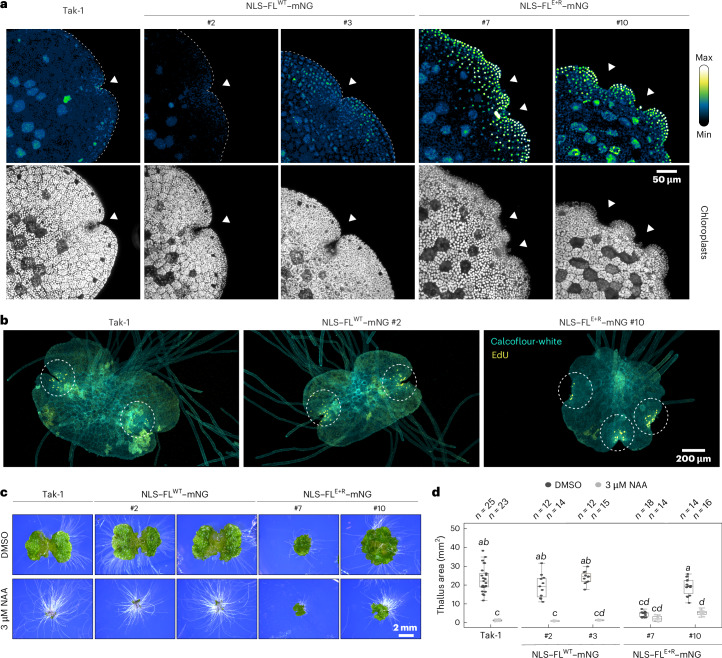
In land plants, the signalling molecule auxin profoundly controls growth and development, chiefly through a transcriptional response system. The auxin response is mediated by modulating the activity of DNA-binding auxin response factor (ARF) proteins. The concentrations and stoichiometry of the competing A- and B-class ARFs define cells' capacity for auxin response. In the minimal auxin response system of the liverwort Marchantia polymorpha, both A- and B-ARFs are unstable, but the underlying mechanisms, developmental relevance and evolutionary history of this instability are unknown. Here we identify a minimal motif that is necessary for MpARF2 (B-class) degradation and show that it is critical for development and the auxin response. Through comparative analysis and motif swaps among all ARF classes in extant algae and land plants, we infer that the emergence of ARF instability probably occurred in the ancestor of the A- and B-ARF clades and, therefore, preceded or coincided with the origin of the auxin response system.
在陆生植物中,信号分子生长素主要通过转录应答系统深刻地控制着生长和发育。生长素应答是通过调节DNA结合生长素应答因子(ARF)蛋白的活性来介导的。竞争性A类和B类ARF的浓度和化学计量决定了细胞对生长素应答的能力。在地钱多歧鹿角菜的最小生长素应答系统中,A类和B类ARF都是不稳定的,但这种不稳定性的潜在机制、发育相关性和进化历史尚不清楚。在这里,我们确定了一个对于MpARF2(B类)降解必不可少的最小基序,并表明它对于发育和生长素应答至关重要。通过对现存藻类和陆生植物中所有ARF类别的比较分析和基序交换,我们推断ARF不稳定性的出现可能发生在A类和B类ARF进化枝的祖先中,因此,在生长素应答系统起源之前或与之同时发生。