
极端降水事件引发阿拉伯海高盐水持续变淡。
Sustained freshening of Arabian Sea High Salinity Water induced by extreme precipitation events.
作者信息
Thoppil Prasad G
机构信息
Ocean Sciences Division, U.S. Naval Research Laboratory, Stennis Space Center, MS, 39529, USA.
出版信息
Nat Commun. 2025 Apr 17;16(1):3667. doi: 10.1038/s41467-025-58950-9.
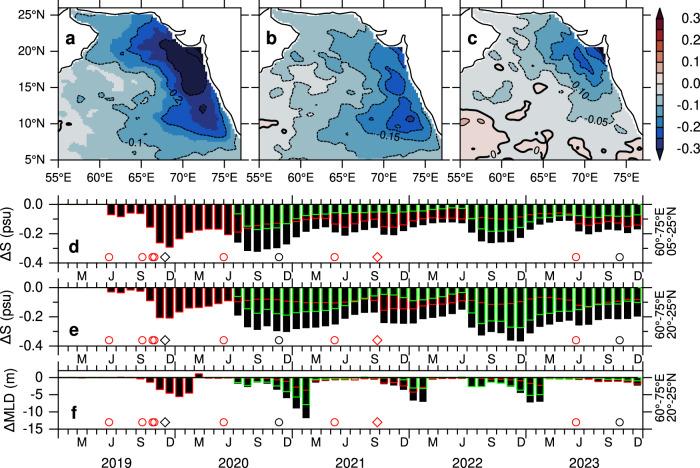
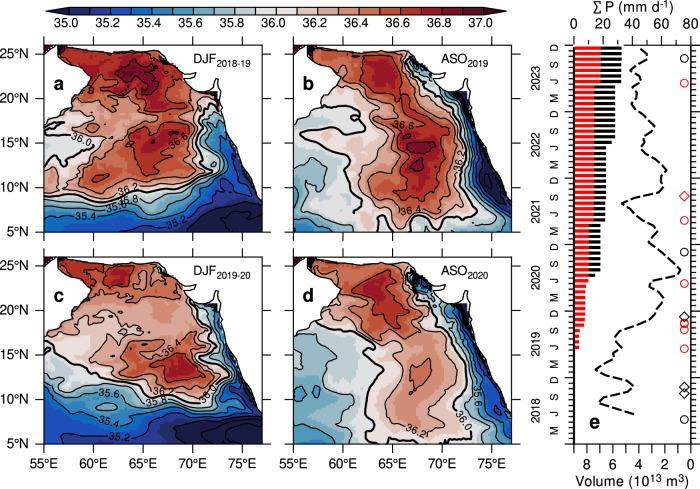
In the northern Arabian Sea, high salinity levels are primarily sustained by year-round evaporation, driving the convective formation of Arabian Sea High Salinity Water (ASHSW) during the winter monsoon (November-February). Although precipitation has largely been discounted as a critical controlling mechanism for winter convection, recent years have seen a notable increase in extreme cyclones over the Arabian Sea, particularly in post-monsoon cyclones (September-December) since 2014. However, the extent to which these cyclone-induced freshwater inputs disrupt the region's freshwater balance (evaporation - precipitation) and impact ASHSW formation remains unclear. Here, we present observational evidence supported by a suite of model simulation experiments, revealing a significant weakening in ASHSW formation triggered and sustained by extreme tropical cyclones. The addition of freshwater reduces the density of high-salinity water, augmenting stratification and disrupting the convective sinking process, ultimately limiting the depth of convective mixing. These findings underscore the profound implications of extreme cyclone-induced freshwater inputs.
在阿拉伯海北部,高盐度水平主要由全年的蒸发作用维持,在冬季季风期间(11月至2月)推动了阿拉伯海高盐水(ASHSW)的对流形成。尽管降水在很大程度上被认为不是冬季对流的关键控制机制,但近年来阿拉伯海的极端气旋显著增加,特别是自2014年以来的季风后气旋(9月至12月)。然而,这些气旋引发的淡水输入在多大程度上扰乱了该地区的淡水平衡(蒸发 - 降水)并影响阿拉伯海高盐水的形成仍不清楚。在此,我们展示了一系列模型模拟实验支持的观测证据,揭示了极端热带气旋引发并维持的阿拉伯海高盐水形成显著减弱。淡水的加入降低了高盐水的密度,增强了分层并扰乱了对流下沉过程,最终限制了对流混合的深度。这些发现凸显了极端气旋引发的淡水输入的深远影响。




 Zotero 插件