
用于机器人对排放源进行环境监测的高斯过程混合模型。
Mixtures of Gaussian processes for robotic environmental monitoring of emission sources.
作者信息
Waarum Ivar-Kristian, van Hove Alouette, Krogstad Thomas Røbekk, Ellefsen Kai Olav, Blomberg Ann Elisabeth Albright
机构信息
Norwegian Geotechnical Institute, Oslo, Norway.
Department of Informatics, University of Oslo, Oslo, Norway.
出版信息
Environ Monit Assess. 2025 May 6;197(6):626. doi: 10.1007/s10661-025-14059-6.
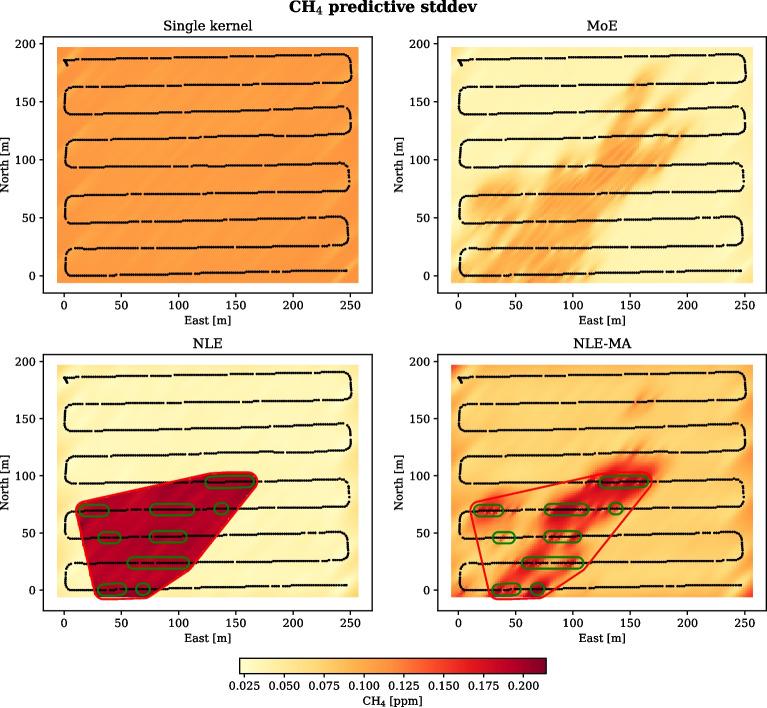
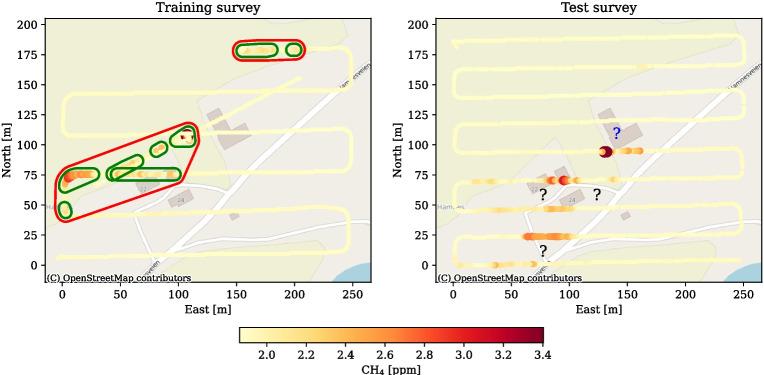
Emission of greenhouse gases such as methane and carbon dioxide is a known driver of atmospheric heating. Traditional and emerging industries need innovative solutions to comply with increasingly strict sustainability demands and document environmental impact. Mobile sensor platforms such as aerial or underwater vehicles with a high degree of autonomy present a cost-efficient option for environmental monitoring. Autonomous vehicles commonly use Gaussian processes (GPs) for online statistical modelling of concentrations of environmental features. Emission sources in the monitoring area introduce a complication, since the variance is likely heterogeneous between areas dominated by influx and areas with background concentrations. Mixtures of GPs have previously been demonstrated to be effective in such scenarios. Mixture methods distinguish between the natural background concentration and emission to improve model performance when predicting concentrations and variance at unsampled locations. The mixing of GP models allows for nonstationarity and anisotropy in the modelled spatial dynamics, which is desirable for emission modelling in environments with advective forces such as wind or water current. In this paper, we compare different approaches to spatial concentration modelling that accommodate heterogeneous dynamics, based on mixtures of GPs. Distinction of background and emission is either data-driven or derived from domain knowledge. The predictive performance of different mixture methods is demonstrated on field measurements near emissions and compared in an online path planning context. We identify and discuss important trade-offs between data-driven and knowledge-based clustering of measurements. Results show that mixture methods give realistic variance estimates, suitable for online planning.
甲烷和二氧化碳等温室气体的排放是已知的大气加热驱动因素。传统产业和新兴产业需要创新解决方案,以符合日益严格的可持续性要求并记录环境影响。高度自主的移动传感器平台,如空中或水下航行器,为环境监测提供了一种经济高效的选择。自主航行器通常使用高斯过程(GPs)对环境特征浓度进行在线统计建模。监测区域内的排放源带来了一个复杂问题,因为在由流入主导的区域和具有背景浓度的区域之间,方差可能是不均匀的。此前已证明高斯过程混合在这种情况下是有效的。混合方法在预测未采样位置的浓度和方差时,区分自然背景浓度和排放,以提高模型性能。高斯过程模型的混合允许在建模的空间动态中存在非平稳性和各向异性,这对于在有风或水流等平流力的环境中进行排放建模是可取的。在本文中,我们比较了基于高斯过程混合的、适应非均匀动态的不同空间浓度建模方法。背景和排放的区分要么是数据驱动的,要么是从领域知识中推导出来。不同混合方法的预测性能在排放源附近的现场测量中得到了验证,并在在线路径规划背景下进行了比较。我们识别并讨论了数据驱动和基于知识的测量聚类之间的重要权衡。结果表明,混合方法给出了现实的方差估计,适用于在线规划。


 Zotero 插件