
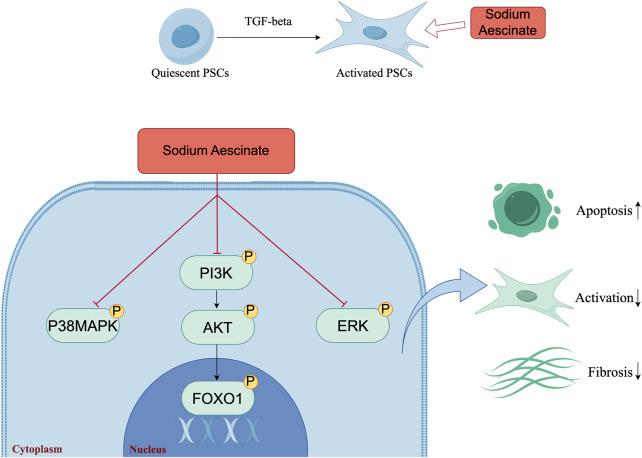
七叶皂苷钠通过抑制PI3K/Akt/FOXO1信号通路促进胰腺星状细胞凋亡并减轻胰腺纤维化。
Sodium aescinate promotes apoptosis of pancreatic stellate cells and alleviates pancreatic fibrosis by inhibiting the PI3K/Akt/FOXO1 signaling pathways.
作者信息
Wang Qing-Yun, Xu Bai-Yan, Wang Yi, Lin Yan-Mei, Zheng Lin-Fu, Liu Gang, Li Da-Zhou, Jiang Chuan-Shen, Wang Wen, Zeng Xiang-Peng
机构信息
Department of Digestive Diseases, Dongfang Hospital of Xiamen University, School of Medicine, Xiamen University, Fuzhou, China.
Department of Digestive Diseases, 900th Hospital of PLA Joint Logistic Support Force, Fuzhou, China.
出版信息
Front Pharmacol. 2025 Apr 22;16:1554260. doi: 10.3389/fphar.2025.1554260. eCollection 2025.
Chronic pancreatitis (CP) is an inflammatory disease of progressive pancreatic fibrosis, and pancreatic stellate cells (PSCs) are key cells involved in pancreatic fibrosis. To date, there are no clinical therapies available to reverse inflammatory damage or pancreatic fibrosis associated with CP. Sodium Aescinate (SA) is a natural mixture of triterpene saponins extracted from the dried and ripe fruits of horse chestnut tree. It has been shown to have anti-inflammatory and anti-edematous effects. This study aims to explore the therapeutic potential of SA in CP and the molecular mechanism of its modulation. Through animal models and experiments, we found that SA significantly alleviated pancreatic inflammation and fibrosis in caerulein-induced CP mice model. In addition, SA inhibited the proliferation, migration and activation of PSCs as well as promoted apoptosis of PSCs through a series of experiments on cells including CCK-8 assay, Western blotting, immunofluorescence staining, wound-healing assay, Transwell migration assays, flow cytometric analysis, etc. Further RNA sequencing and validation assays revealed that inhibition of the PI3K/AKT/FOXO1 signaling pathway was involved in the SA mediated promotion of PSCs apoptosis, thus alleviating pancreatic fibrosis. In conclusion, this study revealed that SA may have promising potential as therapeutic agent for the treatment of CP, and the PI3K/AKT/FOXO1 pathway is a potential therapeutic target for pancreatic inflammation and fibrosis.
慢性胰腺炎(CP)是一种胰腺进行性纤维化的炎症性疾病,胰腺星状细胞(PSCs)是参与胰腺纤维化的关键细胞。迄今为止,尚无临床疗法可逆转与CP相关的炎症损伤或胰腺纤维化。七叶皂苷钠(SA)是从七叶树干燥成熟果实中提取的三萜皂苷天然混合物。已证明其具有抗炎和消肿作用。本研究旨在探讨SA在CP中的治疗潜力及其调节的分子机制。通过动物模型和实验,我们发现SA显著减轻了雨蛙肽诱导的CP小鼠模型中的胰腺炎症和纤维化。此外,通过包括CCK-8测定、蛋白质印迹、免疫荧光染色、伤口愈合测定、Transwell迁移测定、流式细胞术分析等一系列细胞实验,SA抑制了PSCs的增殖、迁移和激活,并促进了PSCs的凋亡。进一步的RNA测序和验证实验表明,抑制PI3K/AKT/FOXO1信号通路参与了SA介导的PSCs凋亡促进作用,从而减轻了胰腺纤维化。总之,本研究表明SA可能具有作为CP治疗药物的潜在前景,并且PI3K/AKT/FOXO1通路是胰腺炎症和纤维化的潜在治疗靶点。


 Zotero 插件