
基于邻域通信的多虚拟同步机并联系统分布式虚拟惯性控制策略
Distributed Virtual Inertia Control Strategy for Multi-Virtual Synchronous Machine Parallel System Based on Neighbor Communication.
作者信息
Cao Ge, Wu Hanbing, Liu Yao, Ren Qiang
机构信息
School of Electrical Engineering, Xi'an University of Technology, Xi'an 710054, China.
Electric Power Research Institute, State Grid Shaanxi Electric Power Co., Ltd., Xi'an 710100, China.
出版信息
Sensors (Basel). 2025 Apr 30;25(9):2855. doi: 10.3390/s25092855.
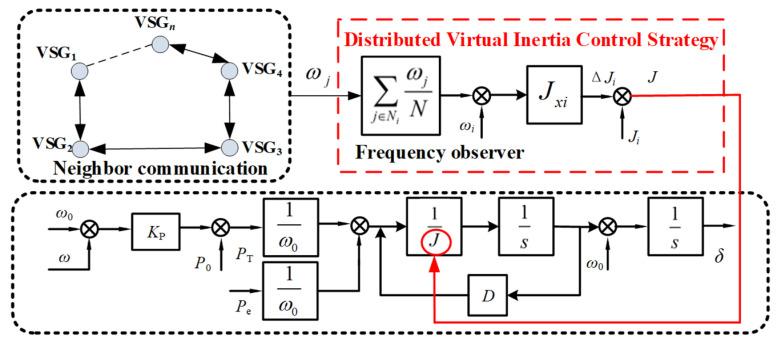
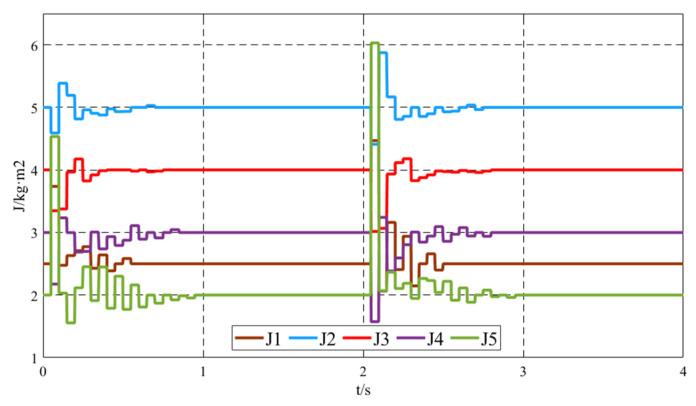
As a typical grid-forming control method, virtual synchronous generator (VSG) control enhances system inertia but introduces frequency oscillation issues. This problem becomes particularly severe in multi-VSG parallel systems when inconsistent virtual inertia exists among power sources, significantly compromising the security and stability of power system operation. Virtual inertia control can directly regulate the rate of change of frequency (RoCoF) under constant torque difference conditions to suppress frequency oscillations, offering faster response characteristics. Therefore, this paper proposes a distributed virtual inertia control strategy for multi-VSG parallel systems. First, a small-signal model of the multi-machine parallel system is established, and its small-signal stability is demonstrated. Second, a neighbor-communication-based distributed virtual inertia coordination control method is proposed. Through neighbor information exchange and local decision-making, this method enables dynamic adjustment of each unit's virtual inertia, driving frequency synchronization among all units in the system. This effectively suppresses post-disturbance frequency oscillations and enhances the dynamic performance of low-inertia power systems. Furthermore, the stability of the proposed control strategy is rigorously proven through the construction of a Lyapunov energy function. Finally, MATLAB/Simulink simulations verify that the proposed virtual inertia control strategy can effectively mitigate frequency oscillations while reducing their settling time.
作为一种典型的电网形成控制方法,虚拟同步发电机(VSG)控制增强了系统惯性,但引入了频率振荡问题。当电源之间存在不一致的虚拟惯性时,这个问题在多VSG并联系统中变得尤为严重,严重影响了电力系统运行的安全性和稳定性。虚拟惯性控制可以在恒定转矩差条件下直接调节频率变化率(RoCoF)以抑制频率振荡,具有更快的响应特性。因此,本文提出了一种用于多VSG并联系统的分布式虚拟惯性控制策略。首先,建立了多机并联系统的小信号模型,并论证了其小信号稳定性。其次,提出了一种基于邻域通信的分布式虚拟惯性协调控制方法。通过邻域信息交换和局部决策,该方法能够动态调整各单元的虚拟惯性,驱动系统中所有单元的频率同步。这有效地抑制了扰动后的频率振荡,提高了低惯性电力系统的动态性能。此外,通过构建李雅普诺夫能量函数严格证明了所提控制策略的稳定性。最后,MATLAB/Simulink仿真验证了所提虚拟惯性控制策略能够有效减轻频率振荡,同时缩短其稳定时间。




 Zotero 插件