
用于增强β-榄香烯递送和肿瘤治疗的巨噬细胞搭载纳米药物
Macrophage hitchhiking nanomedicine for enhanced β-elemene delivery and tumor therapy.
作者信息
Chen Shuying, Li Yongjiang, Zhou Zhuoming, Saiding Qimanguli, Zhang Yiming, An Soohwan, Khan Muhammad Muzamil, Ji Xiaoyuan, Qiao Ruirui, Tao Wei, Kong Na, Chen Wei, Xie Tian
机构信息
School of Pharmacy; Key Laboratory of Elemene Class Anti-Cancer Chinese Medicines; Engineering Laboratory of Development and Application of Chinese Medicines; and Collaborative Innovation Center of Chinese Medicines of Zhejiang Province, Hangzhou Normal University, Hangzhou, Zhejiang 311121, China.
Center for Nanomedicine and Department of Anesthesiology, Brigham and Women's Hospital, Harvard Medical School, Boston, MA 02115, USA.
出版信息
Sci Adv. 2025 May 23;11(21):eadw7191. doi: 10.1126/sciadv.adw7191. Epub 2025 May 21.
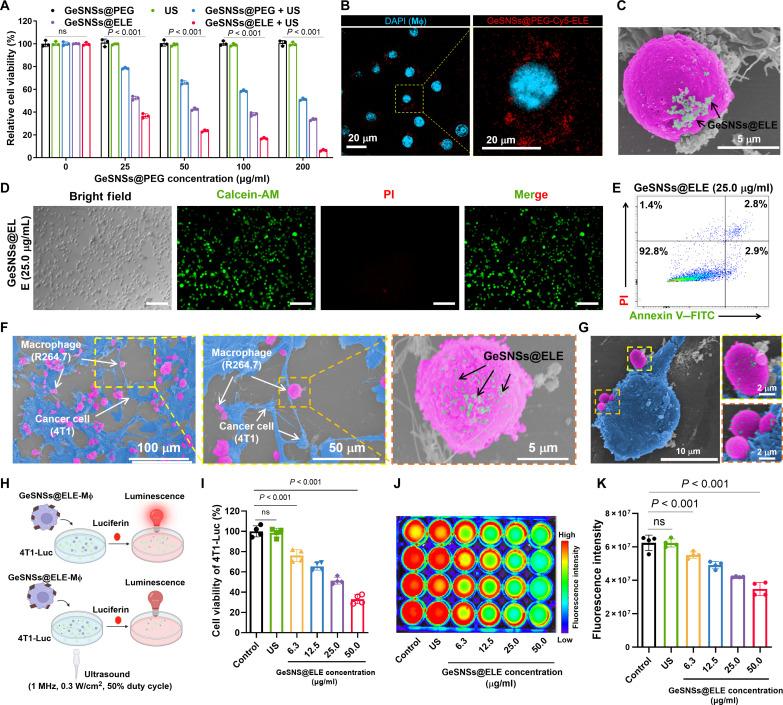
Nanoparticle-based drug delivery systems hold promise for tumor therapy; however, they frequently encounter challenges such as low delivery efficiency and suboptimal efficacy. Engineered living cells can redirect drug delivery systems to effectively reach targeted sites. Here, we used living macrophages as vehicles, attaching them with GeS nanosheets (GeSNSs) carrying β-elemene for transport to tumor sites. GeSNSs act as efficient sonosensitizers, enhancing ultrasound-induced reactive oxygen species generation for treating 4T1 breast tumors. Notably, macrophage hitchhiking delivery of β-elemene-loaded GeSNSs not only achieves high accumulation in tumor regions and suppresses tumor growth under ultrasound treatment, but also effectively remodels the immunosuppressive tumor microenvironment by improving M1-like macrophage polarization and enhancing the populations of mature dendritic cells, CD4, and CD8 lymphocytes, thereby facilitating enhanced sonodynamic chemoimmunotherapy. These findings underscore the potential of macrophage hitchhiking strategy for drug delivery and suggest broader applicability of engineered living materials-mediated delivery technologies in disease therapy.
基于纳米颗粒的药物递送系统在肿瘤治疗方面具有潜力;然而,它们经常遇到诸如递送效率低和疗效欠佳等挑战。工程化活细胞可以使药物递送系统重新定向,从而有效地到达靶向部位。在此,我们使用活巨噬细胞作为载体,将携带β-榄香烯的二硫化锗纳米片(GeSNSs)附着在巨噬细胞上,以运输至肿瘤部位。GeSNSs作为高效的声敏剂,可增强超声诱导的活性氧生成,用于治疗4T1乳腺肿瘤。值得注意的是,巨噬细胞搭载负载β-榄香烯的GeSNSs进行递送,不仅在超声治疗下能在肿瘤区域实现高蓄积并抑制肿瘤生长,还能通过改善M1样巨噬细胞极化以及增加成熟树突状细胞、CD4和CD8淋巴细胞的数量,有效地重塑免疫抑制性肿瘤微环境,从而促进增强的声动力化学免疫治疗。这些发现强调了巨噬细胞搭载策略在药物递送方面的潜力,并表明工程化生物材料介导的递送技术在疾病治疗中具有更广泛的适用性。




 Zotero 插件