Carll Jonathon, Bonaddio Jacinta, Lawrentschuk Nathan
Department of Surgery, University of Melbourne, Melbourne, VIC 3052, Australia.
Department of Urology, The Royal Melbourne Hospital, Melbourne, VIC 3052, Australia.
J Clin Med. 2025 May 20;14(10):3580. doi: 10.3390/jcm14103580.
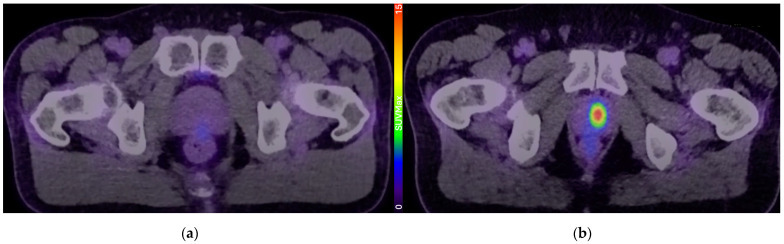
Active surveillance remains the preferred treatment for men with low-risk prostate cancer and select men with favourable intermediate-risk prostate cancer. It involves the close observation of clinicopathological parameters to assess for disease progression, aiming to delay or avoid definitive treatment and related toxicities for as long as possible, without compromising oncological outcomes. A recent advancement in prostate cancer staging is the PSMA PET scan, which uses a tracer that strongly binds a highly expressed cellular biomarker for prostate cancer. Recent articles have also demonstrated that PSMA PET may be a useful tool for risk-stratifying prostate cancer, with the SUVMax of the scan correlated with higher-grade prostate cancer. This has ignited interest in the potential use of PSMA PET to identify men with higher-risk prostate cancer who may be unsuitable for active surveillance, particularly those who were incorrectly classified as lower risk upon initial diagnosis. This review article aims to assess the current state of the literature and clinical guidelines regarding the use of PSMA PET as a tool to risk-stratify prostate cancer, and whether it can be incorporated into active surveillance protocols to identify men who were incorrectly risk-stratified at time of initial diagnosis.
主动监测仍然是低风险前列腺癌男性以及部分具有有利的中风险前列腺癌男性的首选治疗方法。它包括密切观察临床病理参数以评估疾病进展,旨在尽可能长时间地延迟或避免确定性治疗及其相关毒性,同时不影响肿瘤学结局。前列腺癌分期的一项最新进展是PSMA PET扫描,它使用一种能与前列腺癌高度表达的细胞生物标志物紧密结合的示踪剂。近期的文章还表明,PSMA PET可能是对前列腺癌进行风险分层的有用工具,扫描的SUVMax与更高分级的前列腺癌相关。这引发了人们对PSMA PET潜在用途的兴趣,即识别可能不适合主动监测的高风险前列腺癌男性,尤其是那些在初始诊断时被错误分类为低风险的患者。这篇综述文章旨在评估关于使用PSMA PET作为对前列腺癌进行风险分层工具的文献现状和临床指南,以及它是否可以纳入主动监测方案,以识别在初始诊断时被错误进行风险分层的男性。