Shi Kexin, Xu Jingxuan, Wang Hongji, Xue Xiaoliang, Xie Zihan, Han Yuzhu
College of Animal Science and Technology, Southwest University, Chongqing 402460, China.
Chongqing University Herbivore Engineering Research Center, Chongqing 402460, China.
Plants (Basel). 2025 May 15;14(10):1480. doi: 10.3390/plants14101480.
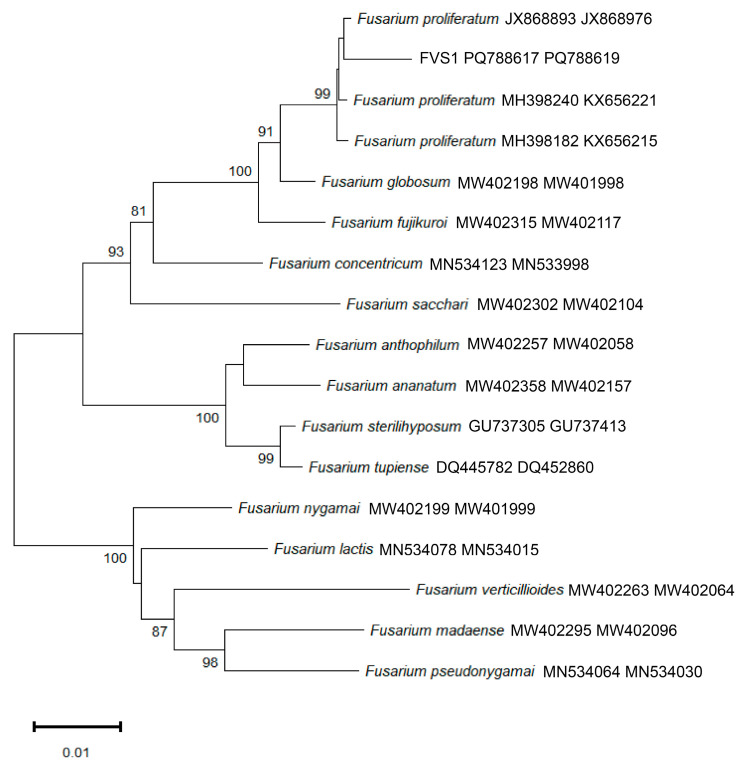
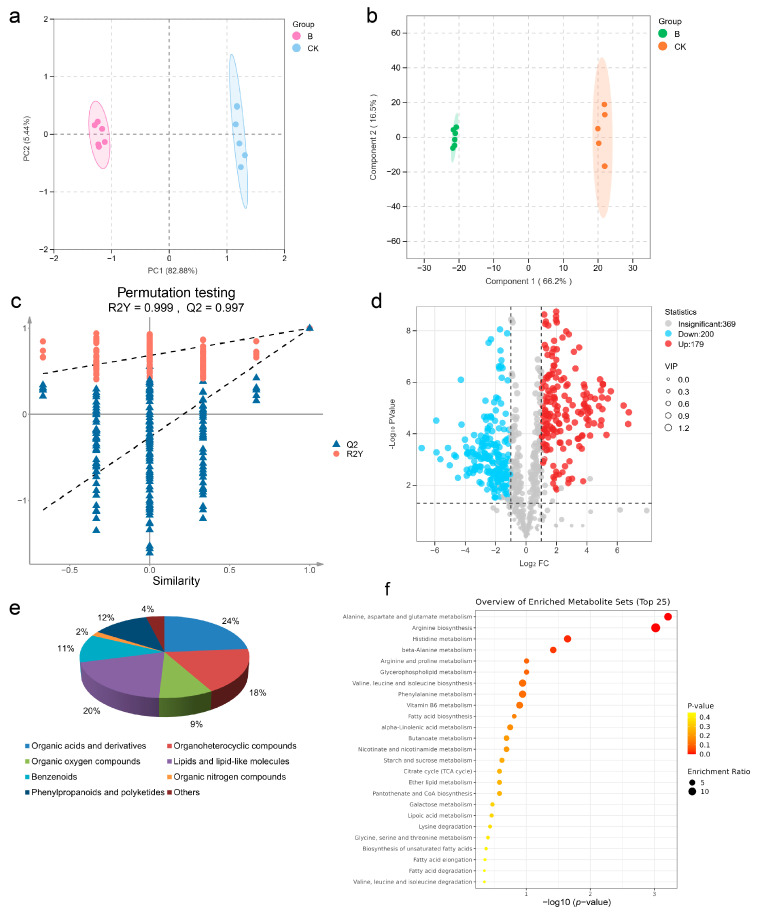
species are of great value in ecological restoration, soil improvement, and the development of a forage resource. In 2024, a novel pod disease affecting four-seeded vetches () emerged in Rongchang District, China, leading to severe yield loss. After obtaining the main pathogenic strain, FVS1, through the tissue isolation method, which was verified according to Koch's postulates, and by combining morphological characteristics with multigene phylogenetic analysis, FVS1 was identified as . The biological properties indicated that the most suitable culture medium of the fungus was oatmeal agar (OA), with the optimum growth temperature 25 °C and the lethal temperature being 35 °C. FVS1 exhibited insensitivity within a pH range of 7 to 9, as well as high adaptability to variations in light duration. To elucidate the physiological and biochemical changes in four-seeded vetches in response to FVS1 infection, non-targeted metabolomics analysis identified 379 differential metabolites, mainly comprising organic acids and derivatives, lipids and lipid-like molecules, and phenylpropanoids and polyketides. The results demonstrated that primarily induced the disease by influencing alterations in the secondary metabolites associated with amino acid metabolism, lipid metabolism, and flavonoid biosynthesis. Four-seeded vetches improved tolerance to the fungus by accumulating histidine, aspartic acid, arginosuccinate, ethanolamine, glycerophosphocholine, naringenin, and catechin. (M3) had the best control effectiveness, and the inhibition rate was 60.68%. This study, for the first time, revealed that caused a pod disease in four-seeded vetches. We analyzed the mechanism of plant-pathogen interaction and screened potential biocontrol strains, providing a theoretical basis for regional disease management.
物种在生态恢复、土壤改良和饲料资源开发中具有重要价值。2024年,中国荣昌区出现了一种影响四籽野豌豆的新型豆荚病害,导致严重减产。通过组织分离法获得主要病原菌FVS1,并根据柯赫氏法则进行验证,结合形态特征与多基因系统发育分析,将FVS1鉴定为[具体菌种名称未给出]。生物学特性表明,该真菌最适宜的培养基是燕麦片琼脂(OA),最适生长温度为25℃,致死温度为35℃。FVS1在pH值7至9范围内表现出不敏感性,对光照时长变化也具有较高适应性。为阐明四籽野豌豆对FVS1感染的生理生化变化,非靶向代谢组学分析鉴定出379种差异代谢物,主要包括有机酸及其衍生物、脂质和类脂分子以及苯丙烷类和聚酮类化合物。结果表明,[具体菌种名称未给出]主要通过影响与氨基酸代谢、脂质代谢和黄酮类生物合成相关的次生代谢物变化来引发病害。四籽野豌豆通过积累组氨酸、天冬氨酸、精氨琥珀酸、乙醇胺、甘油磷酸胆碱、柚皮素和儿茶素提高了对该真菌的耐受性。[具体药剂名称未给出](M3)具有最佳防治效果,抑制率为60.68%。本研究首次揭示了[具体菌种名称未给出]引起四籽野豌豆豆荚病害。我们分析了植物-病原菌相互作用机制并筛选出潜在的生防菌株,为区域病害管理提供了理论依据。