
来自副蕈状芽孢杆菌S48的铬还原酶的克隆与表达用于铬修复
Cloning and expression of chromate reductase from Bacillus paramycoides S48 for chromium remediation.
作者信息
Kalsoom Kalsoom, Din Salah Ud, Ceylan Esma, Hasan Fariha, Khan Samiullah, Badshah Malik, Çanakçi Sabriye, Belduz Ali Osman, Shah Aamer Ali
机构信息
Department of Microbiology, Faculty of Biological Sciences, Quaid-I-Azam University, Islamabad, 45320, Pakistan.
Department of Biology, Karadeniz Technical University, Trabzon, Turkey.
出版信息
Sci Rep. 2025 May 29;15(1):18796. doi: 10.1038/s41598-025-03412-x.
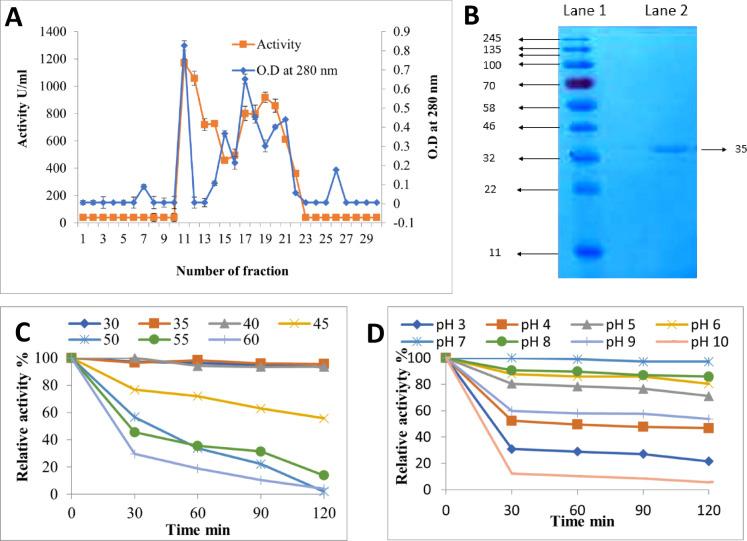
This study explores the production and characterization of chromium reductase from Bacillus paramycoides S48, focusing on its ability to effectively reduce toxic hexavalent chromium to less harmful chromium. The strain exhibited 65% reduction in Cr(VI) within 96 h at 30 °C. Clear morphological and functional group shifts on strain S48 cell surface treated with metal were noted using analytical tools i.e. SEM-EDX and FT-IR. The physico-chemical conditions such as temperature, pH and nutritional factors were optimized for better chromate reductase yield using Placket-Burman and Central Composite design software. The purified chromate reductase, obtained through size exclusion column chromatography, demonstrated a specific activity of 1416.5 U/mg, and 6.6-fold increase in purity, with a molecular mass of approximately 35 kDa. The enzyme exhibited stability at temperature 30-40 °C and pH 5.0-8.0. Furthermore, the purified chromium reductase achieved, 80% reduction of toxic Cr(VI) at temperature 35 °C after 96 h. The BparChR gene was successfully cloned into the pET-28a vector, expressed in E. coli BL21, and purified through Ni-Affinity ion exchange chromatography. The recombinant BparChR protein displayed a specific activity of 1680 U/mg, and a purification fold of 5.73 times. The BparChR exhibited a remarkable 90% reduction in chromium after 96 h, surpassing the efficacy of whole-cell and native chromium reductase. This study concludes that B. paramycoides S48, holds promise for the cost-effective and environmentally friendly detoxification of chromium in contaminated industrial effluents.
本研究探索了副蕈状芽孢杆菌S48中铬还原酶的产生及特性,重点关注其将有毒的六价铬有效还原为危害较小的铬的能力。该菌株在30℃下96小时内使Cr(VI)减少了65%。使用扫描电子显微镜-能谱仪(SEM-EDX)和傅里叶变换红外光谱仪(FT-IR)等分析工具,观察到用金属处理后的S48菌株细胞表面有明显的形态和官能团变化。利用Placket-Burman和中心复合设计软件优化了温度、pH值和营养因子等物理化学条件,以提高铬酸盐还原酶的产量。通过尺寸排阻柱色谱法获得的纯化铬酸盐还原酶,比活性为1416.5 U/mg,纯度提高了6.6倍,分子量约为35 kDa。该酶在30-40℃和pH 5.0-8.0条件下表现出稳定性。此外,纯化的铬还原酶在35℃下96小时后实现了对有毒Cr(VI) 80%的还原。BparChR基因成功克隆到pET-28a载体中,在大肠杆菌BL21中表达,并通过镍亲和离子交换色谱法纯化。重组BparChR蛋白的比活性为1680 U/mg,纯化倍数为5.73倍。BparChR在96小时后使铬减少了90%,效果显著,超过了全细胞和天然铬还原酶。本研究得出结论,副蕈状芽孢杆菌S48在污染工业废水中铬的经济高效且环境友好的解毒方面具有潜力。




 Zotero 插件