
基于过程的瑞典重症监护病房气候影响生命周期评估。
A process-based life cycle assessment of the climate impact of a Swedish intensive care unit.
作者信息
Hemberg Linn, Singh Jagdeep, Bentzer Peter
机构信息
Anaesthesia and Intensive Care, Department of Clinical Sciences Lund, Lund University, Lund, Sweden.
Lund University Agenda 2030 Graduate School, Lund University, Lund, Sweden.
出版信息
Sci Rep. 2025 Jun 3;15(1):19435. doi: 10.1038/s41598-025-02789-z.
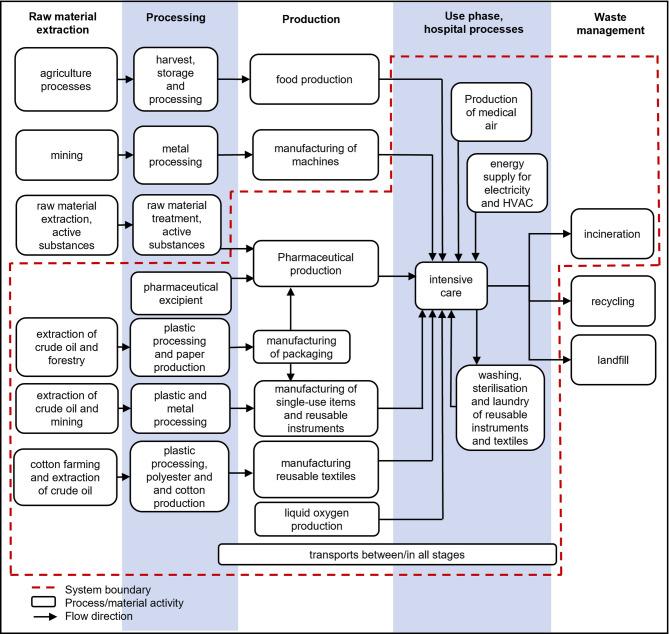
About 4.4% of the global emissions of greenhouse gases can be ascribed to healthcare. Intensive care is among the most resource intensive specialties and the purpose of this study was to quantify the total climate impact of a Swedish intensive care unit (ICU) and identify modifiable elements that can lower the intensive care unit's climate impact. A process-based life cycle assessment was conducted to estimate the climate impact per inpatient day in Sweden using the ReCiPe2016 impact assessment method. The analysis included single-use items; reusable instruments and textiles; pharmaceuticals and fluids; medical gases; and energy consumption for electronics equipment, lighting, and heating, ventilation, and air conditioning (HVAC). Input data were collected in 2022 at a mixed surgical and medical ICU in Sweden. Swedish low-climate-impact energy mix were used in the primary analysis. Results are reported as the global warming potential of carbon dioxide equivalents for 100 years (COeq). The median climate impact of one inpatient day was 30 kg COeq (95%-reference interval: [27-31]). Approximately 63% (19 kg COeq [18-20] could be attributed to single-use items, 19% (5.5 kg COeq [4.3-7.9]) was attributed to the unit's energy consumption, pharmaceuticals and fluids contributed 7% (1.9 kg COeq [1.7-2.2]), and 5% (1.5 kg COeq [1.2-1.9]) was attributed to medical gases. A sensitivity analysis, using a high-climate-impact energy mix increased the total climate impact to 126.5 kg COeq (103-154). In countries with low-climate-impact energy mixes, such as Sweden, the opportunity to reduce the climate impact of intensive case lies primarily in the reduced use of single-use items. For countries that depend on high-climate-impact energy mixes, the foremost opportunity to reduce the climate impact of intensive care is to transition to renewable energy.
全球约4.4%的温室气体排放可归因于医疗保健。重症监护是资源消耗最密集的专科之一,本研究的目的是量化瑞典一家重症监护病房(ICU)的总体气候影响,并确定可降低重症监护病房气候影响的可改变因素。采用基于过程的生命周期评估方法,使用ReCiPe2016影响评估方法估算瑞典每住院日的气候影响。分析包括一次性物品;可重复使用的器械和纺织品;药品和液体;医用气体;以及电子设备、照明、供暖、通风和空调(HVAC)的能源消耗。输入数据于2022年在瑞典一家外科和内科混合的ICU收集。初步分析使用了瑞典低气候影响的能源组合。结果报告为100年二氧化碳当量的全球变暖潜能值(COeq)。每住院日的气候影响中位数为30千克COeq(95%参考区间:[27-31])。约63%(19千克COeq [18-20])可归因于一次性物品,19%(5.5千克COeq [4.3-7.9])归因于该科室的能源消耗,药品和液体占7%(1.9千克COeq [1.7-2.2]),5%(1.5千克COeq [1.2-1.9])归因于医用气体。使用高气候影响能源组合的敏感性分析将总气候影响增加到126.5千克COeq(103-154)。在瑞典等具有低气候影响能源组合的国家,降低重症监护气候影响的机会主要在于减少一次性物品的使用。对于依赖高气候影响能源组合的国家,降低重症监护气候影响的首要机会是转向可再生能源。

 Zotero 插件