Ye Yaqin, Chang Yanting, Ma Yanjun, Deng Yayun, Zhang Wenbo, Chu Tiankui, Tian Hanchen, Yan Baokun, Zhao Pengda, Jiang Zehui, Hu Tao
International Center for Bamboo and Rattan, Beijing, China.
Key Laboratory of National Forestry and Grassland Administration/Beijing for Bamboo & Rattan Science and Technology, Beijing, China.
BMC Genomics. 2025 Jun 4;26(1):560. doi: 10.1186/s12864-025-11648-0.
Paphiopedilum orchids, particularly the Chinese endemic Paphiopedilum armeniacum, are prized for their commercial and ornamental value, with the latter serving as a vital breeding resource owing to its distinctive yellow petals. However, the molecular mechanisms underlying yellow petal formation remain unclear.
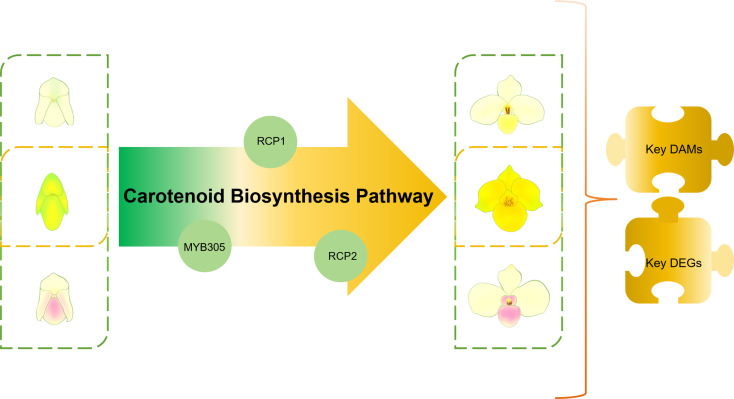
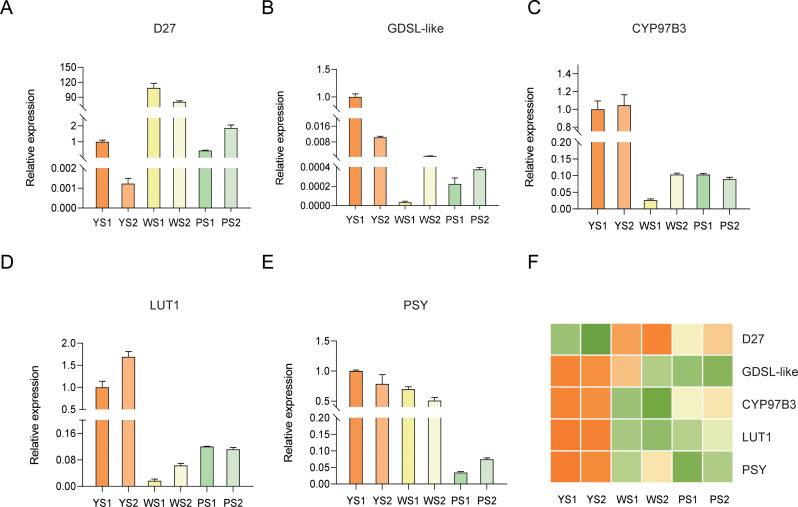
This work employed an integrated transcriptomic and metabolomic comparative analysis of P. armeniacum and two lighter-colored Paphiopedilum species (The sepals and petals are white.) to identify carotenoid-related differentially expressed genes and metabolites before and after blooming in all three species. Metabolomic analysis revealed a marked increase in six differential metabolites, including zeaxanthin, precorrin 2, and β-D-gentiobiosyl crocetin, in P. armeniacum, highlighting their critical role in yellow petal formation. Transcriptomic comparison identified 40 DEGs (including D27, GDSL-like, CYP97B3, LUT1, and PSY) linked to yellow pigmentation, most of which were consistently upregulated in P. armeniacum before and after blooming Integrative metabolomic and transcriptomic analyses demonstrated significant correlations between these genes and metabolites, suggesting their role in regulating carotenoid synthesis and accumulation in yellow petal formation. Furthermore, qRT-PCR elucidates the expression levels of candidate genes, identifying RPL13AD as the optimal reference gene across these three orchid species.
These works elucidate the expression patterns and regulatory roles of carotenoid-related genes in metabolic pathways during P. armeniacum blooming, providing new insights into the molecular mechanisms of carotenoid-mediated plant coloration.
兜兰属兰花,尤其是中国特有的杏黄兜兰,因其商业价值和观赏价值而备受珍视,后者因其独特的黄色花瓣而成为重要的育种资源。然而,黄色花瓣形成的分子机制仍不清楚。
本研究对杏黄兜兰和另外两种颜色较浅的兜兰属植物(萼片和花瓣为白色)进行了转录组和代谢组的综合比较分析,以鉴定这三种植物开花前后与类胡萝卜素相关的差异表达基因和代谢物。代谢组学分析显示,杏黄兜兰中有六种差异代谢物显著增加,包括玉米黄质、前咕啉2和β-D-龙胆二糖藏红花素,突出了它们在黄色花瓣形成中的关键作用。转录组比较确定了40个与黄色色素沉着相关的差异表达基因(包括D27、类GDSL、CYP97B3、LUT1和PSY),其中大多数在杏黄兜兰开花前后持续上调。综合代谢组学和转录组分析表明,这些基因与代谢物之间存在显著相关性,表明它们在调节黄色花瓣形成中类胡萝卜素的合成和积累方面发挥作用。此外,qRT-PCR阐明了候选基因的表达水平,确定RPL13AD为这三种兰花的最佳内参基因。
这些研究阐明了杏黄兜兰开花过程中类胡萝卜素相关基因在代谢途径中的表达模式和调控作用,为类胡萝卜素介导的植物着色分子机制提供了新的见解。