
桉叶精油在培养基和涂层材料中的抗菌活性。
Antibacterial Activity of Eucalyptus Essential Oils in Both Culture Media and Coated Materials.
作者信息
Muhizi Théoneste, Manizabayo Gervais, Uwamariya Colores, Nkuranga Jean Bosco, Umereweneza Daniel
机构信息
Department of Chemistry, School of Sciences-College of Science and Technology-University of Rwanda, Kigali, Rwanda.
出版信息
Int J Microbiol. 2025 May 26;2025:2756030. doi: 10.1155/ijm/2756030. eCollection 2025.
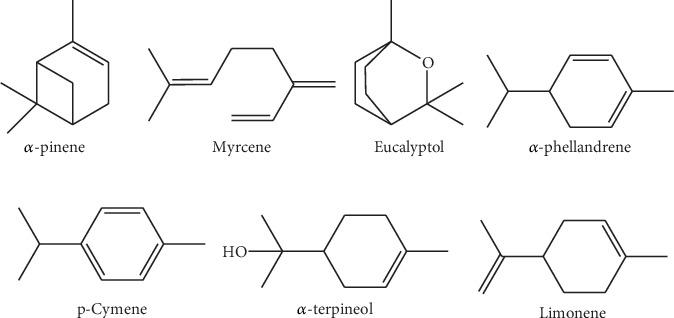
Different factors, including microbial resistance, have led to food contamination and increased human intoxication risks. Therefore, finding new adequate methods to fight against bacterial development is of interest. This study investigates the efficiency of eucalyptus essential oils to inhibit the growth of , , , , and Oils were extracted from eucalyptus leaves by hydrodistillation and chemically analyzed on a coupled gas chromatography-mass spectrometer. The antibacterial activity was assessed in both culture media and film models. Results indicated that eucalyptus oils were rich in different chemicals including -pinene in oils from (89.3%), (39.9%), and (29.6%); p-cymene in (40.1%) and (25.8%); and eucalyptol in (88.3%), (84.6%), (80.7%), (78%), (74.8%), and (70.4%) oils. Terpinen-4-ol was found in (5.7%) and (5.6%) while oils from contained -phellandrene (4.7%), cis- and trans-piperitols (6.5%), (cis)-p-(2 menthen)-1-ol (8.3%), geraniol (19.9%), and piperitone (10.5%). In comparison with a known antibiotic, azithromycin, essential oils from and exhibited significant antimicrobial efficacy against the growth of all tested microorganisms. The antibacterial efficiency from these oils was found to be higher than other essential oils tested ( < 0.05), with minimum inhibitory concentration and minimum bactericidal concentration ranging from 0.5 to 7 and 2.5 to 20 L/mL, respectively. Yet, at all concentrations tested (5-15 L/mL), hydroxy-propyl cellulose (HPC) films containing these oils indicated significant inhibition efficacy of the growth of bacteria compared to HPC films ( < 0.001). Further study on and oils is needed for their various valorization.
包括微生物耐药性在内的不同因素导致了食品污染,并增加了人类中毒风险。因此,寻找对抗细菌生长的新的适当方法备受关注。本研究调查了桉叶精油对 、 、 、 、 和 的生长抑制效率。通过水蒸馏法从桉树叶中提取精油,并使用气相色谱 - 质谱联用仪进行化学分析。在培养基和薄膜模型中评估抗菌活性。结果表明,桉叶精油富含不同的化学成分,包括 (89.3%)、 (39.9%)和 (29.6%)精油中的α - 蒎烯; (40.1%)和 (25.8%)中的对伞花烃;以及 (88.3%)、 (84.6%)、 (80.7%)、 (78%)、 (74.8%)和 (70.4%)精油中的桉叶油素。在 (5.7%)和 (5.6%)中发现了萜品 - 4 - 醇,而 精油含有α - 水芹烯(4.7%)、顺式和反式胡椒醇(6.5%)、(顺式) - p - (2 - 薄荷烯) - 1 - 醇(8.3%)、香叶醇(19.9%)和胡椒酮(10.5%)。与已知抗生素阿奇霉素相比, 和 的精油对所有测试微生物的生长均表现出显著的抗菌效果。发现这些精油的抗菌效率高于其他测试的精油( < 0.05),最低抑菌浓度和最低杀菌浓度分别为0.5至7和2.5至20 μL/mL。然而,在所有测试浓度(5 - 15 μL/mL)下,与羟丙基纤维素(HPC)薄膜相比,含有这些精油的HPC薄膜对细菌生长显示出显著的抑制效果( < 0.001)。需要对 和 的精油进行进一步研究以实现其多种价值利用。

 Zotero 插件