• 文献检索
  • 文档翻译
  • 深度研究
  • 学术资讯
  • Suppr Zotero 插件Zotero 插件
  • 邀请有礼
  • 套餐&价格
  • 历史记录
应用&插件
Suppr Zotero 插件Zotero 插件浏览器插件Mac 客户端Windows 客户端微信小程序
定价
高级版会员购买积分包购买API积分包
服务
文献检索文档翻译深度研究API 文档MCP 服务
关于我们
关于 Suppr公司介绍联系我们用户协议隐私条款
关注我们

Suppr 超能文献

核心技术专利:CN118964589B侵权必究
粤ICP备2023148730 号-1Suppr @ 2026

文献检索

告别复杂PubMed语法,用中文像聊天一样搜索,搜遍4000万医学文献。AI智能推荐,让科研检索更轻松。

立即免费搜索

文件翻译

保留排版,准确专业,支持PDF/Word/PPT等文件格式,支持 12+语言互译。

免费翻译文档

深度研究

AI帮你快速写综述,25分钟生成高质量综述,智能提取关键信息,辅助科研写作。

立即免费体验

新冠疫情下中国学生采用5G进行智能学习行为意向的实证研究

An empirical study of Chinese students' behavioral intentions to adopt 5G for smart-learning in Covid-19.

作者信息

Shah Sayed Kifayat, Tang Zhongjun, Sharif Sayed Muhammad Fawad, Tanveer Arifa

机构信息

Present Address: College of Economics and Management, Beijing University of Technology, Beijing, China.

Present Address: School of Management, Northwestern Polytechnical University, Xi'an, China.

出版信息

Smart Learn Environ. 2021;8(1):25. doi: 10.1186/s40561-021-00172-9. Epub 2021 Oct 29.

DOI:10.1186/s40561-021-00172-9
PMID:40477809
原文链接:https://pmc.ncbi.nlm.nih.gov/articles/PMC8554511/
Abstract

The social distancing due to the Covid-19 epidemic has disturbed all sectors of society, including education. To maintain normal operations, it is necessary to adapt quickly to this situation. Many technologies and platforms have rushed to offer their support to users. This article adopts a critical perspective to reflect on the factors that may cause the hasty adoption of 5G smart learning technology. To investigate students' intentions toward smart learning, this article provides a theoretical framework premised on the technology acceptance model (TAM) by adding components from the social practise theory (SPT). Based on data analysis through Structural equation Modeling (SEM) of a survey (n = 375) conducted in China, we found that the choice of 5G smart-learning technology depends on the combined effect of Material (MAA), Meanings (MEA), and Competency access (COA) factors. The results illustrate that these are the effective factors for student's intentions to adopt 5G smart-learning technology. These outcomes are intended to aid service providers and decision-makers in developing effective ways to increase smart learning use. These findings can also enable us to identify challenges affecting smart learning adoption and to contribute to the design and proper supply of smart learning programs in other countries.

摘要

由于新冠疫情实施的社交距离措施扰乱了包括教育在内的社会各个领域。为维持正常运转,迅速适应这种情况很有必要。许多技术和平台纷纷向用户提供支持。本文从批判性视角反思了可能导致仓促采用5G智能学习技术的因素。为调查学生对智能学习的意向,本文通过在技术接受模型(TAM)基础上加入社会实践理论(SPT)的组成部分,提供了一个理论框架。基于对在中国进行的一项调查(n = 375)的数据通过结构方程模型(SEM)进行分析,我们发现5G智能学习技术的选择取决于物质(MAA)、意义(MEA)和能力获取(COA)因素的综合作用。结果表明,这些是影响学生采用5G智能学习技术意向的有效因素。这些结果旨在帮助服务提供商和决策者制定有效的方法来增加智能学习的使用。这些发现还能使我们识别影响智能学习采用的挑战,并为其他国家智能学习项目的设计和合理供应做出贡献。
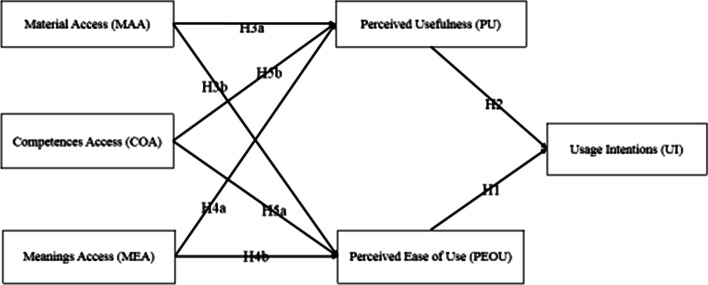
https://cdn.ncbi.nlm.nih.gov/pmc/blobs/8f08/8554511/2548b1b47330/40561_2021_172_Fig3_HTML.jpg
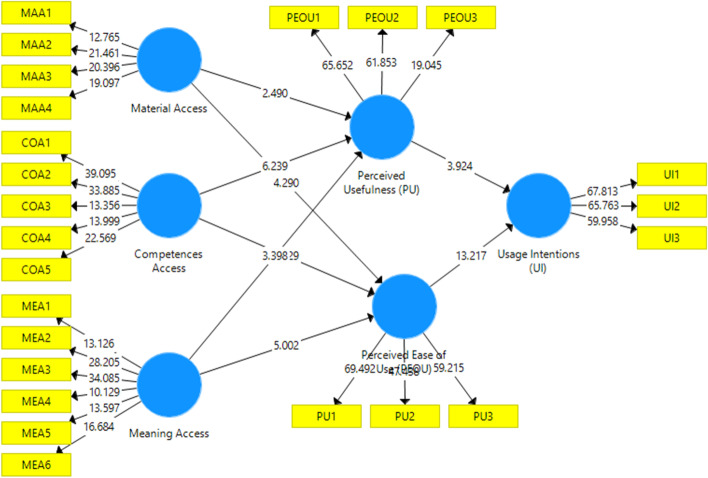
https://cdn.ncbi.nlm.nih.gov/pmc/blobs/8f08/8554511/79852ad7b938/40561_2021_172_Fig1_HTML.jpg
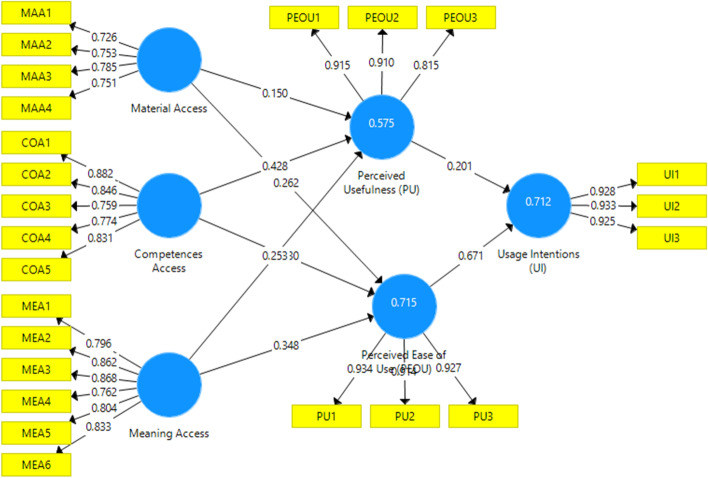
https://cdn.ncbi.nlm.nih.gov/pmc/blobs/8f08/8554511/971c281aeddd/40561_2021_172_Fig2_HTML.jpg
https://cdn.ncbi.nlm.nih.gov/pmc/blobs/8f08/8554511/2548b1b47330/40561_2021_172_Fig3_HTML.jpg
https://cdn.ncbi.nlm.nih.gov/pmc/blobs/8f08/8554511/79852ad7b938/40561_2021_172_Fig1_HTML.jpg
https://cdn.ncbi.nlm.nih.gov/pmc/blobs/8f08/8554511/971c281aeddd/40561_2021_172_Fig2_HTML.jpg
https://cdn.ncbi.nlm.nih.gov/pmc/blobs/8f08/8554511/2548b1b47330/40561_2021_172_Fig3_HTML.jpg

相似文献

1
An empirical study of Chinese students' behavioral intentions to adopt 5G for smart-learning in Covid-19.新冠疫情下中国学生采用5G进行智能学习行为意向的实证研究
Smart Learn Environ. 2021;8(1):25. doi: 10.1186/s40561-021-00172-9. Epub 2021 Oct 29.
2
Acceptance of Smart Technologies in Blended Learning: Perspectives of Chinese Medical Students.中国医学生对混合式学习中智能技术的接受度:观点
Int J Environ Res Public Health. 2023 Feb 3;20(3):2756. doi: 10.3390/ijerph20032756.
3
"Extending the Technology Acceptance Model (TAM) to Predict University Students' Intentions to Use Metaverse-Based Learning Platforms".扩展技术接受模型(TAM)以预测大学生使用基于元宇宙的学习平台的意愿
Educ Inf Technol (Dordr). 2023 Apr 28:1-33. doi: 10.1007/s10639-023-11816-3.
4
The integrated social cognitive theory with the TAM model: The impact of M-learning in King Saud University art education.整合社会认知理论与技术接受模型:移动学习在沙特国王大学艺术教育中的影响。
Front Psychol. 2022 Nov 24;13:1050532. doi: 10.3389/fpsyg.2022.1050532. eCollection 2022.
5
Factors affecting students' intentions to undertake online learning: an empirical study in Vietnam.影响学生进行在线学习意愿的因素:越南的一项实证研究。
Educ Inf Technol (Dordr). 2021;26(6):6629-6649. doi: 10.1007/s10639-021-10465-8. Epub 2021 Mar 4.
6
Behavioral intentions of university teachers and students toward the adoption of the hyb-blended learning method: Evidence from Bangladesh.孟加拉国高校师生采用混合式学习方法的行为意向:证据
Heliyon. 2024 Jul 12;10(14):e34520. doi: 10.1016/j.heliyon.2024.e34520. eCollection 2024 Jul 30.
7
Factors Determining Acceptance of Internet of Things in Medical Education: Mixed Methods Study.医学教育中决定物联网接受度的因素:混合方法研究
JMIR Hum Factors. 2025 Apr 10;12:e58377. doi: 10.2196/58377.
8
Exploring the acceptance for e-learning among higher education students in India: combining technology acceptance model with external variables.探索印度高等教育学生对电子学习的接受度:将技术接受模型与外部变量相结合。
J Comput High Educ. 2022;34(3):844-867. doi: 10.1007/s12528-022-09327-0. Epub 2022 May 31.
9
Impact of Immediacy of Feedback on Continuous Intentions to Use Online Learning From the Student Perspective.从学生视角看反馈即时性对持续使用在线学习意愿的影响
Front Psychol. 2022 Jun 30;13:865680. doi: 10.3389/fpsyg.2022.865680. eCollection 2022.
10
Research on the Factors Affecting the Adoption of Smart Aged-Care Products by the Aged in China: Extension Based on UTAUT Model.中国老年人智能养老产品采纳影响因素研究:基于UTAUT模型的拓展
Behav Sci (Basel). 2023 Mar 21;13(3):277. doi: 10.3390/bs13030277.

本文引用的文献

1
Effect of online learning for dental education in asia during the pandemic of COVID-19.2019年新冠疫情期间在线学习对亚洲牙科教育的影响。
J Dent Sci. 2021 Oct;16(4):1095-1101. doi: 10.1016/j.jds.2021.06.006. Epub 2021 Jun 29.
2
Learning Setting-Generalized Activity Models for Smart Spaces.学习智能空间的通用活动模型。
IEEE Intell Syst. 2010 Sep 9;2010(99):1. doi: 10.1109/MIS.2010.112.