
异位子宫内膜中雌激素信号逐渐减弱,同时纤维化增加。
Progressively diminished estrogen signaling concordant with increased fibrosis in ectopic endometrium.
作者信息
Nie Jichan, Yi Yunhua, Liu Xishi, Guo Sun-Wei
机构信息
Department of Gynecology, Shanghai Obstetrics and Gynecology Hospital, Fudan University, Shanghai, China.
Shanghai Key Laboratory of Female Reproductive Endocrine-Related Diseases, Fudan University, Shanghai, China.
出版信息
Hum Reprod Open. 2025 May 15;2025(3):hoaf028. doi: 10.1093/hropen/hoaf028. eCollection 2025.
STUDY QUESTION
Do all ectopic endometrial lesions (endometriosis and adenomyosis) universally have activated estrogen signaling?
SUMMARY ANSWER
Estrogen signaling diminishes concordantly with increased fibrosis in ectopic endometrium, with deep endometriotic (DE) lesions exhibiting an estrogen biosynthesis capability and estrogen receptor β (ERβ) expression level comparable to that of control endometrium but having suppressed ERα.
WHAT IS KNOWN ALREADY
Endometriosis and adenomyosis are both estrogen-dependent diseases driven by estrogen-mediated lesional development, progression, and symptom manifestation. Of note, ectopic endometrium is thought to have the ability to synthesize estradiol (E) from cholesterol due to upregulation of aromatase (CYP19A1), steroidogenic acute regulatory protein (StAR), 3β-hydroxysteroid dehydrogenase type 2 (HSD3β2), and HSD17β1. In addition to increased estrogen biosynthesis, ERβ and G-protein coupled ER (GPER) are also overexpressed in ectopic endometrium. In particular, the prevailing view holds that prostaglandin E2 plays a vital role in facilitating estrogen biosynthesis and the upregulation of ERβ, positioning itself in the central nexus in a feed-forward loop linking hyperestrogenism and inflammation in all ectopic endometria.
STUDY DESIGN SIZE DURATION
After obtaining written informed consent, we collected lesional tissues from 19 patients with ovarian endometriosis (OE) and 20 patients each with adenomyosis (AD) and DE. As controls, normal endometrial tissue samples (CT) were procured from 20 cycling women free of endometriosis and adenomyosis, and age- and menstrual phase-matched with patients in the other groups. Additionally, primary ectopic or control endometrial stromal cells derived from eight subjects in each of the OE, AD, DE, and CT groups were cultured for experiments.
PARTICIPANTS/MATERIALS SETTING METHODS: We performed immunohistochemistry and western blotting to assess the expression of proteins key to the estrogen biosynthesis (StAR, HSD3β2, aromatase, and HSD17β1) and estrogen receptors (ERα, ERβ, and GPER). Fibrosis was quantified via Masson trichrome staining. Real-time RT-PCR was performed to assess corresponding gene expression levels. The estrogen concentrations in cell cultures of primary stromal cells derived from different tissues were also measured by ELISA.
MAIN RESULTS AND THE ROLE OF CHANCE
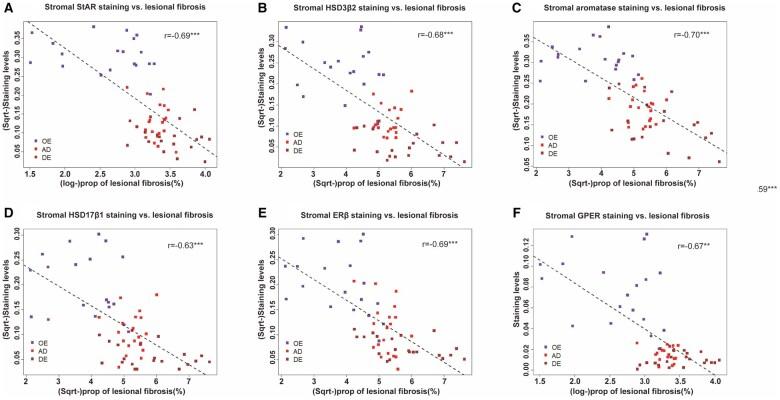
Among all ectopic endometrial tissue samples, the extent of lesional fibrosis was the highest in the DE lesions, followed by the AD and then the OE lesions. The protein and gene expression levels of StAR, HSD3β2, aromatase, and HSD17β1, the four proteins critically involved in estrogen biosynthesis, were significantly higher than in the CT group in OE and AD lesions, but were lowest in DE lesions, which were comparable to that of control endometrium. There was a significantly negative correlation between the expression of these proteins and the extent of lesional fibrosis. Consistently, while the concentration of estrogen in culture supernatants from OE cells was significantly higher than those in CT, it was significantly reduced in AD and DE lesions. In fact, the estrogen concentration in DE cell supernatants was comparable with that in the CT group. The expression of ERβ and GPER was significantly higher in OE and AD lesions than in the CT group and progressively declined with increasing lesional fibrosis; in the DE group, their expression was comparable to the CT group. A significant negative correlation was observed between their expression and the extent of lesional fibrosis. No significant difference in ERα expression was found among different types of ectopic endometrium, but all showed significantly and uniformly lower expression than that of the CT endometrium.
LIMITATIONS REASONS FOR CAUTION
While diminished estrogen signaling concordant with increased lesional fibrosis was demonstrated, no mechanistic data were provided. In addition, while in this study several genes/proteins known to be key to estrogen signaling were evaluated, some other genes/proteins that are also involved in estrogen signaling, such as other members of the HSD17B family, were not evaluated.
WIDER IMPLICATIONS OF THE FINDINGS
Our findings challenge the prevailing notion of activated estrogen signaling in ectopic endometrium of all kinds via the feed-forward loop. As such, there is a need to re-appraise our treatment strategies, especially for lesions that are highly fibrotic and thus well advanced. In addition, our findings can be capitalized to help choose the best treatment modality and to inspire novel therapeutics for endometriosis and adenomyosis.
STUDY FUNDING/COMPETING INTERESTS: This research was supported in part by grant 82071623 (S.-W.G.) from the National Natural Science Foundation of China and by grant 202440057 (J.N.) from the Clinical Research Project of Shanghai Municipal Health Commission. S.-W.G. is a member of the Scientific Advisory Board of Heranova, BioSciences and of FimmCyte A.G., and has provided consultancy advice to these companies, as well as to Shanghai Huilun Biotechnology, but these activities had no bearing on this work. The other authors have no conflict of interest.
TRIAL REGISTRATION NUMBER
N/A.
研究问题
所有异位子宫内膜病变(子宫内膜异位症和子宫腺肌病)是否都普遍存在雌激素信号激活?
总结答案
雌激素信号随着异位子宫内膜纤维化程度的增加而相应减弱,深部子宫内膜异位(DE)病变表现出与对照子宫内膜相当的雌激素生物合成能力和雌激素受体β(ERβ)表达水平,但雌激素受体α(ERα)受到抑制。
已知信息
子宫内膜异位症和子宫腺肌病都是雌激素依赖性疾病,由雌激素介导病变的发展、进展和症状表现。值得注意的是,由于芳香化酶(CYP19A1)、类固醇生成急性调节蛋白(StAR)、3β-羟基类固醇脱氢酶2型(HSD3β2)和17β-羟基类固醇脱氢酶1型(HSD17β1)的上调,异位子宫内膜被认为具有从胆固醇合成雌二醇(E)的能力。除了雌激素生物合成增加外,ERβ和G蛋白偶联雌激素受体(GPER)在异位子宫内膜中也过表达。特别是,普遍观点认为前列腺素E2在促进雌激素生物合成和ERβ上调中起关键作用,在将高雌激素血症与所有异位子宫内膜中的炎症联系起来的前馈回路中处于核心枢纽位置。
研究设计、规模、持续时间:在获得书面知情同意后,我们收集了19例卵巢子宫内膜异位症(OE)患者、20例子宫腺肌病(AD)患者和20例DE患者的病变组织。作为对照,从20名无子宫内膜异位症和子宫腺肌病的周期女性中获取正常子宫内膜组织样本(CT),这些女性在年龄和月经周期上与其他组患者匹配。此外,对来自OE、AD、DE和CT组中每组8名受试者的原代异位或对照子宫内膜基质细胞进行培养以进行实验。
参与者/材料、设置、方法:我们进行了免疫组织化学和蛋白质印迹分析,以评估雌激素生物合成关键蛋白(StAR、HSD3β2、芳香化酶和HSD17β1)和雌激素受体(ERα、ERβ和GPER)的表达。通过Masson三色染色对纤维化进行定量。进行实时逆转录聚合酶链反应(RT-PCR)以评估相应基因的表达水平。还通过酶联免疫吸附测定(ELISA)测量了来自不同组织的原代基质细胞培养物中的雌激素浓度。
主要结果及偶然性的作用
在所有异位子宫内膜组织样本中,DE病变的纤维化程度最高,其次是AD病变,然后是OE病变。参与雌激素生物合成的四种关键蛋白StAR、HSD3β2、芳香化酶和HSD17β1的蛋白质和基因表达水平在OE和AD病变中显著高于CT组,但在DE病变中最低,与对照子宫内膜相当。这些蛋白质的表达与病变纤维化程度之间存在显著负相关。同样,虽然OE细胞培养上清液中的雌激素浓度显著高于CT组,但在AD和DE病变中显著降低。实际上,DE细胞上清液中的雌激素浓度与CT组相当。ERβ和GPER的表达在OE和AD病变中显著高于CT组,并随着病变纤维化程度的增加而逐渐下降;在DE组中,它们的表达与CT组相当。观察到它们的表达与病变纤维化程度之间存在显著负相关。在不同类型的异位子宫内膜中,ERα表达未发现显著差异,但均显著且一致地低于CT组子宫内膜。
局限性、谨慎原因:虽然证明了雌激素信号随着病变纤维化程度的增加而减弱,但未提供机制数据。此外,虽然在本研究中评估了一些已知对雌激素信号起关键作用的基因/蛋白质,但未评估其他一些也参与雌激素信号的基因/蛋白质,例如HSD17B家族的其他成员。
研究结果的更广泛意义
我们的研究结果挑战了通过前馈回路在所有类型异位子宫内膜中激活雌激素信号的普遍观念。因此,有必要重新评估我们的治疗策略,特别是对于纤维化程度高且病情进展良好的病变。此外,我们的研究结果可用于帮助选择最佳治疗方式,并为子宫内膜异位症和子宫腺肌病激发新的治疗方法。
研究资金/利益冲突:本研究部分得到中国国家自然科学基金82071623号资助(S.-W.G.)和上海市卫生健康委员会临床研究项目202440057号资助(J.N.)。S.-W.G.是Heranova生物科学公司和FimmCyte A.G.公司科学顾问委员会成员,并为这些公司以及上海惠伦生物技术公司提供了咨询建议,但这些活动与本研究无关。其他作者没有利益冲突。
试验注册号
无。



 Zotero 插件