
度维利塞和罗米地辛用于复发/难治性外周和皮肤T细胞淋巴瘤的真实世界证据。
Real-world evidence of duvelisib and romidepsin in relapsed/refractory peripheral and cutaneous T-cell lymphomas.
作者信息
Ford Josie G, Koh Min Jung, Lenart Alexandra W, MacVicar Caroline, Chopra Kusha, Meharwal Arushi, Sorial Mark N, Merrill Mwanasha, Rider Anna B, Sohani Aliyah R, McCabe Sean M, Nemec Ronnie A, Iwasaki Makoto, Mistry Dhruv, Kariya Khyati Maulik, Chen Steven, Barnes Jeffrey, McAfee Steven, Chen Yi-Bin, Wong Corben Yuwai, Nasto Kristiana, Jacobsen Eric, Jain Salvia
机构信息
Department of Medicine, Massachusetts General Hospital, Boston, MA.
School of Medicine, University of Connecticut, Farmington, CT.
出版信息
Blood Adv. 2025 Aug 26;9(16):4286-4305. doi: 10.1182/bloodadvances.2025016347.
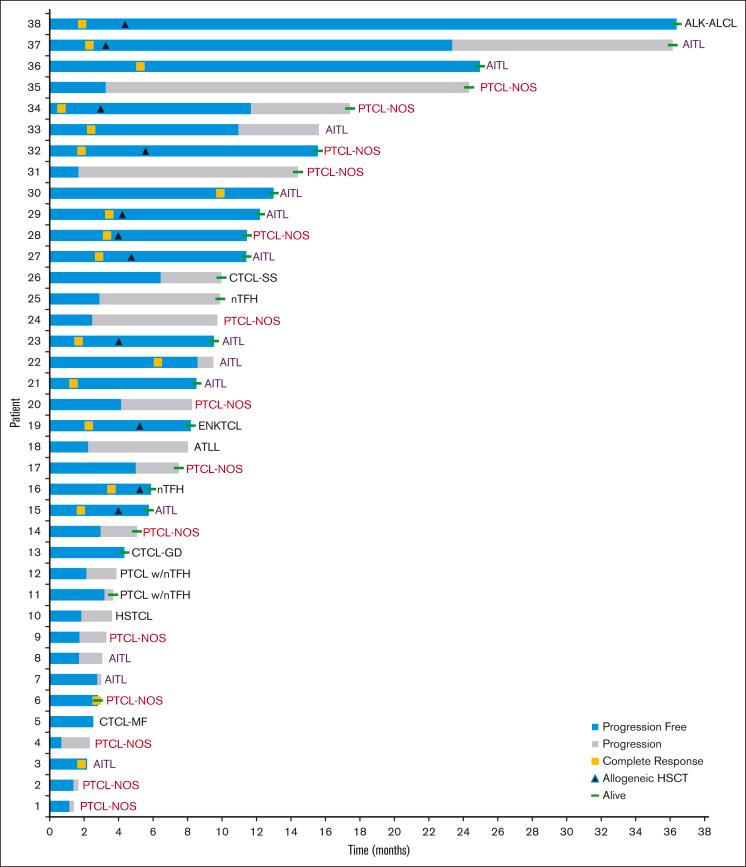
Patients with relapsed or refractory (R/R) peripheral T-cell lymphomas (PTCL) require lineage-specific therapies to bridge to hematopoietic stem cell transplantation (HSCT). A previous phase 1/2 study of duvelisib/romidepsin (duv/romi) reported an overall response rate (ORR) of 58% and a complete response rate (CRR) of 42% with reduced grade 3 to 4 transaminitis (14%). We report real-world duv/romi outcomes in a multicenter, 38-patient R/R PTCL cohort. The median age at diagnosis was 62 years. Histological subtypes included nodal T follicular helper cell (nTFH; n = 17), PTCL-not otherwise specified (n = 14), cutaneous T-cell lymphoma (TCL; n = 3), extranodal natural killer/TCL (n = 1), ALK-negative anaplastic large cell lymphoma (n = 1), adult T-cell leukemia/lymphoma (n = 1), and hepatosplenic TCL (n = 1). The median previous therapy count was 1 (interquartile range [IQR], 1-2); 15 patients relapsed and 23 were refractory to prior treatment, including 8 prior HSCT (5 autologous, 3 allogeneic). After a median of 3 cycles (IQR, 2-4), ORR and CRR were 61% and 47%, respectively, with higher ORR (82% vs 43%) and CRR (71% vs 29%) in nTFH versus non-nTFH. The median progression-free survival and overall survival (HSCT-censored) were 11 and 16 months for nTFH, versus 3.3 and 8.3 months for non-nTFH. The median time to response was 1.9 months (IQR, 1.7-2.6), duration of response was 21 months, and time to next therapy was 17 months. After duv/romi, 11 patients bridged to allo-HSCT. Treatment was well tolerated; the most common grade 3 to 4 toxicities were lymphopenia (n = 15), neutropenia (n = 15), thrombocytopenia (n = 10), and transaminitis (n = 6), seldom leading to discontinuation (n = 4) or death (n = 1). These findings reinforce duv/romi's efficacy and bridging role to curative HSCT in high-risk R/R PTCL.
复发或难治性(R/R)外周T细胞淋巴瘤(PTCL)患者需要特定谱系疗法,以便过渡到造血干细胞移植(HSCT)。先前一项关于度维利塞/罗米地辛(duv/romi)的1/2期研究报告,总体缓解率(ORR)为58%,完全缓解率(CRR)为42%,3至4级转氨酶升高发生率降低(14%)。我们报告了一个多中心、38例R/R PTCL队列中duv/romi的真实世界疗效。诊断时的中位年龄为62岁。组织学亚型包括淋巴结T滤泡辅助细胞(nTFH;n = 17)、未另行指定的PTCL(n = 14)、皮肤T细胞淋巴瘤(TCL;n = 3)、结外自然杀伤/TCL(n = 1)、ALK阴性间变性大细胞淋巴瘤(n = 1)、成人T细胞白血病/淋巴瘤(n = 1)和肝脾TCL(n = 1)。既往治疗次数的中位数为1次(四分位间距[IQR],1 - 2);15例患者复发,23例对既往治疗难治,包括8例既往接受过HSCT(5例自体,3例异体)。经过中位数3个周期(IQR,2 - 4)的治疗,ORR和CRR分别为61%和47%,nTFH患者的ORR(82%对43%)和CRR(71%对29%)更高。nTFH患者的无进展生存期和总生存期(以HSCT为截尾)的中位数分别为11个月和16个月,而非nTFH患者分别为3.3个月和8.3个月。中位缓解时间为1.9个月(IQR,1.7 - 2.6),缓解持续时间为21个月,至下次治疗时间为17个月。接受duv/romi治疗后,11例患者过渡到异基因HSCT。治疗耐受性良好;最常见的3至4级毒性反应为淋巴细胞减少(n = 15)、中性粒细胞减少(n = 15)、血小板减少(n = 10)和转氨酶升高(n = 6),很少导致治疗中断(n = 4)或死亡(n = 1)。这些发现强化了duv/romi在高危R/R PTCL中的疗效以及向治愈性HSCT过渡的作用。


 Zotero 插件