
腹腔镜逆时针模块化肝中叶切除术治疗肝细胞癌:一种标准化的解剖学方法(附视频)
Laparoscopic counterclockwise modular mesohepatectomy for hepatocellular carcinoma: a standardized anatomical approach (with video).
作者信息
Chen Xi, He Wei, Wang Jianjun, Kuang Ming, Jiang Ting, Luo Hua, Hu Zhaohui
机构信息
Department of Hepatobiliary Surgery, Mianyang Central Hospital, School of Medicine, University of Electronic Science and Technology of China, Mianyang, China.
Department of Stomatology Mianyang Central Hospital, School of Medicine, University of Electronic Science and Technology of China, Mianyang, China.
出版信息
Front Oncol. 2025 Jun 18;15:1599403. doi: 10.3389/fonc.2025.1599403. eCollection 2025.
BACKGROUND
Laparoscopic liver resection (LLR) is increasingly utilized for hepatocellular carcinoma (HCC). However, laparoscopic anatomical resection of Couinaud segments 4, 5, and 8 remains technically demanding due to complex vascular anatomy and a broad transection plane.
METHODS
This study retrospectively analyzed patients who underwent laparoscopic counterclockwise modular mesohepatectomy (LCMM) at our center. The LCMM approach standardizes the dissection sequence, optimizes vascular control, and utilizes Laennec's capsule theory to facilitate safe and precise anatomical liver resection. Perioperative outcomes, including operative time, intraoperative blood loss, and postoperative complications, were assessed.
RESULTS
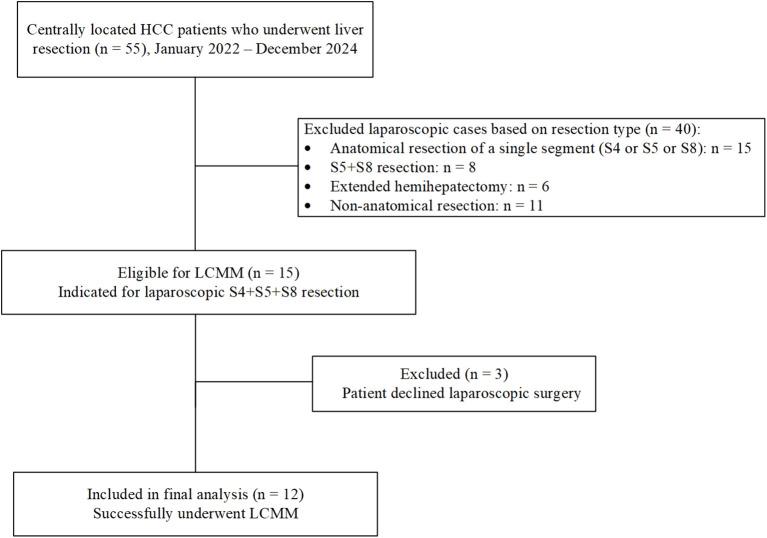
A total of 12 patients with centrally located HCC underwent LCMM. The mean operative time was 253.66 ± 52.47 minutes, and the mean intraoperative blood loss was 177.91 ± 112.76 mL. No conversions to open surgery or intraoperative transfusions were required. The mean postoperative hospital stay was 9.83 ± 4.26 days. Postoperative complications occurred in three patients (one bile leakage, one pulmonary infection, and one posthepatectomy liver failure). No perioperative mortality occurred. The mean disease-free survival (DFS) was 18.75 months.
CONCLUSION
LCMM appears to be a technically effective and anatomically guided approach for managing centrally located HCC. It facilitates intraoperative control of key vascular structures and yields promising short-term oncological outcomes. Further prospective studies are warranted to confirm its long-term efficacy.
背景
腹腔镜肝切除术(LLR)在肝细胞癌(HCC)治疗中的应用日益广泛。然而,由于血管解剖结构复杂且横断平面较宽,腹腔镜下对肝Couinaud 4、5和8段进行解剖性切除在技术上仍具有挑战性。
方法
本研究回顾性分析了在本中心接受腹腔镜逆时针模块化中肝切除术(LCMM)的患者。LCMM方法规范了解剖顺序,优化了血管控制,并运用Laennec包膜理论以促进安全、精确的解剖性肝切除。评估了围手术期结局,包括手术时间、术中出血量和术后并发症。
结果
共有12例中心型HCC患者接受了LCMM。平均手术时间为253.66±52.47分钟,平均术中出血量为177.91±112.76毫升。无需转为开放手术或术中输血。术后平均住院时间为9.83±4.26天。3例患者出现术后并发症(1例胆漏、1例肺部感染和1例肝切除术后肝衰竭)。无围手术期死亡发生。平均无病生存期(DFS)为18.75个月。
结论
LCMM似乎是一种技术上有效的、以解剖为导向的治疗中心型HCC的方法。它有助于术中控制关键血管结构,并产生了有前景的短期肿瘤学结局。有必要进行进一步的前瞻性研究以证实其长期疗效。


 Zotero 插件