
水杨酸和茉莉酸甲酯激活的慢生根瘤菌缓解大豆共生中的水分胁迫
Alleviation of water stress in soybean symbiosis by salicylic acid and methyl jasmonate-activated Bradyrhizobium.
作者信息
Nyzhnyk Tetiana, Kiedrzyńska Edyta, Kots Sergii, Zalewski Maciej, Kiedrzyński Marcin
机构信息
Institute of Plant Physiology and Genetics, Department of Symbiotic Nitrogen Fixation, National Academy of Sciences of Ukraine, Vasylkivska 31/17, Kyiv, 03022, Ukraine.
European Regional Centre for Ecohydrology of the Polish Academy of Sciences, Tylna 3, Lodz, 90-364, Poland.
出版信息
BMC Plant Biol. 2025 Jul 3;25(1):862. doi: 10.1186/s12870-025-06806-1.
BACKGROUND
The use of exogenous compounds with growth-regulatory properties can play an effective part in providing plants with the necessary plastic resources for the synthesis of protective compounds. The aim of the research is to determine the effectiveness of salicylic acid and methyl jasmonate treatment for inducing resistance in soybean-Bradyrhizobium symbiosis, and improving symbiotic capacity.
METHODS
Soybean nodule bacteria Bradyrhizobium japonicum cultures were treated with salicylic acid (50 µM) or methyl jasmonate (0.75 µM) and used to create symbioses with soybean. The symbioses were cultivated under normal watering and water stress conditions, and the resulting plants were tested for inter alia pro-oxidant-antioxidant status, productivity and N-fixation activity.
RESULTS
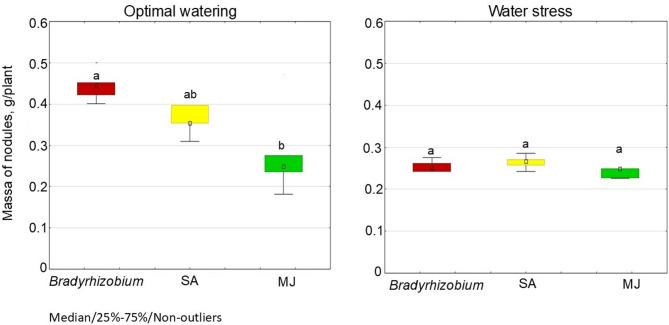
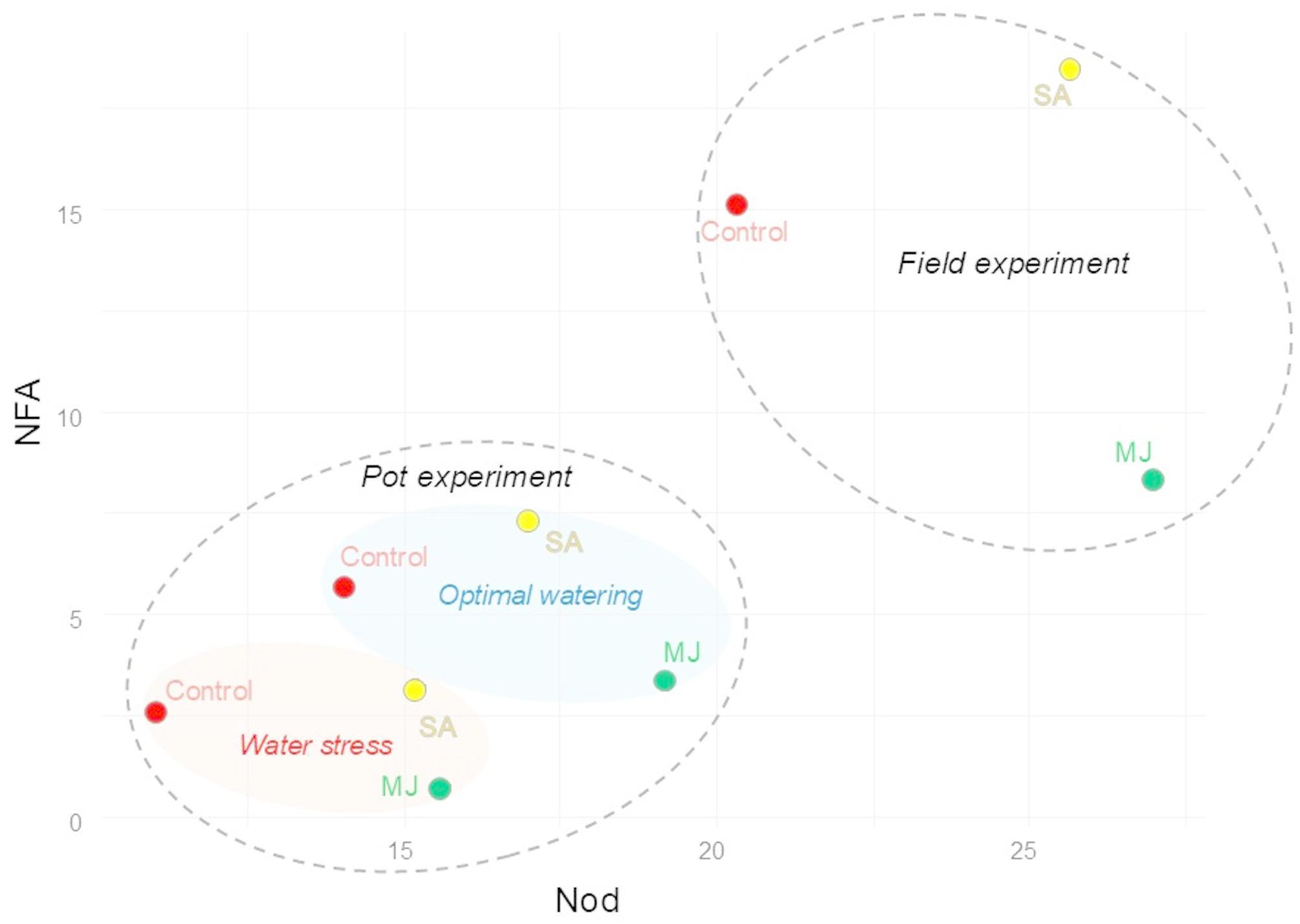
The 0.75 µM methyl jasmonate treatment demonstrated 54.7% catalase and 14.6% greater superoxide dismutase (by 14.6%) activity, as well as and induced two-fold higher hydrogen peroxide, under water stress; in addition, nodulation processes were stimulated by 40% and inhibited nitrogen-fixing activity inhibited by 73.5%. The 50 µM salicylic acid treatment exhibited 54.5% lowered hydrogen peroxide, but 20.7% greater superoxide dismutase activity and 44.8% higher catalase activation water stress; this increased the efficiency of molecular nitrogen fixation (by 23.5%) and productivity (by 15.9%) in soybeans.
CONCLUSIONS
Effect of 50 µM SA-treated Bradyrhizobium effectively activates the protective antioxidant mechanisms of soybean, improving symbiotic capacity and stress tolerance. Methyl jasmonate 0.75 µM in combination with Bradyrhizobium stimulates nodulation and inhibites nitrogen fixation in soybean under both optimal and insufficient water supply.
背景
使用具有生长调节特性的外源化合物可有效为植物提供合成保护化合物所需的可塑性资源。本研究的目的是确定水杨酸和茉莉酸甲酯处理对诱导大豆 - 慢生根瘤菌共生抗性及提高共生能力的有效性。
方法
用50 μM水杨酸或0.75 μM茉莉酸甲酯处理大豆根瘤菌慢生根瘤菌培养物,并用于与大豆建立共生关系。在正常浇水和水分胁迫条件下培养共生体,对所得植株进行促氧化剂 - 抗氧化剂状态、生产力和固氮活性等测试。
结果
在水分胁迫下,0.75 μM茉莉酸甲酯处理显示过氧化氢酶活性提高54.7%,超氧化物歧化酶活性提高14.6%,过氧化氢诱导量增加两倍;此外,结瘤过程受到40%的刺激,固氮活性受到73.5%的抑制。50 μM水杨酸处理使过氧化氢降低54.5%,但超氧化物歧化酶活性提高20.7%,过氧化氢酶活性在水分胁迫下提高44.8%;这提高了大豆分子固氮效率(提高23.5%)和生产力(提高15.9%)。
结论
50 μM水杨酸处理的慢生根瘤菌能有效激活大豆的保护性抗氧化机制,提高共生能力和胁迫耐受性。0.75 μM茉莉酸甲酯与慢生根瘤菌结合在水分供应充足和不足的情况下均刺激大豆结瘤并抑制固氮。




 Zotero 插件