Willems Anneliese, Chong Alvin H, Tapley Amanda, Grace Sandra, Magin Parker
Skin Health Institute, Level 1/80 Drummond Street, Carlton, VIC 3053, Australia.
Department of Medicine, Medical Building, Building 181, University of Melbourne, Grattan Street, Parkville, VIC 3010, Australia.
Fam Pract. 2025 Jun 4;42(4). doi: 10.1093/fampra/cmaf053.
General practitioner (GP) confidence in management and diagnosis across the range of dermatological conditions has not been well-explored.
This study aimed to document Australian GPs' confidence and its associations in diagnosing and managing dermatological presentations.
A cross-sectional questionnaire-based study of Australian GPs. Recruitment was through the restricted Facebook group ('GPs Down Under') and 2022 Royal Australian College of General Practice conference attendees. Items elicited practitioner and practice demographics, dermatology educational experience, and confidence levels in diagnosing and managing 28 dermatological curriculum areas.
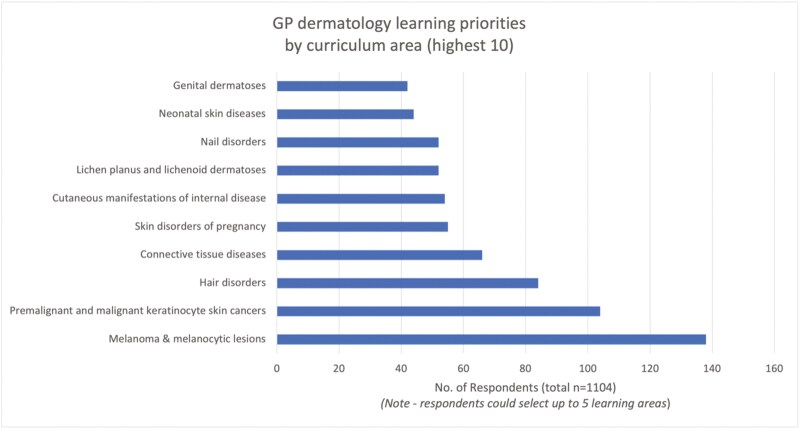
Respondents (n = 278) were most confident in managing eczema, bacterial skin infections, acne, contact dermatitis, and fungal skin diseases. They reported lower confidence for nail disease, connective tissue diseases, vasculitis, vascular tumours and malformations, and cutaneous manifestations of internal diseases. GPs reported greater confidence in managing, as opposed to diagnosing, melanoma and melanocytic lesions, premalignant and malignant keratinocyte skin cancers, sexually transmitted infections, and the skin and viral exanthems. Melanoma and melanocytic lesions, premalignant and malignant keratinocyte skin cancers were perceived as the greatest learning priorities.
While Australian GPs report high confidence in diagnosing and managing common dermatological conditions, confidence declines for rarer, more complex presentations. Notably, GPs feel more confident in managing skin cancers than diagnosing them, indicating a need for enhanced training in diagnostic skills, particularly dermoscopy. These findings have implications for education delivery.
全科医生(GP)对各类皮肤病的管理和诊断信心尚未得到充分探索。
本研究旨在记录澳大利亚全科医生在诊断和管理皮肤疾病方面的信心及其关联因素。
对澳大利亚全科医生进行基于问卷调查的横断面研究。通过受限的脸书群组(“澳大利亚全科医生”)和2022年澳大利亚皇家全科医学院会议参会者进行招募。问卷项目涉及从业者和诊所人口统计学、皮肤病教育经历,以及对28个皮肤病课程领域的诊断和管理信心水平。
受访者(n = 278)对湿疹、细菌性皮肤感染、痤疮、接触性皮炎和真菌性皮肤病的管理最有信心。他们对指甲疾病、结缔组织疾病、血管炎、血管肿瘤和畸形以及内科疾病的皮肤表现信心较低。全科医生表示,在管理黑色素瘤和黑素细胞病变、癌前和恶性角质形成细胞皮肤癌、性传播感染以及皮肤和病毒疹方面,相比诊断,他们更有信心。黑色素瘤和黑素细胞病变、癌前和恶性角质形成细胞皮肤癌被视为最大的学习重点。
虽然澳大利亚全科医生对诊断和管理常见皮肤病有较高信心,但对罕见、更复杂的病症信心下降。值得注意的是,全科医生在管理皮肤癌方面比诊断更有信心,这表明需要加强诊断技能培训,特别是皮肤镜检查。这些发现对教育提供有启示意义。