
GS-DTI:一种利用大语言模型进行药物-靶点相互作用预测的图结构感知框架。
GS-DTI: a graph-structure-aware framework leveraging large language models for drug-target interaction prediction.
作者信息
Yu Qinze, Zhou Chang, Jiang Jiyue, Shi Xiangyu, Li Yu
机构信息
Department of Computer Science and Engineering, CUHK, Hong Kong SAR 999077, China.
Department of Computer Science and Technology, Beijing JiaoTong University, Beijing 100044, China.
出版信息
Bioinformatics. 2025 Aug 2;41(8). doi: 10.1093/bioinformatics/btaf445.
MOTIVATION
Accurate and generalizable prediction of drug-target interactions (DTIs) remains a critical challenge for drug discovery, particularly when addressing underexplored targets and compounds. Recent advances in graph neural networks and large-scale pre-trained models offer new opportunities to capture rich structural and functional features essential for DTI prediction while enhancing the generalization ability.
RESULTS
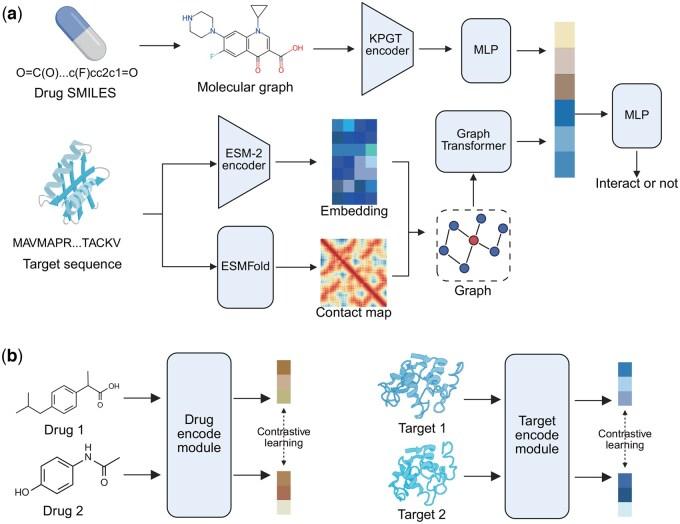
We present GS-DTI, a graph structure-based DTI prediction framework that integrates molecular graph transformers, protein language models, and protein tertiary structure. Our method achieved robust and interpretable DTI predictions. GS-DTI extracts drug features from SMILES-derived molecular graphs using a knowledge-guided pre-trained transformer, while protein features are derived from both sequence and predicted 3D structure for comprehensive representation. A multi-task loss function equipped with contrastive learning is adopted to enhance generalization and functional interpretability. Extensive experiments on the benchmarks and challenging cross-domain settings demonstrate that GS-DTI achieves state-of-the-art performance. Notably, our model improves the MCC by over 10% compared to previous methods in the drug-target pair cold start test. The model can pinpoint the binding pockets of the targets, offering robust interpretability, and case studies show GS-DTI's promising potential in virtual screening for new candidate drugs of BACE1.
AVAILABILITY AND IMPLEMENTATION
The GS-DTI source code and processed datasets are available at https://github.com/purvavideha/GSDTI. All experimental data are derived from public sources.
动机
准确且可推广的药物-靶点相互作用(DTI)预测仍然是药物发现中的一项关键挑战,尤其是在处理研究较少的靶点和化合物时。图神经网络和大规模预训练模型的最新进展为捕捉DTI预测所需的丰富结构和功能特征提供了新机会,同时增强了泛化能力。
结果
我们提出了GS-DTI,一种基于图结构的DTI预测框架,它整合了分子图变换器、蛋白质语言模型和蛋白质三级结构。我们的方法实现了稳健且可解释的DTI预测。GS-DTI使用知识引导的预训练变换器从SMILES衍生的分子图中提取药物特征,而蛋白质特征则来自序列和预测的三维结构,以实现全面表征。采用配备对比学习的多任务损失函数来增强泛化能力和功能可解释性。在基准测试和具有挑战性的跨域设置上进行的广泛实验表明,GS-DTI取得了领先的性能。值得注意的是,在药物-靶点对冷启动测试中,我们的模型比以前的方法将马修斯相关系数(MCC)提高了超过10%。该模型可以精确指出靶点的结合口袋,具有强大的可解释性,案例研究表明GS-DTI在虚拟筛选BACE1新候选药物方面具有广阔的潜力。
可用性和实现
GS-DTI的源代码和处理后的数据集可在https://github.com/purvavideha/GSDTI获取。所有实验数据均来自公共来源。



 Zotero 插件