Hsieh H S, Jaffé E R
J Clin Invest. 1971 Jan;50(1):196-202. doi: 10.1172/JCI106473.
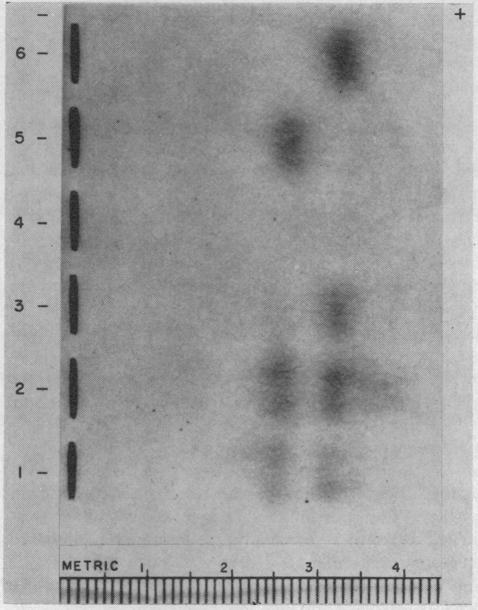
The electrophoretic mobility and activity of NADH-methemoglobin reductase in erythrocytes of patients with hereditary methemoglobinemia, obligatory heterozygotes, and normal subjects were examined. Six distinct electrophoretic variants were found in studies of erythrocytes from members of ten different families. Five variants (Boston Slow, Duarte, Princeton, Puerto Rico, and California) were associated with significant methemoglobinemia and moderate to marked decreases in enzymic activity. Precise correlations between levels of NADH-methemoglobin reductase activity, electrophoretic mobility, and clinical severity of methemoglobinemia, however, could not be drawn. One variant (Boston Fast) was associated with almost normal activity and very minimal methemoglobinemia. Nine members from three generations of two Italian families were found to have two bands with NADH-methemoglobin reductase activity in their erythrocytes, one with normal mobility and one with a mobility identical with that of Boston Fast. No functional or clinical impairment could be attributed to this abnormality. The observations made in this investigation were consistent with an autosomal recessive mode of inheritance of multiple alleles for NADH-methemoglobin reductase. As has been shown to be true for hemoglobin and glucose-6-phosphate dehydrogenase, multiple aberrations in the NADH-methemoglobin reductase of human erythrocytes apparently exist, some with and some without functional consequences. Two bands with NADPH-methemoglobin reductase activity with electrophoretic mobilities distinct from those of the NADH-methemoglobin reductase were found in human erythrocytes. These bands were normal in hemolysates of erythrocytes from patients with hereditary methemoglobinemia, but were absent from the hemolysate of erythrocytes deficient in NADPH-methemoglobin reductase activity. These latter erythrocytes, however, contained normal concentrations of methemoglobin and had a normal ability to reduce methemoglobin in vitro. These observations were most consistent with the thesis that the NADH-methemoglobin reductase, distinct from any NADPH-methemoglobin reductase, was the major system responsible for the reduction of methemoglobin to hemoglobin in human erythrocytes.
对患有遗传性高铁血红蛋白血症的患者、强制杂合子以及正常受试者红细胞中的NADH-高铁血红蛋白还原酶的电泳迁移率和活性进行了检测。在对来自十个不同家族成员的红细胞研究中发现了六种不同的电泳变体。五种变体(波士顿慢型、杜阿尔特型、普林斯顿型、波多黎各型和加利福尼亚型)与显著的高铁血红蛋白血症以及酶活性中度至显著降低有关。然而,无法得出NADH-高铁血红蛋白还原酶活性水平、电泳迁移率与高铁血红蛋白血症临床严重程度之间的确切相关性。一种变体(波士顿快型)与几乎正常的活性以及非常轻微的高铁血红蛋白血症有关。在两个意大利家族的三代九名成员中,发现他们的红细胞中有两条具有NADH-高铁血红蛋白还原酶活性的条带,一条迁移率正常,另一条迁移率与波士顿快型相同。这种异常未导致功能或临床损害。本研究中的观察结果与NADH-高铁血红蛋白还原酶多等位基因的常染色体隐性遗传模式一致。正如血红蛋白和葡萄糖-6-磷酸脱氢酶的情况一样,人类红细胞中的NADH-高铁血红蛋白还原酶显然存在多种畸变,有些有功能后果,有些则没有。在人类红细胞中发现了两条具有NADPH-高铁血红蛋白还原酶活性的条带,其电泳迁移率与NADH-高铁血红蛋白还原酶不同。这些条带在遗传性高铁血红蛋白血症患者的红细胞溶血产物中正常,但在缺乏NADPH-高铁血红蛋白还原酶活性的红细胞溶血产物中不存在。然而,后一种红细胞含有正常浓度的高铁血红蛋白,并且在体外具有还原高铁血红蛋白的正常能力。这些观察结果最符合这样的论点,即与任何NADPH-高铁血红蛋白还原酶不同的NADH-高铁血红蛋白还原酶是人类红细胞中负责将高铁血红蛋白还原为血红蛋白的主要系统。