
G蛋白βγ亚基刺激Shc衔接蛋白的磷酸化。
G protein beta gamma subunits stimulate phosphorylation of Shc adapter protein.
作者信息
Touhara K, Hawes B E, van Biesen T, Lefkowitz R J
机构信息
Howard Hughes Medical Institute, Duke University Medical Center, Durham, NC 27710, USA.
出版信息
Proc Natl Acad Sci U S A. 1995 Sep 26;92(20):9284-7. doi: 10.1073/pnas.92.20.9284.
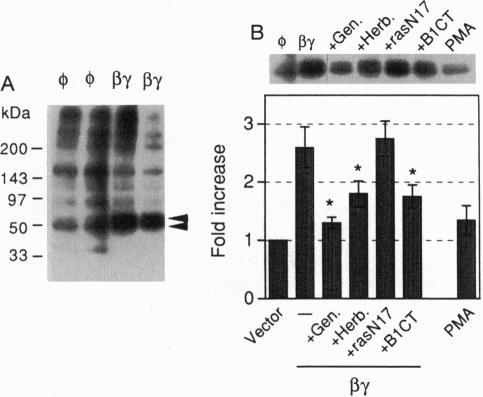
The mechanism of mitogen-activated protein (MAP) kinase activation by pertussis toxin-sensitive Gi-coupled receptors is known to involve the beta gamma subunits of heterotrimeric G proteins (G beta gamma), p21ras activation, and an as-yet-unidentified tyrosine kinase. To investigate the mechanism of G beta gamma-stimulated p21ras activation, G beta gamma-mediated tyrosine phosphorylation was examined by overexpressing G beta gamma or alpha 2-C10 adrenergic receptors (ARs) that couple to Gi in COS-7 cells. Immunoprecipitation of phosphotyrosine-containing proteins revealed a 2- to 3-fold increase in the phosphorylation of two proteins of approximately 50 kDa (designated as p52) in G beta gamma-transfected cells or in alpha 2-C10 AR-transfected cells stimulated with the agonist UK-14304. The latter response was pertussis toxin sensitive. These proteins (p52) were also specifically immunoprecipitated with anti-Shc antibodies and comigrated with two Shc proteins, 46 and 52 kDa. The G beta gamma- or alpha 2-C10 AR-stimulated p52 (Shc) phosphorylation was inhibited by coexpression of the carboxyl terminus of beta-adrenergic receptor kinase (a G beta gamma-binding pleckstrin homology domain peptide) or by the tyrosine kinase inhibitors genistein and herbimycin A, but not by a dominant negative mutant of p21ras. Worthmannin, a specific inhibitor of phosphatidylinositol 3-kinase (PI3K) inhibited phosphorylation of p52 (Shc), implying involvement of PI3K. These results suggest that G beta gamma-stimulated Shc phosphorylation represents an early step in the pathway leading to p21ras activation, similar to the mechanism utilized by growth factor tyrosine kinase receptors.
已知百日咳毒素敏感的Gi偶联受体激活丝裂原活化蛋白(MAP)激酶的机制涉及异源三聚体G蛋白(Gβγ)的βγ亚基、p21ras激活以及一种尚未鉴定的酪氨酸激酶。为了研究Gβγ刺激的p21ras激活机制,通过在COS-7细胞中过表达Gβγ或与Gi偶联的α2-C10肾上腺素能受体(ARs)来检测Gβγ介导的酪氨酸磷酸化。对含磷酸酪氨酸蛋白进行免疫沉淀显示,在用激动剂UK-14304刺激的Gβγ转染细胞或α2-C10 AR转染细胞中,两种约50 kDa的蛋白(命名为p52)的磷酸化增加了2至3倍。后一种反应对百日咳毒素敏感。这些蛋白(p52)也能用抗Shc抗体进行特异性免疫沉淀,并与两种Shc蛋白(46 kDa和52 kDa)共迁移。β肾上腺素能受体激酶的羧基末端(一种Gβγ结合的普列克底物蛋白同源结构域肽)共表达或酪氨酸激酶抑制剂染料木黄酮和赫曲霉素A可抑制Gβγ或α2-C10 AR刺激的p52(Shc)磷酸化,但p21ras的显性负突变体则不能。磷脂酰肌醇3激酶(PI3K)的特异性抑制剂渥曼青霉素抑制了p52(Shc)的磷酸化,这意味着PI3K参与其中。这些结果表明,Gβγ刺激的Shc磷酸化是导致p21ras激活途径中的早期步骤,类似于生长因子酪氨酸激酶受体利用的机制。

 Zotero 插件