Meares C F, Goodwin D A, Leung C S, Girgis A Y, Silvester D J, Nunn A D, Lavender P J
Proc Natl Acad Sci U S A. 1976 Nov;73(11):3803-6. doi: 10.1073/pnas.73.11.3803.
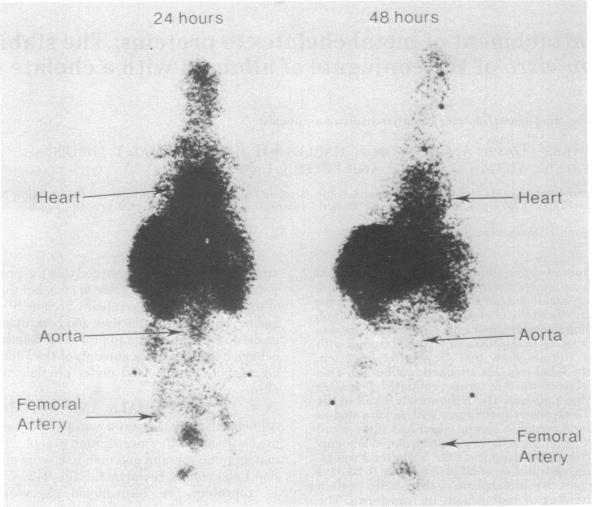
Human serum albumin has been conjugated to 1-(p-bnezenediazonium)-(ethylenedinitrilo)tetraacetic acid, a powerful chelating agent, and radioactive 111indium ions have been added specifically to the chelating groups. The product, with a specific radioactivity of about 1 mCi/mg of protein, was employed as a radiotracer in scintillation scanning studies with human volunteers. Results show that 48 hr after injection, practically all of the label remains attached to albumin. This is confirmed by electrophoresis of serum proteins; 7 days after injection, 85% of the radioactivity in the serum is still in the albumin fraction. These observations agree with in vitro studies of the labeled albumin in human serum, where loss of the metal ion from the chelating group to the protein transferrin amounts to less than 3% after 1 week and less than 5% after 2 weeks. Measurements of the distribution of label in mice up to 23 days after injection suggest that metabolism of the labeled protein does not lead to binding of indium ions by transferrin. The binding of indium and other metal ions by transferrin has previously posed a major impediment to the use of metal chelates for in vivo diagnostic procedures. Demonstration of the kinetic inertness of the chelate in these experiments suggests the use of related chelates as physical probes of biological systems.
人血清白蛋白已与一种强力螯合剂1-(对苯重氮基)-(乙二胺四乙酸)偶联,并且已将放射性铟离子特异性地添加到螯合基团上。该产物的比放射性约为1毫居里/毫克蛋白质,被用作人体志愿者闪烁扫描研究中的放射性示踪剂。结果表明,注射后48小时,几乎所有的标记物仍与白蛋白结合。血清蛋白电泳证实了这一点;注射后7天,血清中85%的放射性仍存在于白蛋白组分中。这些观察结果与对人血清中标记白蛋白的体外研究一致,在体外研究中,螯合基团中的金属离子向蛋白质转铁蛋白的流失在1周后少于3%,在2周后少于5%。对注射后长达23天的小鼠体内标记物分布的测量表明,标记蛋白质的代谢不会导致铟离子与转铁蛋白结合。转铁蛋白与铟及其他金属离子的结合此前一直是将金属螯合物用于体内诊断程序的主要障碍。在这些实验中螯合物动力学惰性的证明表明,相关螯合物可作为生物系统的物理探针。