Williams K J, Heighway J, Birch J M, Norton J D, Scott D
CRC Department of Cancer Genetics, Paterson Institute for Cancer Research, Christie Hospital NHS Trust, Manchester, UK.
Br J Cancer. 1996 Sep;74(5):698-703. doi: 10.1038/bjc.1996.424.
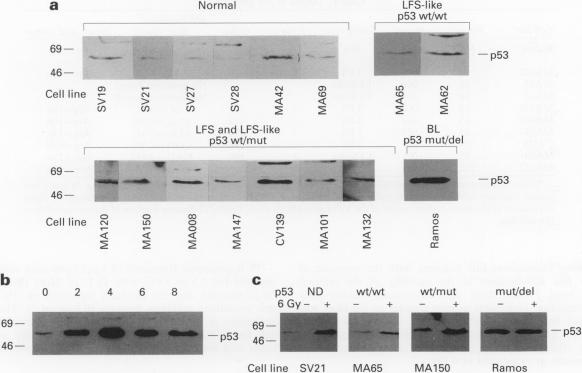
The radiation response of Epstein-Barr virus (EBV)-immortalised lymphoblastoid cell lines derive from Li-Fraumeni syndrome (LFS) and LFS-like individuals was investigated. Cells from all LFS and LFS-like cases showed an accumulation of p53 protein following 137Cs gamma-irradiation, which was associated with cell cycle arrest at the G1/S border. This response was indistinguishable from that seen in cells derived from normal individuals, and occurred in cases with missense mutations in the TP53 gene at codons 175, 180, 220 and 248 and also in two LFS-like individuals with no TP53 mutation. Previous studies using lymphocytes and fibroblasts from LFS individuals have demonstrated abnormal radiation responses in these cells. This suggest cell type specificity in the contribution of a mutant p53 protein to phenotype.
对源自李-佛美尼综合征(LFS)及LFS样个体的爱泼斯坦-巴尔病毒(EBV)永生化淋巴母细胞系的辐射反应进行了研究。所有LFS及LFS样病例的细胞在经137Csγ射线照射后均出现p53蛋白积累,这与细胞周期在G1/S边界处停滞有关。这种反应与正常个体来源的细胞中所见的反应无法区分,并且在TP53基因密码子175、180、220和248处存在错义突变的病例以及两名无TP53突变的LFS样个体中也会发生。先前使用LFS个体的淋巴细胞和成纤维细胞进行的研究已证明这些细胞中存在异常的辐射反应。这表明突变型p53蛋白对表型的贡献存在细胞类型特异性。