Chen U, Chen S, Saha P, Dutta A
Department of Pathology, Brigham and Women's Hospital, Harvard Medical School, Boston, MA 02115, USA.
Proc Natl Acad Sci U S A. 1996 Oct 15;93(21):11597-602. doi: 10.1073/pnas.93.21.11597.
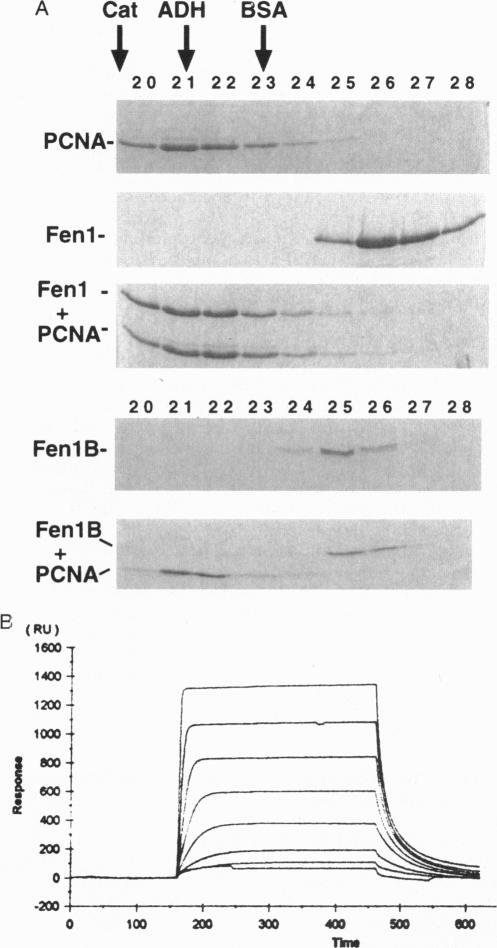
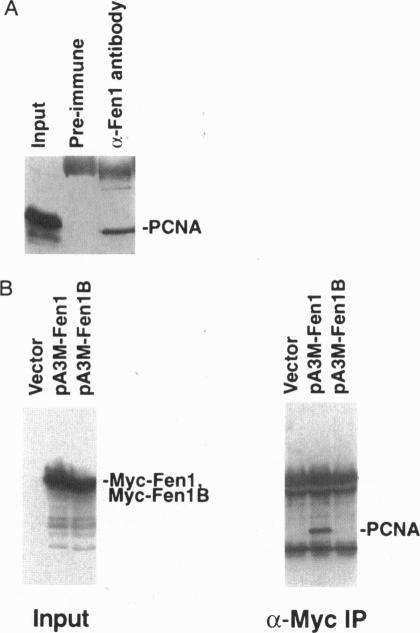
Fen1 or maturation factor 1 is a 5'-3' exonuclease essential for the degradation of the RNA primer-DNA junctions at the 5' ends of immature Okazaki fragments prior to their ligation into a continuous DNA strand. The gene is also necessary for repair of damaged DNA in yeast. We report that human proliferating-cell nuclear antigen (PCNA) associates with human Fen1 with a Kd of 60 nM and an apparent stoichiometry of three Fen1 molecules per PCNA trimer. The Fen1-PCNA association is seen in cell extracts without overexpression of either partner and is mediated by a basic region at the C terminus of Fen1. Therefore, the polymerase delta-PCNA-Fen1 complex has all the activities associated with prokaryotic DNA polymerases involved in replication: 5'-3' polymerase, 3'-5' exonuclease, and 5'-3' exonuclease. Although p21, a regulatory protein induced by p53 in response to DNA damage, interacts with PCNA with a comparable Kd (10 nM) and a stoichiometry of three molecules of p21 per PCNA trimer, a p21-PCNA-Fen1 complex is not formed. This mutually exclusive interaction suggests that the conformation of a PCNA trimer switches such that it can either bind p21 or Fen1. Furthermore, overexpression of p21 can disrupt Fen1-PCNA interaction in vivo. Therefore, besides interfering with the processivity of polymerase delta-PCNA, p21 also uncouples Fen1 from the PCNA scaffold.
Fen1(或成熟因子1)是一种5'-3'核酸外切酶,对于在未成熟冈崎片段5'端的RNA引物-DNA连接点降解至关重要,这些片段在连接成连续DNA链之前需要进行该降解过程。该基因对于酵母中受损DNA的修复也是必需的。我们报告称,人增殖细胞核抗原(PCNA)与人Fen1结合,解离常数为60 nM,每个PCNA三聚体与三个Fen1分子的化学计量比明显。在未过表达任何一方的细胞提取物中可观察到Fen1与PCNA的结合,且这种结合由Fen1 C末端的一个碱性区域介导。因此,聚合酶δ-PCNA-Fen1复合物具备与参与复制的原核DNA聚合酶相关的所有活性:5'-3'聚合酶、3'-5'核酸外切酶和5'-3'核酸外切酶。尽管p21是p53在DNA损伤应答时诱导产生的一种调节蛋白,它与PCNA结合的解离常数相当(10 nM),每个PCNA三聚体与三个p21分子的化学计量比相同,但并未形成p21-PCNA-Fen1复合物。这种相互排斥的相互作用表明,PCNA三聚体的构象发生了切换,使其要么结合p21,要么结合Fen1。此外,p21的过表达可在体内破坏Fen1与PCNA的相互作用。因此,除了干扰聚合酶δ-PCNA的持续合成能力外,p21还使Fen1与PCNA支架分离。